An Introduction to the Microsorum Genus Profile
Java Fern (Microsorum pteropus) is an extremely hardy, low-light freshwater epiphyte that thrives attached to driftwood or rock rather than buried in substrate. It requires a pH range of 6.0–8.0, water temperatures between 68°F–82°F, low-to-moderate lighting, and light liquid fertilization to prevent leaf melting and rhizome rot.
If you have spent any time in the fishkeeping hobby, you have likely seen this iconic plant sitting in a local shop display. It looks almost indestructible with its thick, leathery leaves and dark green aesthetic. However, far too many aquarists bring one home, shove its roots deep into gravel, and watch it turn into black mush within weeks.
I have seen countless beginners blame themselves when their aquatic greenery turns to slime. The truth is simple: you are dealing with a wild, specialized survivor that operates under its own geological rules. Once you understand how this plant breathes, feeds, and anchors itself in moving water, keeping it alive becomes nearly effortless.
Natural Asian River Basin Origins: Shaded Streams & Emergent Rheophyte Habitats
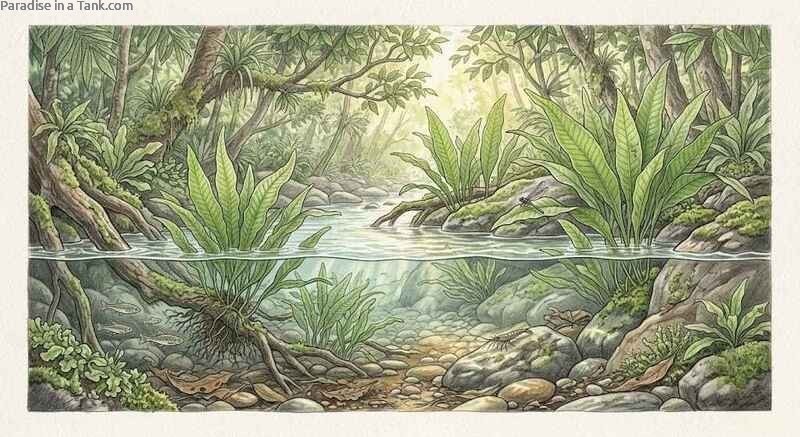
To truly care for this species, we have to look at where it evolved over millions of years. Microsorum pteropus is native to tropical Southeast Asia, blanketed across humid forest floors, rocky riverbanks, and tumbling waterfalls throughout Thailand, Malaysia, and Indonesia.
In these naturally shaded tropical stream beds, the plant exists as a true rheophyte—an organism adapted to living in fast-flowing water currents. It does not grow in quiet, muddy swamps where soil settles over roots. Instead, it clings fiercely to slick granite boulders and submerged fallen timber while torrential monsoon rain washes over it.
During the dry season, river levels drop, leaving huge colonies exposed to damp tropical air while their dark roots drink from spray zones. During the wet season, swollen waters submerge them under meters of rushing, oxygen-rich floodwater. They do not depend on deep substrate beds for nutrition; they snatch dissolved organic wastes directly out of the passing current.
Silhouette Morphology: Analyzing the Tough, Leathery Leaf Structure and Dark Rhizome
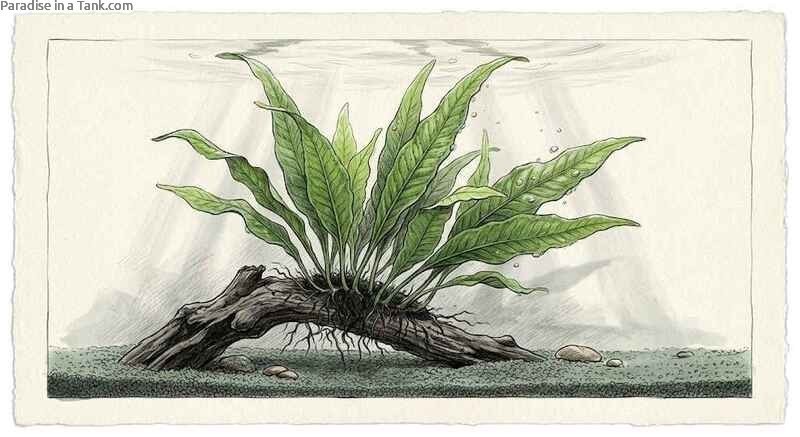
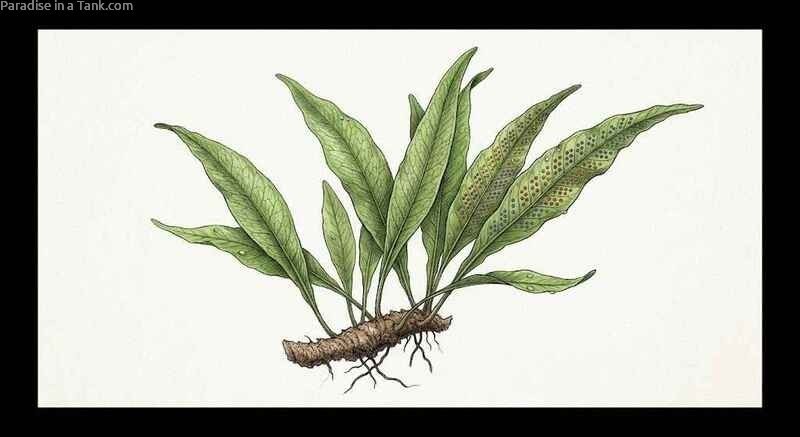
Look closely at a healthy speciman and you will notice it looks nothing like delicate stems such as Cabomba or Hygrophila. The leaves are thick, coarse, and covered in a waxy cuticle that feels like tough leather beneath your fingers. This tough exterior acts as natural armor against grazing snails, hungry fish, and physical damage from rushing river debris.
At the base of those leaves sits the most critical anatomical component: the rhizome. This horizontal, bright-to-dark green woody runner acts as the plant’s central distribution highway and primary energy storage organ. From the topside of this crawling runner, vertical leaves shoot skyward toward the light.
From the underside of that same horizontal runner, a tangle of coarse, dark brown or charcoal-colored fibers extends downward. Beginners often mistake these fuzzy hair-like tendrils for standard plant roots. In reality, they are specialized structural anchors called holdfasts. Their primary biological job is to grip micro-grooves in wood and stone, not to suck up soil nutrients.
Understanding Rhizome Architecture & The Substrate Golden Rule
The Rhizome Engine: Why the Horizontal Green Stem Requires Direct Water Flow and Light
The horizontal green runner is the actual living heartbeat of your plant. Think of this fleshy stem as a miniature biological solar battery that must remain constantly exposed to passing water. It relies on continuous water movement to flush away stagnant waste products and deliver oxygen and dissolved minerals directly across its epidermal layer.
When water flows freely across the exposed stem, beneficial bacterial biofilms cannot suffocatingly coat the tissue. The runner actively processes light energy and nutrients, pushing out fresh leaf shoots along its leading edge while extending new grip fibers below. If this central structure remains clean and bathed in gentle current, the plant is virtually immortal.
Substrate Danger: How Burying the Rhizome Starves the Plant of Oxygen and Causes Rapid Rot
Here is where standard gardening instincts fail completely in an aquarium. When you bury that horizontal runner under sand, gravel, or rich aquasoil, you create an immediate biological disaster zone. You cut off all water circulation to the tissue, creating a dark, anaerobic micro-environment around the plant’s vital center.
Without fresh oxygen exchange, anaerobic bacteria like Clostridium take over and begin consuming the trapped tissue. The trapped runner chokes, turns brown, softens into foul-smelling gray muck, and rots from the inside out. Within days, the once-sturdy leaves detaching at the base float aimlessly to the top of your tank, leaving behind a decaying mess that spikes your dissolved ammonia levels.
Elevated Mounting: Positioning Java Fern on Hardscape Structures for Maximum Longevity
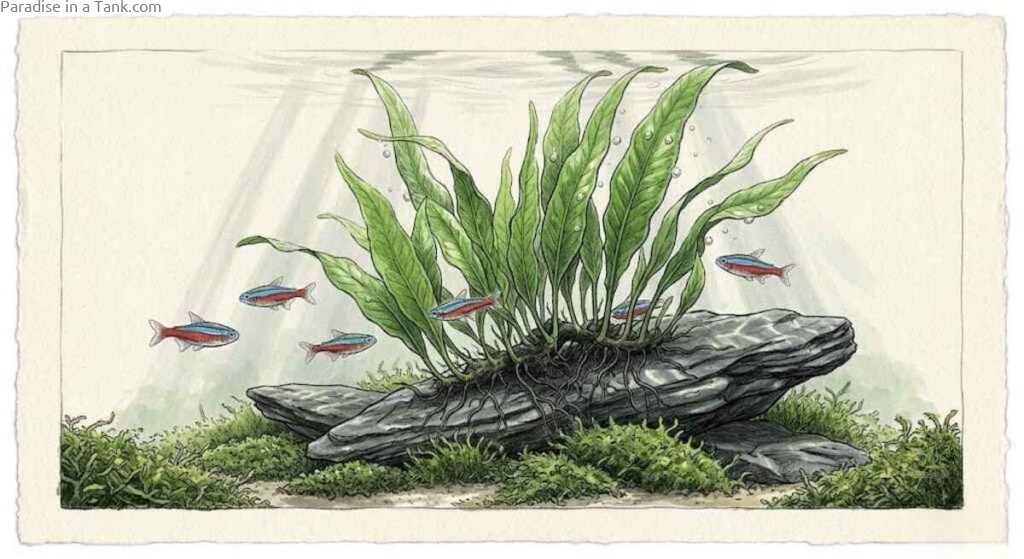
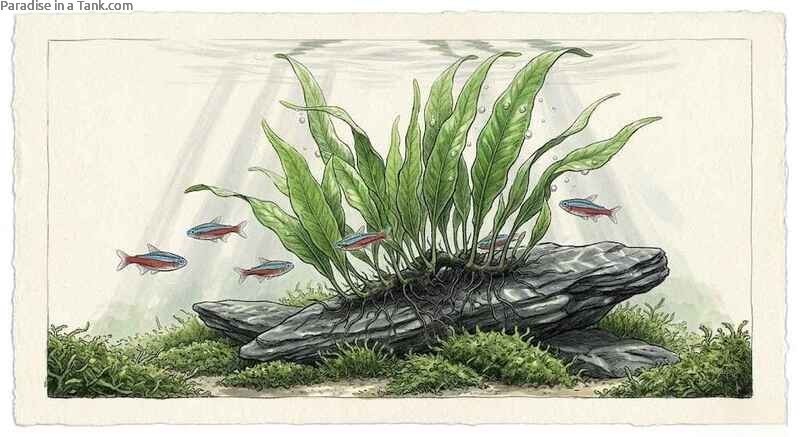
To keep your display thriving for years, you must elevate the entire biological structure off the tank floor. Mounting the specimen onto raised driftwood branches, textured lava stone, or ceramic cave loops keeps the sensitive runner fully suspended in open water.
Positioning the plant in the upper-to-mid layer of your tank exposes the leaves to balanced circulation while allowing detritus to fall past the holdfasts rather than settling on them. This elevated position mimics its natural stream-bed habitat, giving you robust, bright green growth without risking root suffocation.
Mounting Mechanics: Attaching Java Fern to Hardscape
Cyanoacrylate Super Glue Method: Applying Plant-Safe Gel to Dry Wood and Rock Contact Points
The fastest and most reliable way to secure your plant is using liquid mechanics—specifically standard cyanoacrylate super glue gel. This chemical compound is completely non-toxic to fish, shrimp, and biofilter bacteria once it comes into contact with water.
To use this technique, pull your target wood or rock out of the tank and dab the chosen mounting spot dry with a paper towel. Gently pat the underside of the plant’s anchor fibers dry as well. Apply a couple of tiny, pea-sized dots of super glue gel directly onto the rock or wood, then press the brown anchor fibers onto the glue for 10 to 15 seconds.
Be careful never to smear glue directly onto the green horizontal runner itself, as this can smother the growing tip. Once submerged, the gel cures instantly into a durable white bond that keeps the plant firmly anchored while the natural holdfasts take over.
Cotton Thread & Fishing Line Method: Tying Techniques for Long-Term Natural Root Anchoring
If you prefer a non-chemical approach or want to avoid visible glue spots, mechanical wrapping is your best friend. Standard dark cotton thread or clear 4-lb monofilament fishing line works exceptionally well for securing large specimens to twisting branches.
Take your plant and position it against the hardscape contours where you want it to live permanently. Wrap the thread snugly around the brown anchor fibers and the wood 4 to 6 times, tying it off with a simple double knot. If you use organic cotton thread, it will naturally break down and dissolve over several months—right around the time the plant’s holdfasts have completely locked onto the wood.
For a step-by-step visual breakdown of these securing methods, you can check out our detailed guide on attaching Java Fern to hardscape elements to master your layout techniques.
Crevice Wedging: Securing Rhizomes Inside Natural Driftwood Knots and Stone Gaps Without Adhesives
Nature rarely relies on glue or string, and you don’t always have to either. If you have intricate piece of Malaysian driftwood or porous dragon stone with natural cracks and deep crevices, you can use physical friction to lock the plant in place.
Carefully slide the trailing brown holdfast fibers into a tight nook or wood knot using a pair of aquascaping tweezers. Push firmly enough to secure the plant against gentle currents, but make sure the main green horizontal stem remains sitting cleanly outside the crack in open water. Over time, the plant will weave its fibers into the tiny pores of the hardscape, creating an unbreakable natural anchor.
The Master Compendium of Java Fern Varieties & Morphologies
Java Fern Classic (Microsorum pteropus): Broad, Sweeping Green Leaves for Midground Framing
The standard wild-type variety is the workhorse of the planted aquarium world. It features broad, lance-shaped leaves that can reach 8 to 13 inches in height under ideal conditions, developing a rich, emerald-green color with light vertical veins running through the blade.
This classic form is ideal for framing midground transitions or hiding bulky aquarium hardware like heater tubes and filter intake pipes. Its sturdy leaves hold up effortlessly against boisterous fish species that typically shred softer plants.
Java Fern Windelov (Lace Java Fern): Distinctive Antler-Like Branched Leaf Tips
Named after Holger Windeløv, the founder of Tropica aquarium plants, this heavily stylized cultivar is one of the most eye-catching epiphytes available. It grows slightly more compact than the wild type, usually topping out at 6 to 8 inches in height.
What sets Windelov apart is its unique leaf tips, which split off into delicate, lacy, antler-like fronds. This fine texture creates incredible visual contrast when mounted next to smooth-leaved plants or dark driftwood.
To explore more unique aquatic cultivars and leaf structures, take a look at our comprehensive Java Fern varieties breakdown to find the perfect fit for your setup.
Narrow & Needle Leaf Variants: Ultra-Slender Vertical Blades Suited for Nano Aquascapes
For smaller aquariums or detailed high-energy layouts, Narrow Leaf and Needle Leaf variants offer a sleeker silhouette. The Narrow Leaf variety produces thin, ribbon-like blades that grow long and sway gracefully in filter currents.
Needle Leaf takes this minimalist aesthetic even further, producing razor-thin vertical blades that rarely exceed a quarter-inch in width. These slender variants add incredible depth and scale to nano aquascapes without overcrowding the water column or blocking valuable light.
Trident Java Fern: Deeply Lobed, Three-Pronged Leaf Structures for High-Texture Aquascapes
Trident is highly prized by professional aquascapers for its unique feather-like appearance. Instead of solid lanceolate blades, each leaf forks outward near the base into three to five distinct, narrow lobes resembling a oceanic trident.
This variety grows in dense, bushy tufts that add intricate visual detail to rocks and wood branches. It grows slightly faster than the classic variety when provided with consistent water circulation and clean water column fertilization.
Water Parameters & Low-Light System Foundations
Lighting Thresholds: Preventing Leaf Scorching under Moderate-to-Low Light
One of the biggest mistakes keepers make with Microsorum pteropus is giving it too much light. This is an obligate shade plant that evolved underneath dense jungle canopies. Subjecting it to intense, full-spectrum high-output LED lighting will quickly scorch the delicate foliage.
Under high light, the leaves develop pale bleached patches, clear translucent spots, and thick coats of stubborn brush algae. Stick to low-to-moderate lighting levels—aiming for roughly 10 to 30 PAR at the plant level—or shade the fern beneath broad-leaved floating plants like Frogbit or Red Root Floaters.
Water Chemistry Range: pH 6.0–8.0, Temp 68°F–82°F, and Hardness Tolerances
Microsorum pteropus is remarkably adaptable across a wide spectrum of water parameters, making it an ideal choice for almost any freshwater setup. It thrives across a pH range of 6.0–8.0 and comfortably tolerates water temperatures from 68°F–82°F.
| Parameter Variable | Ideal Target Range | Critical Threshold Limits |
|---|---|---|
| Water Temperature | 72°F–78°F | Below 65°F or Above 84°F |
| pH Level | 6.5–7.5 | Below 5.5 or Above 8.3 |
| General Hardness (GH) | 3–12 dGH | Extremely soft or brackish water |
| Light Exposure (PAR) | 10–30 PAR | Direct high light above 50 PAR |
While it survives in hard water, it prefers moderate carbonate hardness and low-to-moderate total dissolved solids. Keep your dissolved nitrate levels below 20 PPM through regular water changes to prevent unwanted algae from colonizing the slow-growing leaves.
Diagnostic Troubleshooting & Common Issues
Black Spots on Leaves: Distinguishing Healthy Sporangia (Propagation Dots) from Decay
Panic often strikes new keepers when dark brown or black dots suddenly appear on the undersides of their fern leaves. Before you trim off those leaves, take a closer look under good lighting.
If the dark spots are arranged in tidy, symmetrical rows along the underside of mature blades, you are looking at sporangia—the plant’s natural spore-producing reproductive organs. However, if you see irregular, jagged black patches spreading across the leaf surface accompanied by thinning tissue, your plant is suffering from nutrient starvation or heat stress.
Translucent Leaf Melt: Managing Parameter Shock and Sudden Lighting Adjustments
When moving a new plant into your display, you may notice the leaf tips turning clear, glassy, and soft. This process, commonly called “melt,” happens when the plant experiences sudden shifts in water chemistry, temperature, or lighting intensity.
Do not throw the plant away! The leaves may die back as the plant reallocates stored energy from old foliage down into the central runner. As long as the horizontal stem remains firm, green, and well-oxygenated in open water, it will push out new, fully adapted leaves within a few weeks.
Propagation Protocols: Adventitious Plantlets & Rhizome Splitting
Propagating this species is straightforward and incredibly rewarding. The plant uses two primary methods to clone itself, giving you an endless supply of free greenery for future aquascapes.
- Adventitious Leaf Daughter Plantlets: As mature leaves age, tiny bumps develop along the blade margins and tips. These bumps quickly sprout miniature green leaves and tiny brown anchor fibers right on the parent leaf. Once these daughter plantlets reach an inch in size, simply pop them off with your fingers and mount them onto new hardscape.
- Rhizome Division via Sharp Pruning: If you have a large, healthy mother plant with a long horizontal stem, you can physically split it into multiple plants. Use sharp, sterilized shears to slice cleanly through the green runner, ensuring each severed piece retains at least 3 to 4 healthy leaves and intact holdfast fibers.
- Spore Dispersal in Flowing Water: In mature, established setups with high water quality, mature sporangia release microscopic spores that float through the water column, settling on porous wood and growing into tiny green gametophytes completely on their own.
Taking care of Microsorum pteropus comes down to respecting its ancestral river roots: keep the runner unburied, supply gentle current, keep the light soft, and let this ancient Asian survivor do what it has done for millions of years. You now have everything you need to build a lush, bulletproof underwater forest!