Dwarf & Micro Anubias Variations
Anubias species are slow-growing, ultra-hardy epiphyte aquatic plants hailing from tropical West Africa. Ranging in size from tiny 1-inch micro-leafed varieties like Nana Petite to massive 12-inch broad-leaf species like Coffeifolia, these plants thrive in low-to-medium light, requiring a stable pH of 6.0–7.5, water temperatures of 72–82°F, and zero substrate burial of their creeping rhizome.
If you have ever tried your hand at keeping a planted freshwater aquarium, chances are you have encountered the indestructible Anubias family. Coming to us from the shaded, rushing streams and forest riverbanks of West Africa, these heavy-duty green beauties are absolute staples in the hobby. But far too many hobbyists treat them as an afterthought, tossing a single generic pot into the gravel and wondering why the leaves slowly turn yellow or rot away into mush. To get the absolute best out of these ancient African epiphytes, you need to understand their specialized anatomy and match the right cultivar to your specific layout vision. Check out our comprehensive Anubias care guide to learn more about balancing lighting, water parameters, and nutrients for these hardy plants.
The dwarf and micro cultivars are easily the most famous members of this genus, and for good reason. They allow aquascapers to build dense, lush green carpets or fill tight crevices on hardscape without constantly reaching into the tank with pruning shears. Let’s look at the absolute powerhouse varieties in this compact group.
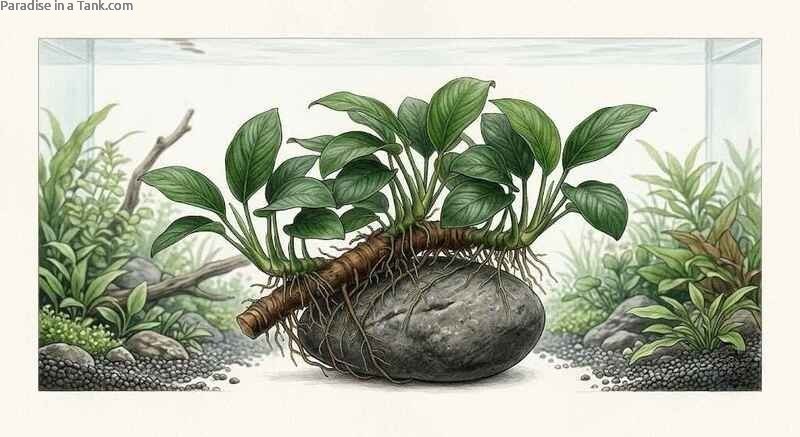
- Anubias Barteri v. Nana: The classic compact 3–4 inch dwarf staple. This is the undisputed workhorse of the planted tank world. Featuring thick, dark green teardrop-shaped leaves anchored to a sturdy horizontal stem, it stays small enough to fit into almost any aquarium layout while remaining tough enough to withstand curiosity from cichlids or goldies.
- Anubias Nana Petite: Micro-leafed variant ideal for detailed nano aquascaping. A naturally occurring dwarf mutation of Anubias barteri v. nana, this little gem produces leaves barely the size of a fingernail (0.5–1 inch). It grows at a painstaking crawl, making it the ultimate selection for delicate nano tanks, miniature tree canopy designs, or filling ultra-fine cracks in lava rock.
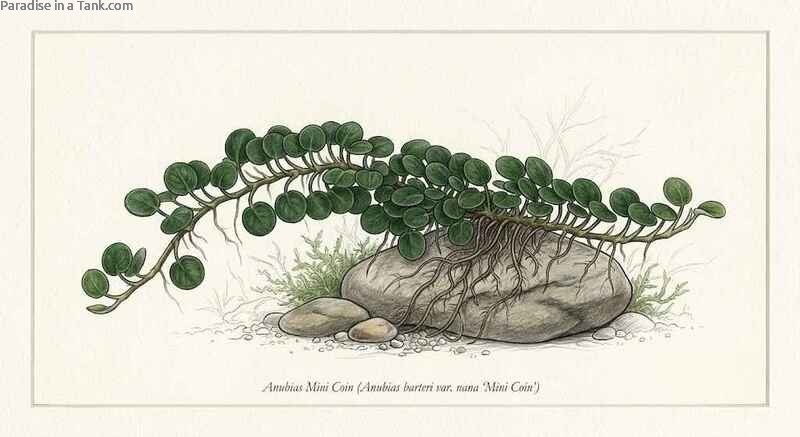
- Anubias Mini Coin: Round, coin-shaped foliage morphs. One of the newer and more exciting additions to the trade, Mini Coin features distinctly circular, saucer-like leaves attached to short, stiff petioles. Its unique geometric profile breaks up the monotonous lance and teardrop leaf shapes commonly found in planted aquariums.
When selecting dwarf varieties, keep in mind that their smaller stature leaves them more vulnerable to being choked out by stubborn green spot algae if placed directly beneath unshaded high-intensity LED lights. Their slow metabolic engine simply cannot process high light levels, which turns their tough leaf blades into prime real estate for algae spores.
Always position these compact cultivars in the lower third of the water column, nestled into the gentle shadow cast by taller stems or arching driftwood branches.
- Lighting Requirements: Low to moderate (1.0–2.0 watts per gallon or 10–30 PAR).
- Ideal Placement: Foregrounds, attached to midground hardscape, nano layouts.
- Leaf Size Range: 0.5 inches (Nana Petite) to 4.0 inches (Standard Nana).
- Growth Speed: Exceptionally slow (1 leaf every 3–6 weeks depending on CO2 availability).
To get these compact plants established properly without smothering their creeping root structures, you must attach them directly to rocks or wood rather than burying them. Be sure to review our step-by-step guide on planting and attaching Anubias to master the safest gluing and tying techniques for your hardscape.
Large & Broad-Leaf Anubias Variations
Moving up in scale, large and broad-leaf Anubias varieties offer stunning structural presence, deep texture, and unmistakable architectural weight to midground and background zones. While dwarf varieties nestle into crevices, these heavyweights demand attention and can easily anchor an entire aquascape layout.
In nature, these larger species often grow along the splash zones of waterfalls and muddy riverbanks, frequently shifting between fully submerged aquatic life and exposed, high-humidity terrestrial environments during seasonal rainfall floods. Because of this amphibious adaptation, their leaves are reinforced with thick, waxy outer cuticles designed to prevent dehydration and ward off hungry herbivorous fish.
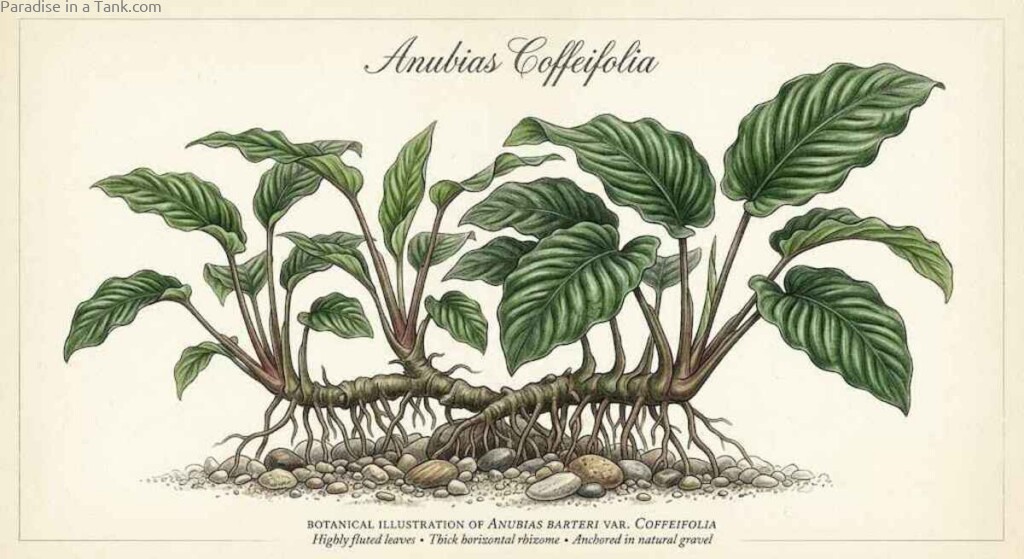
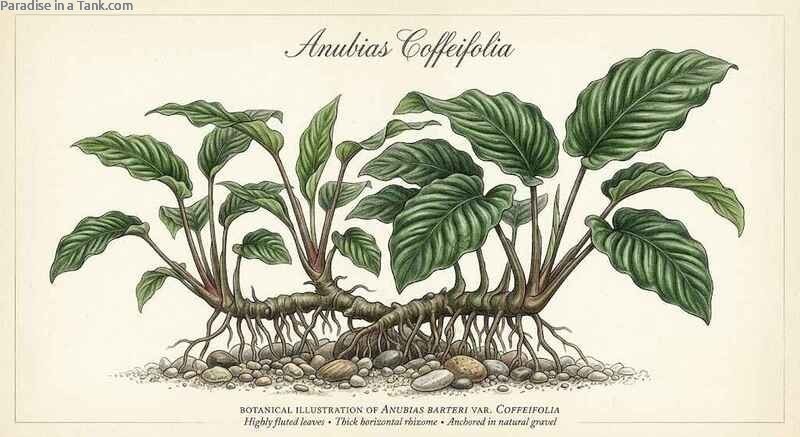
- Anubias Coffeifolia: Deeply ribbed, coffee-leaf textured foliage with red-brown emergent growth. Named for its striking resemblance to the coffee plant (Coffea arabica), this cultivar features heavy, arching leaf blades with prominent, sunken veins. New leaves unfurl in a stunning shade of warm chocolate-brown or reddish-copper before maturing into a deep, glossy forest green.
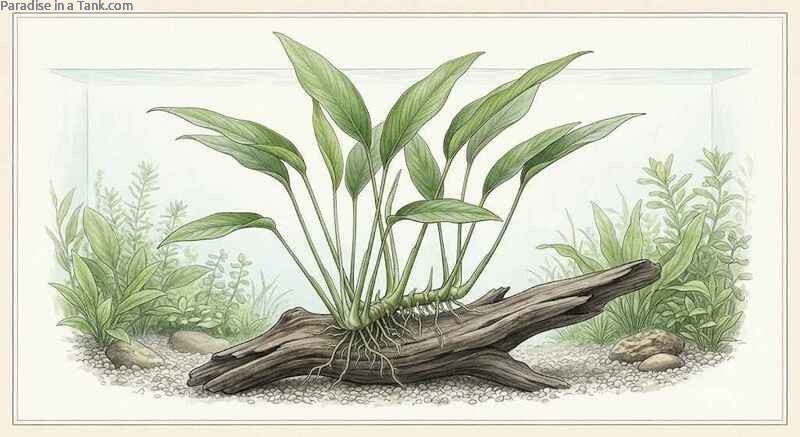
- Anubias Congensis & Lanceolata: Tall, narrow lance-shaped leaves suited for midground and background depth. These upright cultivars break the traditional oval-leaf mold of the Anubias family. Featuring long, elegant, spear-like foliage that stretches upward toward the surface, they excel at filling vertical space and softening hard hardscape edges in taller tanks.
Because broad-leaf varieties produce large surface areas, they collect drifting detritus, uneaten fish food, and loose fish poop far more easily than small-leafed plants. If solid waste accumulates on the upper face of a broad leaf, it blocks light penetration and creates stagnant pockets where organic waste can burn the tissue or trigger local algal blooms.
Position your broad-leaf specimens in areas of your tank that receive gentle, consistent water movement from a filter outlet or circulation pump. This continuous current sweeps away settling debris and carries fresh dissolved nutrients right past the leaf surface.
- Lighting Requirements: Low to medium; tolerates moderate shade well.
- Ideal Placement: Midground anchors, background depth creation, large cichlid setups.
- Leaf Size Range: 5.0 to 12.0 inches long.
- Growth Speed: Slow to moderate (1 leaf every 2–4 weeks under optimal water chemistry).
If you keep larger fish species like Severums, Oscar cichlids, or Silver Dollars that love to shred soft aquatic plants like Hygrophila or Cabomba, broad-leaf Anubias varieties are practically your only bulletproof green option. Their thick, leather-like leaves are far too tough for most herbivorous fish to bite through, allowing you to maintain a lush, natural environment without waking up to floating plant shreds.
Color Cultivars & High-Contrast Strains
For years, aquascapers were limited strictly to varying shades of deep emerald green when working with the Anubias family. However, through careful selective propagation and genetic isolation of natural color mutations in commercial nurseries, vibrant color cultivars have taken the hobby by storm.
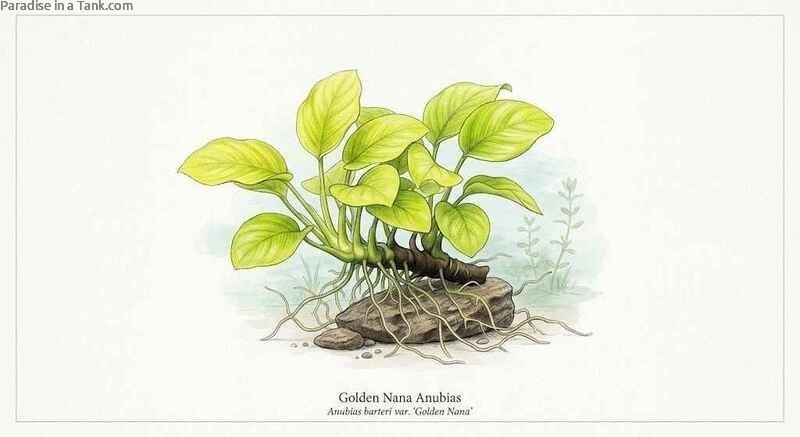
- Anubias Golden Nana: Vibrant lime-to-yellow foliage for color contrast against dark driftwood. This eye-catching cultivar displays bright chartreuse, neon-green, and creamy yellow foliage that immediately pops against dark substrates, black painted tank backgrounds, or water-logged Malaysian driftwood.
Unlike standard green varieties, Anubias Golden Nana requires slightly higher light intensity to maintain its brilliant yellow pigmentation. If grown in pitch-black shadows, the plant will slowly increase its chlorophyll production as a survival mechanism, causing the bright chartreuse leaves to fade back into a generic light green over time.
Maintaining color intensity in high-contrast strains requires a delicate balancing act. You need enough light energy to drive the bright coloration, but you must keep organic nutrients under tight control to prevent algae from coating the lighter leaf blades.
- Target pH Range: 6.2–7.2 for optimal nutrient uptake.
- Water Hardness: 3–10 dGH (soft to moderately hard water).
- Nitrate Levels: Keep target nitrates around 10–20 ppm to prevent nutrient starvation without triggering algae.
- Phosphate Levels: Maintain at 0.5–1.0 ppm to avoid leaf pinholes and green spot algae outbreaks.
To prevent light starvation while safeguarding your bright Golden foliage from stubborn algae, consider employing a biological cleanup crew. Dwarf Otocinclus catfish, Nerite snails, and Amano shrimp are ideal tankmates that gently graze across the wide leaf surfaces without damaging the delicate tissue underneath.
Comparative Species Matrix: Leaf Shape, Height, Growth Rate, and Placement
| Anubias Variety | Primary Leaf Shape | Average Mature Height | Growth Rate Expectation | Ideal Aquascape Placement |
|---|---|---|---|---|
| Anubias Barteri v. Nana | Classic Teardrop | 3.0–4.0 inches | Slow (1 leaf / 3–4 weeks) | Foreground or Midground Hardscape |
| Anubias Nana Petite | Miniature Oval | 1.0–2.0 inches | Extremely Slow (1 leaf / 4–6 weeks) | Foreground, Nano Hardscape, Cracks |
| Anubias Mini Coin | Round / Saucer | 1.5–2.5 inches | Very Slow (1 leaf / 4–5 weeks) | Nano Accents, Driftwood Branches |
| Anubias Coffeifolia | Deeply Ribbed / Oval | 6.0–9.0 inches | Slow to Moderate (1 leaf / 2–3 weeks) | Midground Anchor, Feature Focal Point |
| Anubias Congensis | Narrow / Lanceolate | 8.0–12.0+ inches | Moderate (1 leaf / 2 weeks) | Background / Vertical Midground |
| Anubias Golden Nana | Compact Teardrop | 3.0–4.0 inches | Slow (1 leaf / 3–4 weeks) | High-Contrast Midground Focal Point |
By matching the specific growth habit, ultimate height, and light requirements of these distinct Anubias cultivars to your tank’s footprint, you can easily build an indestructible, low-maintenance aquatic landscape that thrives for years to come. Grab your favorite variety, secure that creeping rhizome above the substrate, and watch your underwater world transform!