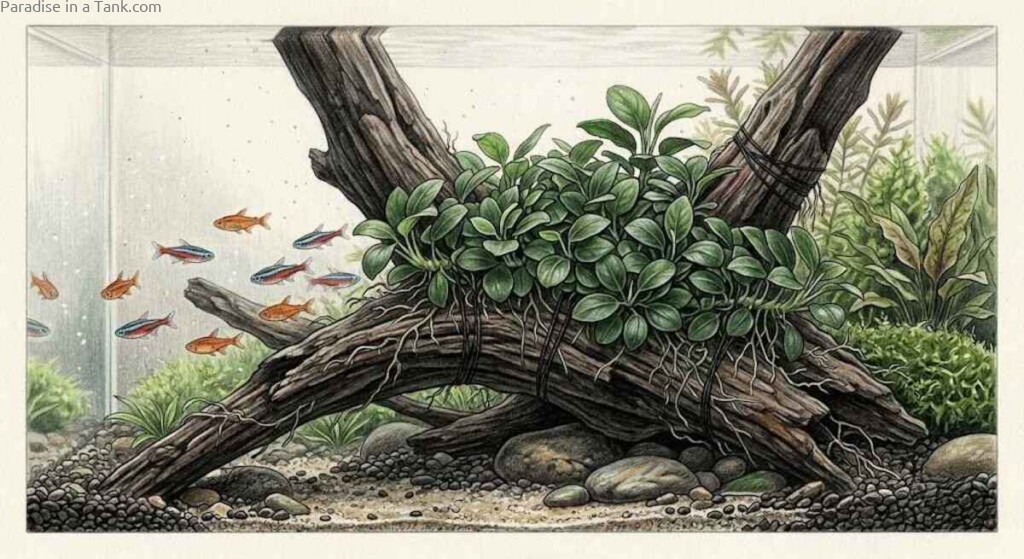
Introduction to the Anubias Genus
Anubias is an ultra-hardy aquatic epiphyte genus native to tropical West Africa, thriving attached to rocks or driftwood rather than buried in substrate. It requires low-to-moderate lighting, stable water parameters (pH 6.0–7.5, temperature 72°F–82°F, and hardness 3–15 dGH), and an exposed rhizome to prevent fatal rot and tissue collapse.
The aquatic plant hobby is full of delicate, temperamental greenery that wilts the moment your light timer slips or your nitrate levels spike. Anubias is the absolute antithesis of that fragile drama. Native to the shadowy riverbanks of tropical West Africa, this genus has spent millions of years adapting to extreme environmental shifts, amphibious shorelines, and rushing currents. When you add Anubias to your aquarium, you are inviting a prehistoric survivor into your glass box.
Natural West African River Habitats: Rheophyte Adaptations and Emergent Growth
In the wild river systems of Cameroon, Nigeria, and Gabon, Anubias exists as a true rheophyte—a plant specialized to survive in fast-flowing water. It does not sink roots into deep, mud-heavy soil beds. Instead, it clings fiercely to exposed granite boulders, submerged tree roots, and decaying forest debris along river margins.
These West African waterways undergo violent seasonal flooding cycles. During the wet season, torrents of water completely submerge the plants beneath several feet of dark, murky river flow. During the dry season, the water recedes, exposing the foliage to high atmospheric humidity while the roots anchor deep into damp rock crevices. Understanding this natural rhythm is the key to mastering their long-term care in aquascapes.
Anatomical Breakdown: Thick Leathery Foliage, Rhizome Dynamics, and Anchoring Roots
To survive these harsh amphibious conditions, the Anubias genus developed specialized anatomical armor. The leaves are covered in a thick, waxy cuticle layer that feels almost like tough leather to the touch. This dense cellular barrier prevents underwater herbivores from easily chewing through the foliage and protects the plant from drying out during seasonal emergent spells.
At the absolute heart of the plant lies the rhizome—a thick, green horizontal stem that acts as the central command hub for nutrient storage and growth. Every single leaf stalk emerges from the top of this rhizome, while tough, creeping structural roots sprout downward from its underside. These primary structural roots do not pull massive amounts of water or nutrients from soil like terrestrial plants do. Their main job is to form an unbreakable, biological vice grip on hard surfaces so rushing currents cannot sweep the plant downstream.
The Golden Substrate Rule: Why Anubias Cannot Be Buried
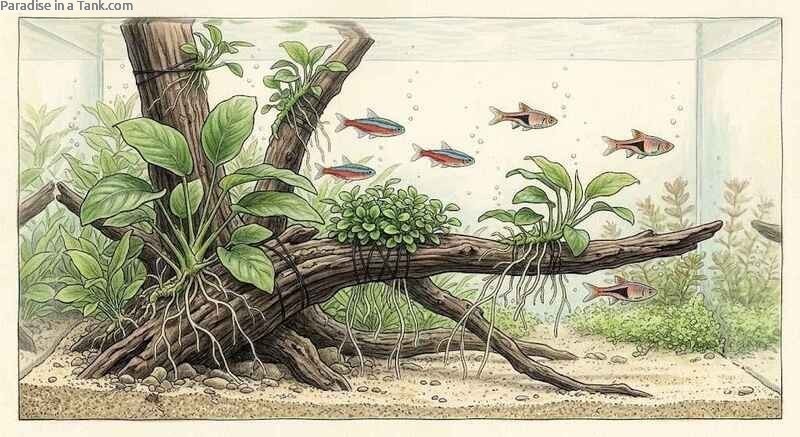
If you remember only one single rule from this entire guide, let it be this one: never shove the thick central rhizome beneath sand, soil, or gravel. Novice fishkeepers make this catastrophic mistake every day because traditional terrestrial gardening tricks us into burying roots deep in the dirt. Doing this to an epiphyte is a total death sentence.
- Rhizome Mechanics: How buried rhizomes suffocate and develop rapid anaerobic rot.
When you bury the rhizome under heavy aquarium substrate, you block the oxygen-rich water flow that must constantly wash over its outer tissue. Starved of circulation, oxygen-depleted pockets of anaerobic bacteria immediately attack the soft organic material. Within days, the thick stem turns into a mushy, foul-smelling brown sludge that spreads through the entire plant structure. The leaves will abruptly snap off at the base, float to the top of the tank, and leave you with nothing but rotting debris floating in your water column. - Substrate Workarounds: Elevating rhizomes above sand/gravel while allowing feeder roots to extend downward.
You can still achieve the illusion of a substrate-rooted plant without suffocating the central stem. Position the plant so the thick rhizome rests entirely above the substrate bed, fully exposed to the open water current. You can gently guide the longer, thin feeder roots down into loose gravel or coarse sand. Over time, these feeder roots will naturally crawl deep into the substrate to soak up organic waste while the horizontal stem breathes freely above.
Hardscape Mounting Techniques
Because Anubias naturally thrives out of the dirt, mounting it directly onto hardscape elements like lava rock, manzanita, or Malaysian driftwood is the most reliable way to display it. If you want a deep dive into the physical step-by-step processes for fixing these plants in place, take a look at our detailed instructions for planting and attaching Anubias in aquascapes.
- Super Glue Gel Method: Fastening dry rhizomes to rock and wood contact points using cyanoacrylate.
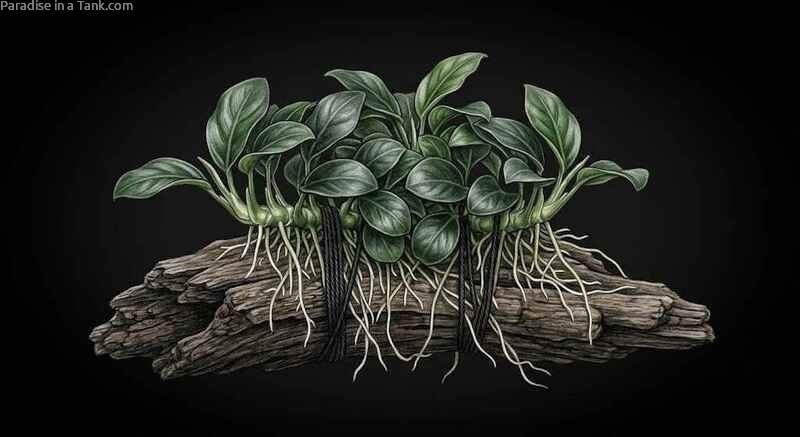
Cyanoacrylate super glue gel is the fastest, safest hack in modern aquascaping. Dab a tiny dot of gel onto a dry spot on your rock or driftwood, pat the underside of the rhizome dry with a paper towel, and press them firmly together for 10 seconds. The glue cures instantly upon contact with moisture, forming a completely non-toxic bond that holds the plant fast while new roots develop. - Thread & Line Tying: Securing heavy rhizomes with cotton thread or monofilament.
For massive specimens with thick stems, tying is an exceptionally reliable method. Wrap simple dark cotton thread or thin monofilament fishing line around the rhizome and hardscape 3–4 times, tying it off with a snug knot. Cotton thread naturally breaks down and rots away underwater after a few months (just enough time for the plant’s natural anchoring roots to grab hold), whereas monofilament provides a permanent hold. - Natural Wedging: Slipping roots into hardscape gaps and driftwood knots.
If your hardscape features natural cracks, deep bark ridges, or porous volcanic cavities, you do not need glue or thread at all. Gently push the flexible anchoring roots directly into the crevice using your fingers or broad-tip tweezers. Ensure the thick horizontal rhizome remains outside the crack so it is not pinched or suffocated by surrounding stone.
The Master Compendium of Anubias Varieties
The Anubias genus offers an unbelievable variety of leaf shapes, leaf textures, and structural sizes, ranging from microscopic foreground miniatures to towering background focal points. To explore the complete visual showcase of leaf forms across the market, check out our comprehensive overview of popular Anubias varieties for home aquariums.
- Anubias Nana & Nana Petite: Dwarf varieties engineered for nano aquascapes and foreground placement.
Anubias barteri var. nana is the classic dwarf variety that set the standard for planted tanks, sporting teardrop-shaped leaves that grow 2–4 inches long. Its ultra-popular cultivar, ‘Nana Petite’, takes dwarfism to the extreme with tiny leaves measuring less than 0.5 inches across. These tiny specimens are custom-built for nano tanks, creating a brilliant sense of scale when glued along intricate driftwood branches. - Anubias Coffeifolia: Ridged, coffee-leaf textured foliage with rich red-brown young shoots.
Anubias barteri var. coffeifolia is easily recognized by its striking, heavily corrugated leaf structure that mimics the deep ridges of a coffee plant leaf. Emerging young leaves sprout in a deep copper or red-brown shade before maturing into a rich, dark emerald green. This dramatic color shift and intense textural depth make it a showstopping midground feature piece. - Anubias Congensis & Lanceolata: Elongated, lance-shaped foliage suited for background framing.
If you need height and structural drama near the back glass, Anubias congensis and Anubias lanceolata are top-tier choices. These species produce long, elegant, arrow-shaped foliage mounted on tall, upright petioles that can easily reach 10–16 inches in height. Their upright habit creates a dense jungle backdrop that helps hide unsightly filter intake pipes and heater tubes. - Golden & Mini Coin Morphs: High-contrast color variations and circular leaf cultivars.
Modern commercial cultivators have developed stunning genetic mutations that brighten up dark aquarium corners. ‘Golden’ varieties produce bright lime-green to yellowish foliage that pops against dark volcanic stone. Meanwhile, ‘Mini Coin’ features broad, almost perfectly circular leaves that offer a softer, rounded texture compared to standard pointed leaf shapes.
| Anubias Cultivar | Average Plant Height | Ideal Aquarium Placement Zone | Key Visual Characteristics |
|---|---|---|---|
| Anubias Nana Petite | 1–2 inches | Nano Foreground & Driftwood Branches | Microscopic teardrop leaves forming dense green cushions. |
| Anubias Nana | 3–5 inches | Foreground & Midground Hardscape | Compact dark green leaves with exceptional hardiness. |
| Anubias Coffeifolia | 6–9 inches | Midground Focal Points | Deeply ribbed leaf surfaces with bronze new growth. |
| Anubias Congensis | 10–16 inches | Background Hardscape Framing | Long, narrow lanceolate foliage growing tall and upright. |
| Anubias Golden | 3–6 inches | Midground Contrast Areas | High-contrast neon-lime to yellow foliage. |
Water Parameters & Low-Light Tolerances
One of the greatest benefits of keeping Anubias is its staggering biological adaptability. It survives in environments where demanding stem plants melt into slush within 48 hours.
Lighting Thresholds: Avoiding Green Spot Algae on Slow-Growing Leaves
Because Anubias adapted to live under dense canopy shade in West African rainforest rivers, its light requirements are exceptionally modest. Low-to-moderate lighting (around 10–30 PAR) is all this plant needs to drive photosynthesis. High-intensity lighting setups will actually ruin your plant.
Because the leaves grow so slowly and last for years, they are prone to colonizing green spot algae (Choetophora) under intense, unshaded overhead light. If you notice tough green dots blanketing the upper leaves, move the plant to a shaded corner or place taller plants overhead.
Water Parameters: pH 6.0–7.5, Temp 72°F–82°F, and Hardness Flexibility
In terms of liquid chemistry, Anubias is remarkably forgiving. It thrives in tropical water temperatures ranging between 72°F–82°F (22°C–28°C), making it compatible with almost all community tropical fish. It accommodates a pH scale range of 6.0–7.5 and tolerates soft-to-hard water environments anywhere between 3–15 dGH.
| Parameter Variable | Ideal Target Range | Acceptable Survival Range |
|---|---|---|
| Water Temperature | 72°F–78°F | 68°F–84°F |
| pH Level | 6.5–7.2 | 6.0–7.8 |
| General Hardness (dGH) | 4–10 dGH | 2–18 dGH |
| Nitrate Concentration | 5–20 PPM | 0–40 PPM |
Propagation & Maintenance
Maintaining Anubias is as effortless as its daily care, requiring only occasional trimming and basic biological maintenance to keep it looking pristine for years.
- Rhizome Splitting: Cutting healthy rhizomes with a sanitized razor (minimum 3–4 leaves per division).
Propagating Anubias is completely foolproof. When a mother plant’s central stem grows long and thick with multiple leaf clusters, locate a clean section between node points. Using a sharp, sanitized razor blade or surgical scissors, make a clean, swift slice straight through the rhizome. Ensure both the newly separated piece and the parent plant retain at least 3–4 healthy leaves and a few strong anchoring roots. Attach the new division to a piece of hardscape, and it will immediately begin growing as an independent plant. - Algae Control: Utilizing Nerite snails, Amano shrimp, and low-flow shaded zones.
Slow-growing leaves act as natural magnet plates for opportunistic algae spores and drifting organic detritus. Rather than scrubbing leaves by hand and risking damage to the delicate leaf cuticle, deploy a dedicated clean-up crew. Amano shrimp (Caridina multidentata) and Nerite snails (Vittina natalensis) will tirelessly graze on leaf surfaces, devouring film algae and organic waste without harming the plant tissue. Keep water flow gentle in shaded zones to ensure detritus does not settle in thick layers across the foliage.
With a properly mounted rhizome, gentle shade, and a steady aquatic environment, your Anubias will anchor into a breathtaking, low-maintenance aquatic centerpiece that lasts for decades.