Introduction to the Cryptocoryne Genus
Cryptocoryne plants require stable water parameters (pH 6.0–7.5, 72°F–82°F), moderate lighting, and a nutrient-dense substrate at least 2.5 inches deep to thrive without melting. They feed primarily through deep benthic root networks, making subterranean root tabs or rich aquasoil essential for continuous, lush growth.
Natural Asian Stream Origins: Low-Light Forest Canopy Adaptations
In the wild, Cryptocoryne species inhabit the slow-moving forest streams, marshes, and riverbanks of Southeast Asia. Beneath dense jungle canopies, these plants evolved under extremely heavy shade where direct sunlight almost never pierces the water surface. Instead of relying on intense photon bombardment to drive rapid photosynthesis, Cryptocoryne species adapted to utilize subtle, low-intensity full-spectrum light efficiently.
Because forest streams undergo seasonal flooding and drastic changes in water depth, Crypts developed complex chemical mechanisms to adjust their cellular foliage based on immediate ambient light levels. When you bring them into a home aquarium, this evolutionary history works heavily in your favor. They do not demand blinding LED setups or massive energy inputs. However, this deep-seated evolutionary programming also makes them ultra-sensitive to sudden environmental shifts. In nature, when a fallen tree canopy suddenly exposes a shady stream to full sun, or when seasonal rains alter the water chemistry, the plant discards its old foliage to sprout new leaves tailored specifically to the fresh conditions.
Root Architecture: Deep Benthic Taproots and Rhizome Spreading
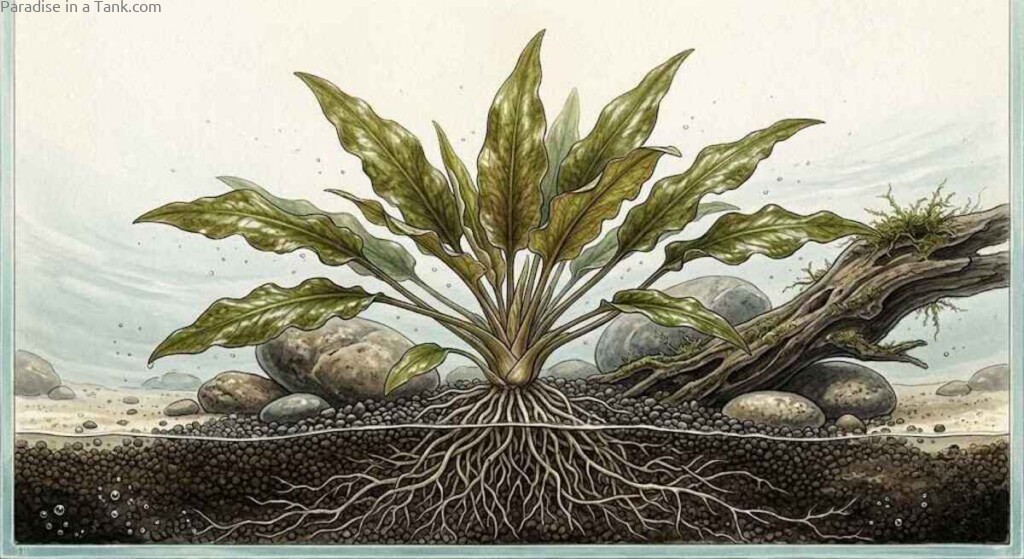
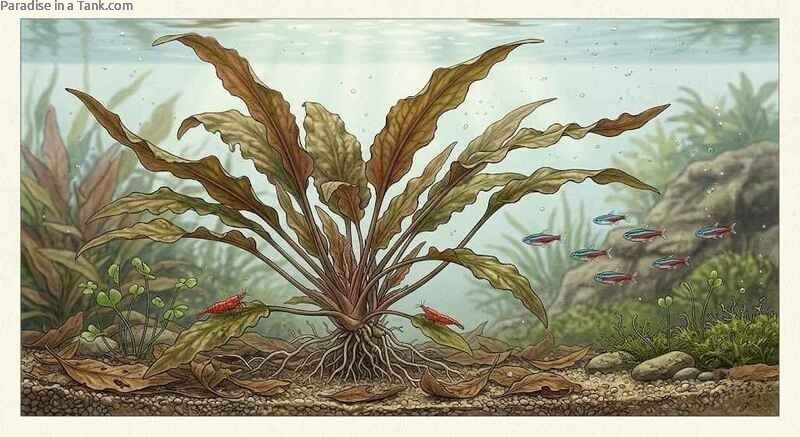
Unlike floating plants or stem species that absorb the majority of their daily sustenance directly from the surrounding water column, Cryptocoryne species rely almost entirely on an aggressive, highly developed subterranean root structure. Below the surface of your gravel or sand, a Crypt produces a thick central rhizome anchored by long, fibrous benthic taproots that dive deep into the substrate.
These massive root systems serve two critical survival functions: anchoring the plant against shifting stream currents in the wild and mining deep anaerobic substrate layers for decaying organic detritus, iron, and trace minerals. Over time, as the primary rhizome establishes itself, it sends out horizontal underground stolons. These stolons creep through the substrate, sprouting brand-new genetically identical plantlets several inches away from the mother plant. Understanding how to manage this creeping root system when establishing your tank layout is vital, which is why learning how to plant Cryptocoryne correctly right from the start will save you from disturbing their delicate rhizomes later.
Understanding & Preventing “Crypt Melt”
What is Crypt Melt?
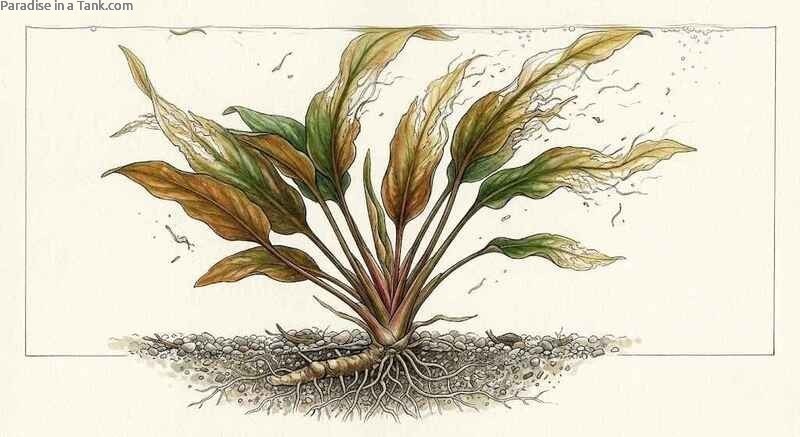
“Crypt Melt” is the dramatic, notorious biological response where a seemingly healthy plant dissolves into a translucent, gelatinous sludge almost overnight. While it strikes terror into the hearts of beginner aquarists, melt is not actually a fatal disease—it is a drastic, evolutionary defense mechanism. When a Cryptocoryne experiences a sudden shock in its local environment, it rapidly shuts down cellular energy transport to its leaves. The plant intentionally jettisons its current foliage, reabsorbing stored sugars back down into the underground rhizome so it can rebuild new leaves optimized for the new environment.
Common catalysts for this shock include:
- Moving the plant from an external nursery to your home aquarium
- A sharp drop or spike in water pH, temperature, or carbonate hardness (dKH)
- Abruptly changing lighting fixtures or altering the daily photoperiod duration
- Uprooting and physically relocating the plant to a different spot in the substrate
- Dosing excessive liquid algaecides or unbuffered liquid carbon treatments
Melt Prevention
Preventing Crypt melt comes down to one single golden rule: unbroken environmental consistency. Cryptocoryne plants can adapt to a surprisingly wide variety of water parameters, but they absolutely despise rapid fluctuations. When introducing new specimens to your tank, always float the bag to equalize water temperature gradually, and slowly drip-acclimate the plants to match your home water chemistry before placing them in the substrate.
Keep your daily water parameters rock-solid within target ranges. Maintain a steady pH between 6.0–7.5, keep water temperature locked in between 72°F–82°F, and maintain a dKH of 3–10. Avoid sweeping, massive water changes that alter parameters overnight; instead, perform consistent, smaller weekly maintenance sweeps of 15–20%. Once you plant a Crypt in your tank, leave it alone. Never uproot or shift it around just to tweak your aquascape, as disturbing the benthic root zone is the single fastest way to trigger a complete cellular shutdown.
Recovery Protocol
If you wake up one morning to find your prized Cryptocoryne transformed into a puddle of melting goo, do not panic, and under no circumstances should you throw the plant away. The most common mistake beginners make is tearing up the substrate and discarding a melting Crypt, thinking it is completely dead.
Follow this straightforward recovery protocol to restore your plant:
- Carefully siphoning away the dissolved, rotting leaf debris so it does not spike your ammonia levels or rot the crown.
- Leaving the submerged root crown and rhizome completely buried undisturbed in the substrate.
- Maintaining stable lighting, temperature, and water parameters without adding erratic chemical doses.
- Allowing 2–4 weeks for the stored energy in the subterranean rhizome to push out fresh, resilient leaves adapted perfectly to your water.
Substrate & Benthic Root Feeding Dynamics
Why Crypts Require Deep Substrates (2.5+ Inches of Aquasoil or Sand)
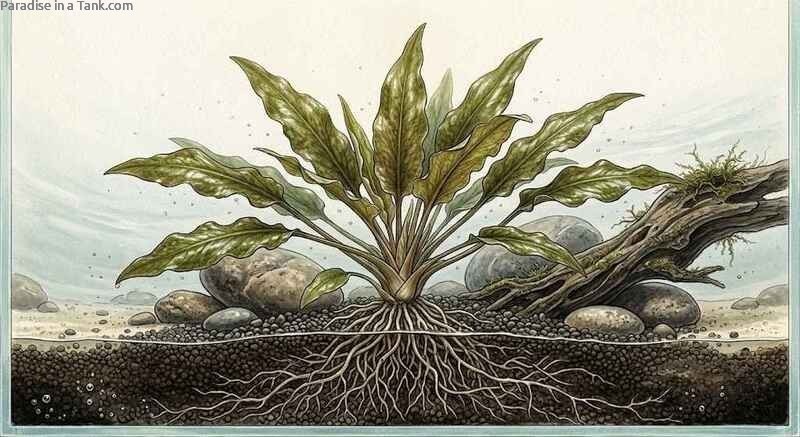
Because Cryptocoryne species build such massive, wide-reaching root architectures, depth is non-negotiable. Planting a Crypt in a shallow 1-inch layer of decorative gravel will severely stunt its growth, starve its rhizome, and leave the crown unstable. You must provide a clean substrate bed at least 2.5 to 3.5 inches deep.
A deep substrate bed gives the extensive taproots enough room to push downward without crushing against the bare glass bottom of the aquarium. Furthermore, a deep substrate layer allows beneficial micro-zones to form beneath the surface where anaerobic and aerobic bacteria process organic fish waste into rich, bioavailable plant nutrients. Whether you choose nutrient-rich aquasoil or a fine natural sand layer, adequate depth ensures the delicate root hairs stay protected from hungry bottom-dwelling fish like loaches or cichlids that love to dig.
Root Tabs vs. Liquid Fertilizers: Feeding Heavy Benthic Root Systems
To grow massive, vibrant Cryptocoryne specimens, you must feed them where they actually eat: at the roots. Dosing the open water column with heavy liquid fertilizers might feed floating plants or mosses, but it does very little for a Crypt. Worse yet, dumping high concentrations of iron and nitrogen into open water without high-intensity lighting usually results in an explosive algae bloom on your glass and leaves.
Instead, rely heavily on nutrient-rich root tabs inserted directly into the substrate right beneath the plant’s root crown. Standard root tabs packed with slow-release nitrogen, phosphorus, potassium, iron, and essential trace elements mimic the rich, muddy riverbeds of their native Asian streams. Slide fresh root tabs 2 inches deep into the substrate near your Crypts every 3 to 4 months. While a tiny trace of liquid fertilizer in the water column can support overall tank balance, solid subterranean root feeding remains the true engine behind dense, melt-free Crypt foliage.
The Master Compendium of Cryptocoryne Species
Cryptocoryne Wendtii (Green, Brown, Tropica, Red)
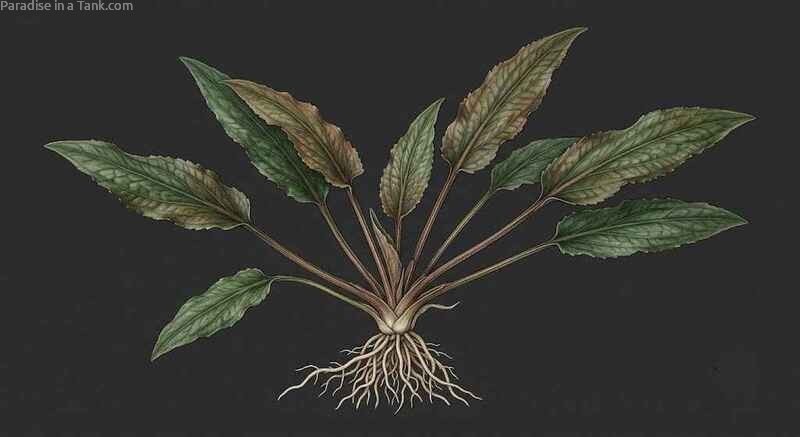
- Cryptocoryne Wendtii: The undisputed king of the midground. This classic species is notoriously hardy, highly adaptable, and available in several striking color morphs including Green, Brown, Tropica, and Red. Under low light, Wendtii leaves stretch wide and tall; under higher light, the plant stays compact and spreads horizontally, making it an insanely versatile layout tool for beginners and veterans alike.
Cryptocoryne Parva
- Cryptocoryne Parva: The absolute smallest dwarf member of the entire genus. Parva features tiny, stiff, bright-green lance-shaped leaves that rarely grow taller than 2–3 inches. Because it grows at a notoriously slow crawl compared to other varieties, it is prized for creating long-lasting, low-maintenance foreground carpets that never require frequent trimming or aggressive lawnmowing.
Cryptocoryne Lutea & Undulata
- Cryptocoryne Lutea & Undulata: Medium-sized workhorses that bring incredible texture to the midground. Lutea produces sturdy, upright dark green leaves with distinct dark midribs, while Undulata features beautiful, wavy-edged foliage that shifts from bronze to rich olive depending on light intensity. Both species excel at filling out transitions between low rocks and taller background stem plants.
Cryptocoryne Balansae & Usteriana
- Cryptocoryne Balansae & Usteriana: The heavyweights of the background section. Balansae (also known as Cryptocoryne crispatula) and Usteriana develop long, ribbon-like leaves reaching 18 to 24 inches in length, characterized by distinct “puckered” or ruffled bullate textures. Placed in the back corners of a display tank, their tall fronds arch gracefully across the water surface, creating dramatic shadowy aesthetics. For a deeper breakdown of growth rates, color variations, and leaf structures across these distinct plant types, explore our comprehensive Cryptocoryne species guide to pick the exact variety for your tank layout.
System Parameters & Low-Light Adaptations
| Parameter | Ideal Range | Biological Purpose |
|---|---|---|
| Water Temperature | 72°F–82°F | Maintains optimal enzymatic activity and cellular metabolism within the rhizome. |
| pH Level | 6.0–7.5 | Ensures subterranean nutrients remain fully soluble and easily bioavailable to root hairs. |
| Carbonate Hardness (dKH) | 3–10 dKH | Buffers against sudden acidity swings that trigger severe cellular leaf melt. |
| General Hardness (dGH) | 4–12 dGH | Provides vital calcium and magnesium essential for building strong, rigid leaf cell walls. |
| Lighting Intensity | Low to Moderate (1.5–2.5 PAR/gal) | Prevents leaf scorching, discourages algae, and keeps foliage growth full and compact. |
Lighting Requirements
Cryptocoryne species thrive under low to moderate full-spectrum LED lighting photoperiods lasting roughly 6 to 8 hours per day. High-intensity lighting setups designed for demanding stem plants will actually stress Crypts, encouraging thick brush algae to anchor onto their slow-growing leaves. If your lighting is too intense, Crypt foliage may lay completely flat against the substrate or take on stunted, dark purple tones. Conversely, if lighting is too dim, the stems will become leggy and thin as they reach upward for photons. Aim for a balanced, consistent light source and let the plant settle into its rhythm.
Water Chemistry Thresholds
While Crypts are remarkably tolerant of varying water chemistry once acclimated, they demand stability above all else. They flourish best in slightly acidic to neutral water with a pH of 6.0–7.5, though established colonies can tolerate up to 8.0 if the hardness remains stable. Keep your temperature dial set between 72°F–82°F. Fluctuations in water hardness or thermal shocks during cold water refills are prime triggers for sudden leaf sloughing, so always temp-match replacement water during routine tank maintenance.
Propagation via Underground Stolon Runners
Propagating Cryptocoryne plants is an incredibly rewarding, hands-off process because the plant does most of the heavy lifting beneath the gravel. Rather than producing seeds in standard aquarium settings, a healthy, established Crypt spreads across your aquascape by sending out horizontal subterranean runners known as stolons.
As these stolons extend outward from the central mother plant, tiny daughter nodes form along the runner. Within a few weeks, these nodes push fine white rootlets down into the substrate and sprout small vertical leaves above the surface. Over time, a single parent Crypt will create a dense, interconnected colony of identical plantlets spread across several inches of space.
If you want to move these new baby plants to a different aquarium or share them with fellow hobbyists, wait until the daughter plant has developed at least 4 to 5 distinct leaves and built its own independent root network at least 1–2 inches deep.
To propagate manually:
- Gently push your fingers into the substrate between the mother plant and the baby plantlet to locate the connecting horizontal runner stem.
- Using a pair of sharp, curved aquascaping scissors, clip the subterranean runner stem cleanly halfway between the two plants.
- Carefully lift the daughter plant straight up out of the substrate, taking care not to rip or tear its delicate roots.
- Immediately replant the daughter specimen into its new home, gently burying the root structure while keeping the main crown fully exposed above the substrate line.
With a little patience, stable water conditions, and a rich substrate bed beneath their roots, these remarkable Asian stream plants will reward you with a lush, timeless aquatic landscape that lasts for years.