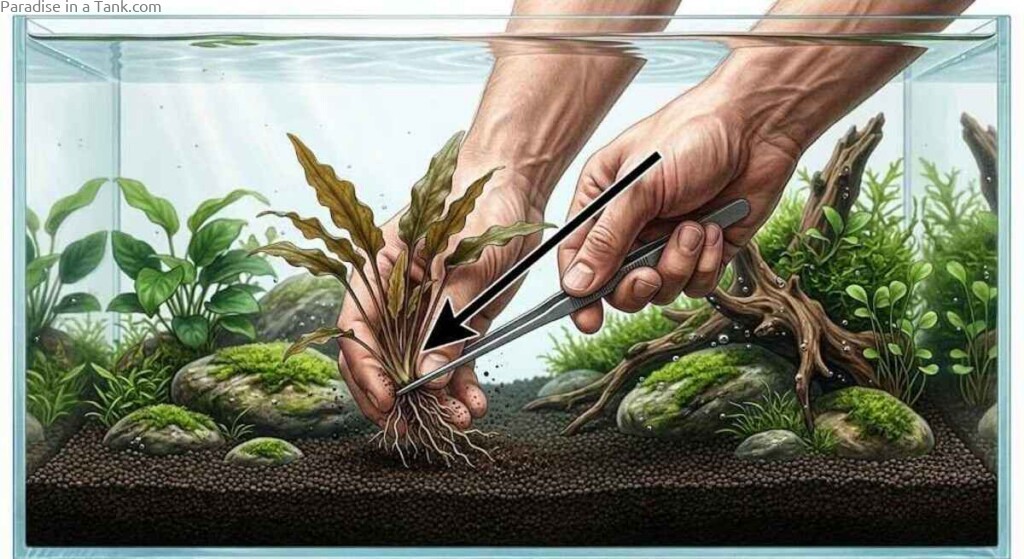
Cryptocoryne species thrive when anchored in a fine substrate that is 2.5–3 inches deep, enriched with iron-heavy root tabs placed 1 inch from their base, with their sensitive root crowns positioned precisely at the substrate surface line to prevent fatal rot and recover from transplant melt.
Planted aquariums can sometimes feel like a high-stakes balancing act, but few plants carry as much historical clout—and dramatic flare—as the humble Cryptocoryne. Originating from the nutrient-dense, slow-moving jungle streams of Southeast Asia, these heavy-rooting plants have adapted over millions of years to absorb minerals directly out of muddy riverbeds. If you treat them like stem plants that just soak up whatever liquid fertilizer is floating in the water column, you will watch them dissolve into a pile of transparent mush.
Setting up Cryptocoryne isn’t difficult, but it does require you to respect their natural anatomical demands. Whether you are adding a single specimen to a lush nano tank or carpeting a massive display, getting your hands dirty with proper planting techniques is the absolute foundation of long-term success.
The Step-by-Step Cryptocoryne Planting Guide
Before you stick a plant into your gravel, you need to handle its delicate tissue with care. Fresh plants straight from the aquatic nursery are vulnerable, and how you prepare them dictates whether they establish roots in days or disintegrate within hours.
Preparing Nursery Plants: Unpotting, Gel Rinsing, and Root Trimming
When you bring home a new plant, it typically arrives in a plastic slit pot lined with dense rockwool, or sealed in a sterile tissue culture cup packed with nutritional gel. You must remove every bit of this growth medium. Rockwool holds onto excess debris and chokes out expanding roots, while tissue culture gel decomposes underwater, creating localized bacterial blooms and localized spikes in ammonia.
- Gently squeeze the plastic pot to loosen the root mass, then slide the plant out smoothly.
- Under a trickling stream of room-temperature tap water (68–75°F), carefully tease away the rockwool using a pair of curved aquascaping tweezers or your fingers.
- If using tissue culture plants, submerge the gel-covered base in a bowl of tepid water and wash the clear jelly off completely.
- Inspect the root system. You will usually see a dense, tangled mass of long, fleshy roots.
- Using sharp, sterile aquascaping shears, trim the root tips back so they are roughly 1–2 inches long.
Trimming roots sounds counterintuitive, but it serves a vital physiological purpose. Long, matted roots tend to crush together when shoved into gravel, forming stagnant dead zones that rot underwater. Pruning forces the plant to launch brand-new, highly efficient root hairs directly into your substrate.
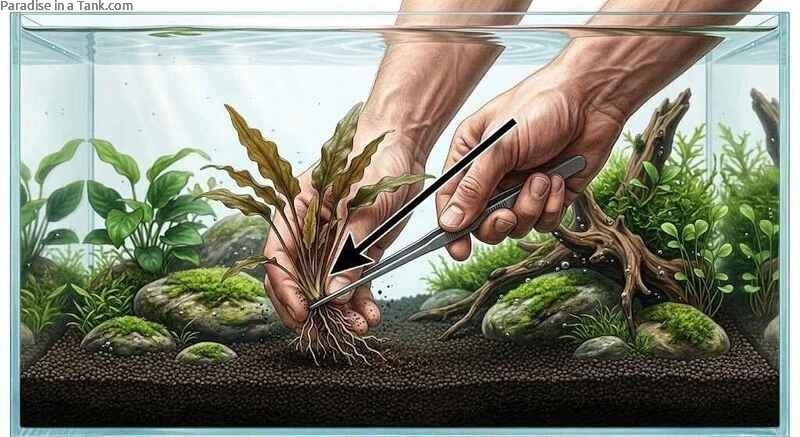
Root Crown Placement: Ensuring Crown Nodes Sit Directly at the Substrate Line
The most common mistake aquarists make when planting Crypts is burying them too deep. The anatomical heart of the plant is its root crown—the distinct, slightly hardened junction where the green leaf stems meet the white or brownish root structures.
If you bury this crown under substrate, you suffocate the plant. Anaerobic bacteria quickly attack the trapped node, rotting the plant from its core. Conversely, if you leave the crown hovering completely above the substrate, the newly exposed structural nodes dry out or suffer physical damage from water currents and curious fish.
Grasp the plant near its base with long aquascaping tweezers, angle it at roughly 45°, and push it downward into the substrate slightly deeper than necessary. Slowly release your grip on the tweezers and gently pull the plant upward until the junction point—the root crown node—sits perfectly level with the top layer of your substrate. The roots should anchor down into the soil while the base of the leaf stems remains totally exposed to clean water flow.
Substrate Mechanics for Cryptocoryne
Unlike water-column feeders that drink up liquid nutrients directly through their foliage, Crypts build massive, expansive taproot architectures designed to mine heavy soil deposits. You must provide an anchor zone built to nourish these subsurface networks. For a deeper look into water parameters and lighting requirements for these heavy root feeders, take a look at our ultimate Cryptocoryne care guide.
- Ideal Depth: Maintaining 2.5–3 inches of fine substrate for taproot expansion. Fine-grade inert gravel or rich aqua soil gives roots the room they need to stretch out horizontally and vertically without being crushed by heavy, compact rocks.
- Root Tab Placement: Inserting iron-rich fertilizer tabs 1 inch from the root base. Push these slow-release tabs deep down into the substrate layer. Placing them directly against the roots can cause localized nutrient burn, while setting them 1 inch away encourages the root system to aggressively grow outward to feed.
Managing Crypt Melt: Diagnosis and Recovery
Almost every aquarist who touches a Cryptocoryne eventually experiences the dread of “Crypt melt.” You wake up, look into your tank, and realize that yesterday’s lush, vibrant leaves have transformed into slimy, translucent strings of goo. Don’t panic, and do not pull the plant out of your aquarium.
| Problem Condition | Visual Foliage Signs | Root System Status | Immediate Action Required |
|---|---|---|---|
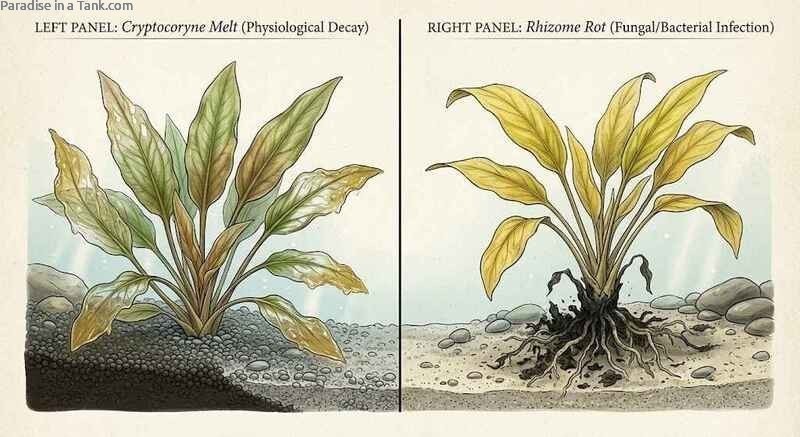
| Crypt Melt | Leaves turn soft, translucent, and dissolve into slime over 24–48 hours. | Firm, plump, white/tan roots firmly anchored in substrate. | Trim melted leaves, leave substrate undisturbed, and await new shoots. |
| Complete Crown Rot | Leaves rot at the base node, detaching completely with black foul-smelling mush. | Soft, squishy, black or grey disintegrating root system. | Remove dead plant material entirely; siphon out rotting organic debris. |
Identifying Crypt Melt vs. Rot
Crypt melt is not actually a disease; it is an emergency physiological survival mechanism. When a Crypt experiences a sudden shift in light intensity, water hardness, temperature, or water chemistry (such as a sudden jump in PPM of dissolved solids), it intentionally shed its existing leaves. The plant abandons its current foliage to conserve energy and rebuild new leaves tailored specifically to the new environmental parameters.
Rot, on the other hand, is the biological death of the entire organism caused by suffocated crowns, localized anaerobic sulfur pockets, or extreme bacterial infections. If the roots remain firm and grounded, the plant is simply resetting itself.
Step-by-Step Recovery: Trimming Melted Leaves Without Disturbing the Substrate
- Grab a pair of sharp, fine-tipped aquascaping scissors.
- Carefully snip off the disintegrating, slimy leaves as close to the root crown as possible without damaging the central node.
- Use a siphon hose to gently vacuum up the decaying leaf tissue floating near the substrate line so it doesn’t rot and trigger an ammonia spike.
- Do not pull the root mass out of the substrate. Even if every single leaf melts away, the underground crown remains alive.
- Keep your lighting on a strict, consistent timer and maintain clean, stable water conditions.
Within 10–20 days, tiny, tightly rolled green spires will begin pushing up out of the substrate directly from the intact root crown. To explore the diverse leaves and color forms that can emerge during this recovery phase, check out our detailed Cryptocoryne species guide.
Moving & Transplanting Protocols
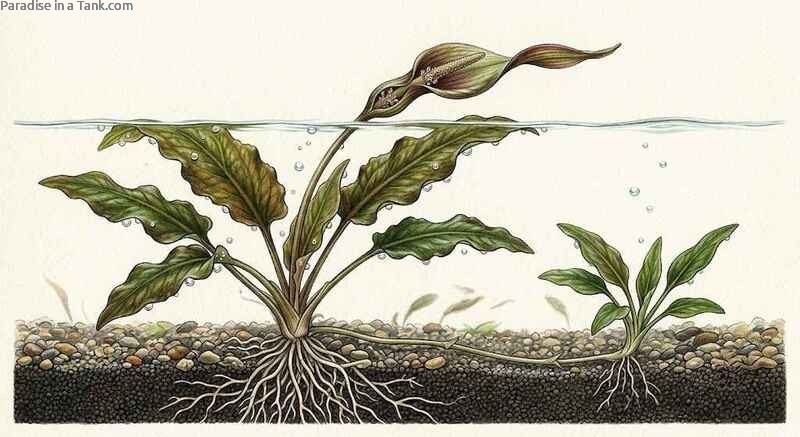
Once a Cryptocoryne digs its heels into your substrate, it wants to stay there. These plants send out an extensive, interlocking grid of runner roots that cling tightly to surrounding gravel and soil grains.
Why Moving Crypts Triggers Melt: Mitigating Stress During Aquascape Redesigns
When you yank a Crypt out of the substrate during a tank redesign, you inevitably tear thousands of microscopic root hairs that absorb vital minerals and anchor the plant. The sudden loss of root surface area leaves the plant incapable of supporting its existing leaf mass. Combined with the stress of being exposed to open air and changing water parameters in a new spot, the plant naturally triggers its melt protocol to survive.
If you must relocate a Crypt, proceed with extreme caution:
- Use your fingers to dig gently around the perimeter of the root zone, lifting the surrounding substrate to free the deep taproots rather than pulling hard on the stems.
- Trim back the oldest, largest leaves by roughly 30–50% before replanting. Reducing the plant’s overall foliage load lowers its metabolic demand while its damaged roots work to re-establish themselves in the new location.
- Immediately insert a fresh root tab next to the transplanted root mass to give the plant an instant supply of bioavailable iron and nitrogen as it settles into its new home.
By handling the root crown with care, maintaining a deep nutrient-rich substrate, and remaining calm when environmental shifts trigger a temporary melt, you can keep these primitive, ancient jungle plants thriving in your aquarium for years to come.