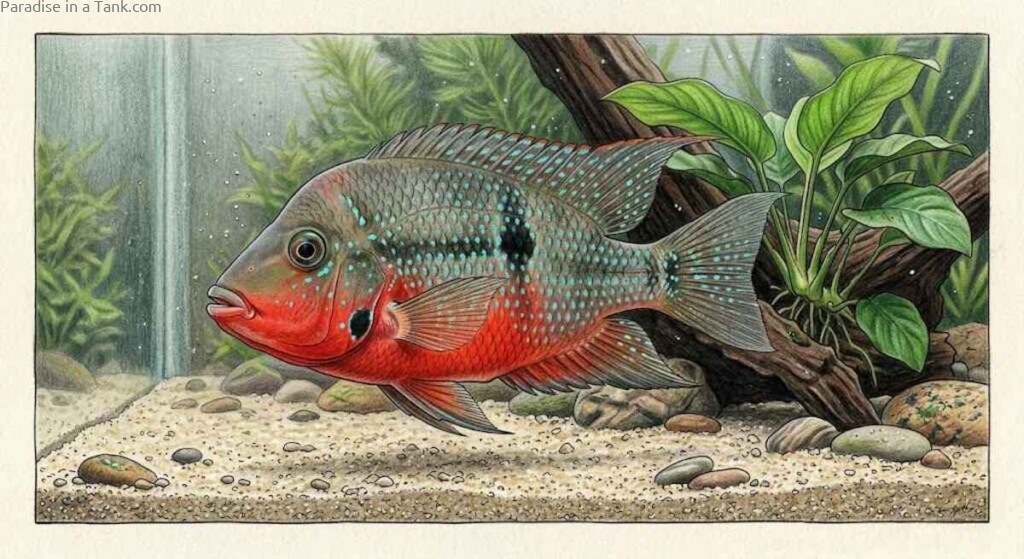
Growth Trajectories and Final Physical Dimensions
Firemouth cichlids (Thorichthys meeki) reach an average adult size of 13–15 cm (5–6 inches) for males and 10–12 cm (4–4.5 inches) for females. Single specimens require a minimum tank capacity of 110 Liters (30 Gallons) with a 90 cm footprint, while breeding pairs or community setups require 200–280 Liters (55–75 Gallons) maintained at a pH of 7.0–8.0 and under 20 PPM nitrate.
When you bring home a juvenile Firemouth cichlid from your local fish store, you are looking at an unpretentious 4 cm fish slipping quietly between plastic plants. Do not let that modest footprint fool you into thinking a desktop tank will suffice. These Central American cichlids hail from the river basins, limestone cenotes, and slow-moving streams of the Yucatán Peninsula. Over millions of years, they evolved as territorial, substrate-sifting bottom-dwellers that require deliberate physical space to stake out boundaries and display their iconic crimson throat displays without ripping each other apart.
Understanding the true growth trajectory of this species is the difference between keeping a thriving, vibrant display and watching an overcrowded tank disintegrate into continuous territorial warfare. If you ignore their biological physical requirements, you will deal with stunted growth, rampant bacterial outbreaks, and hyper-aggressive territory disputes.
Max Size Realities: How Long Do Males and Females Actually Grow?
In a properly sized aquarium with pristine water parameters, male Firemouth cichlids top out between 13 and 15 cm in standard length (measured from the tip of the snout to the base of the caudal fin). Females remain noticeably more compact, typically topping out at 10 to 12 cm. This size difference is not merely a cosmetic quirk; it heavily dictates the bioload and swimming space required inside your display tank.
Beyond raw length, males develop a significantly deeper body profile and a pronounced, sharply pointed dorsal fin as they reach full maturity. Their body mass expands considerably, requiring ample turning radius and uninhibited territory corridors. Females maintain a slightly slimmer profile, but during spawning cycles, their abdomen swells dramatically as they carry ripe egg batches.
If you want to dive deeper into biological distinctions, color variations, and behavioral sexing methods, take a look at our guide on identifying male vs female Firemouth cichlid traits. Knowing exactly which sex you are raising allows you to construct long-term spatial boundaries long before physical dominance battles erupt in the water column.

Timeline Milestones: Tracking the Juvenile-to-Adult Development Phase
Firemouth cichlids do not shoot up to full adult dimensions overnight. Instead, they exhibit distinct, step-by-step physical growth stages over their first two years of life. Rapid early growth occurs during the first six months, where a well-fed juvenile will gain nearly 1 cm per month if maintained in clean, warm water with zero ammonia and zero nitrite accumulation.
By month 12, most specimens reach approximately 70–80% of their ultimate body size. During this phase, their metabolic rate is exceptionally high, meaning they produce vast quantities of physical waste and organic nitrogenous compounds. Growth slows down considerably between 12 and 24 months, where physical development shifts from simple linear length into muscle density, head hump formation, and fin filament elongation.
| Timeline Milestone | Physical Growth Benchmark | Environmental & Behavioral Priorities |
|---|---|---|
| Early Stage (Months 1 to 6) | Reaches 5–8 cm in length with rapid fin development. | High protein diet, frequent water changes, zero nitrate buildup. |
| Sub-Adult Stage (Months 7 to 12) | Reaches 9–11 cm; sexual dimorphism becomes visible. | Establish permanent visual barriers and permanent cave territories. |
| Adult Maturity (Months 13 to 24) | Reaches full size (12–15 cm males, 10–12 cm females). | Maintain stable pH levels and manage territorial boundary squabbles. |
Engineering the Ideal Enclosure Volume
Minimum Footprint: Why a Single Specimen Needs 110 Liters (30 Gallons)
A common mistake made by hobbyists is assuming volumetric capacity is all that matters. You might think a tall, vertical 100-liter column tank is sufficient for a single Firemouth, but vertical height is largely useless for a substrate-oriented species. Firemouth cichlids spend over 80% of their waking hours cruising within 10 cm of the bottom layout. Therefore, horizontal surface area—the tank footprint—is the defining metric for success.
A single adult specimen requires an absolute minimum footprint of 90 cm in length by 30 cm in depth, which translates to a standard 110 Liter (30 Gallon) long enclosure. This baseline floor footprint provides enough linear space for the fish to patrol its territory without constantly running into glass barriers or filter intakes.
If you plan to keep a mated pair or a mixed Central American community, you must scale up significantly to a minimum of 200 to 280 Liters (55 to 75 Gallons) with a 120 cm footprint. When two male Firemouths challenge each other, they flare their bright red branchiostegal membranes, open their mouths wide, and perform side-by-side tail-slapping routines. Without a 120 cm linear run, weaker individuals cannot retreat outside the dominant male’s sightline, leading to frayed fins, severe stress, and eventual systemic disease outbreaks.
For a complete overview of housing, filtration choices, and environmental requirements, check out our complete Firemouth cichlid care guide to build a bulletproof system.
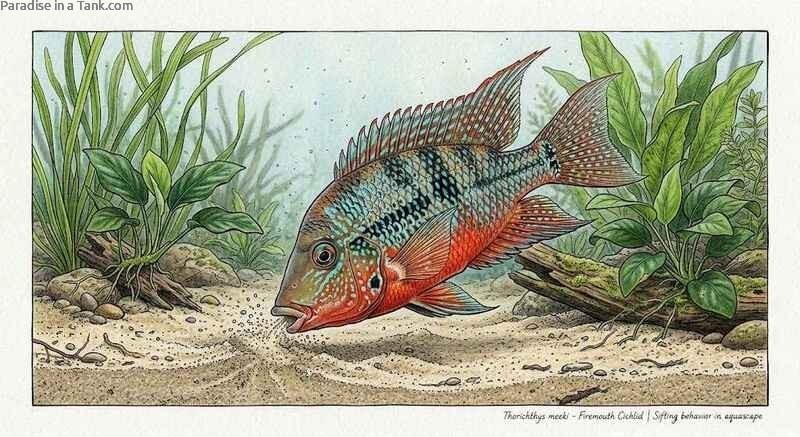
Substrate Dynamics: The Biological Need for Deep, Fine Sand Layers
Look closely at the lower jaw apparatus of a Firemouth cichlid and you will notice an specialized, downward-facing snout structure. These fish are obligate sand-sifters. In nature, they plunge their faces directly into fine substrate, scooping up mouthfuls of sediment, filtering tiny invertebrates through their gill rakers, and spitting the remaining sand out in smooth plumes.
Providing sharp gravel, crushed coral, or coarse stone substrates is a direct violation of their evolutionary programming. Coarse gravel cuts their delicate mouth membranes, leads to mouth rot infections, and completely prevents their natural foraging behaviors. Furthermore, heavy gravel traps uneaten food, waste particles, and rotting organic detritus deep within the crevices where siphon tubes cannot reach.
You must provide a smooth pool filter sand or natural river sand bed at a uniform depth of 5–7 cm (2–3 inches). This depth allows the fish to dig deep pits during breeding preparations without scraping their bellies on bare glass bottom panels.
- Severe Gill Damage: Coarse, sharp gravel abrasively slices through fragile gill tissues during sifting attempts.
- Mouth Lesions and Bacterial Rot: Jagged substrate edges cause open sores on the lip margins, opening entry points for opportunistic Aeromonas bacteria.
- Anaerobic Gas Pocket Formation: Substrates deeper than 8 cm without active diggers or burrowing snails trap toxic hydrogen sulfide gas pockets that can poison the water column if suddenly disturbed.
- Internal Intestinal Impaction: Ingestion of non-passable gravel chunks can block the digestive tract, causing fatal abdominal dropsy.
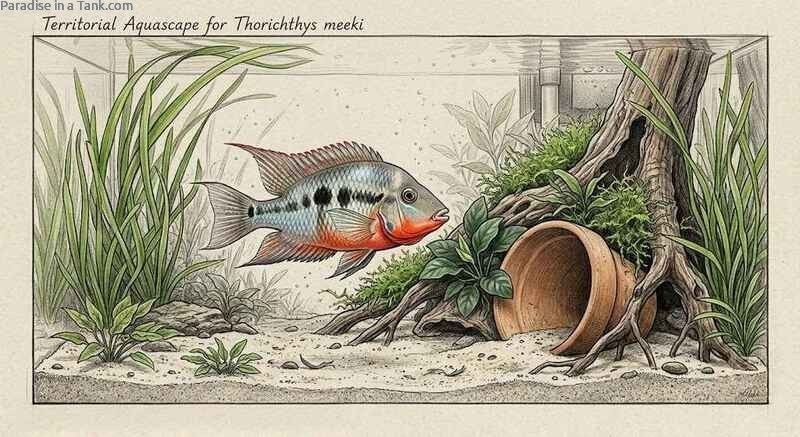
Visual Breaks: Using Terracotta Pots and Driftwood to Establish Boundaries
Territory in a cichlid tank is not defined by water volume; it is defined by physical sightlines. If a dominant Firemouth can stand in the middle of the aquarium and see every single competitor from end to end, it will attempt to control the entire system, ruthlessly harassing every tankmate until they are crammed into upper corner glass edges.
To prevent this territorial tyranny, you must build distinct physical micro-zones across the aquarium floor using smooth driftwood, river stones, and terracotta pots. Terracotta pots angled at 45-degree angles serve as perfect, budget-friendly spawning caves and security hides. Position large pieces of driftwood vertically or diagonally in the middle third of the tank to create total visual blockades.
When a subordinate male is chased away, it only needs to duck behind a vertical driftwood trunk or a stack of smooth river rocks to break visual contact. The moment the dominant male loses sight of its rival, the chase immediately terminates, resetting the aggressive urge and keeping stress hormones down across the population.
Long-Term Environmental Maintenance Protocols
Once your enclosure volume, fine sand bed, and physical rockscape boundaries are locked in place, maintaining physical stability becomes a weekly habit. Firemouth cichlids generate substantial metabolic waste, and their constant sand-sifting activity churns fine organic particles into the water column. Without heavy mechanical and biological filtration, your water chemistry will rapidly degrade.
Keep nitrate levels consistently under 20 PPM through strict weekly 30–50% water changes. High nitrate concentrations over extended periods cause chronic organ stress, dull the brilliant red throat pigmentation, and stunt growth in developing juveniles. Pair your water changes with a high-quality food regimen that limits waste output; you can review our recommended strategy for a balanced Firemouth cichlid diet and nutrition strategy to keep waste production low and water quality crystal clear.
- Unstable pH Swings: Firemouths require a stable pH between 7.0 and 8.0. Soft, acidic water weakens their slime coat and triggers physiological stress.
- Excess Organic Buildup: Failing to clean filter pads weekly leads to organic sludge accumulation, dropping dissolved oxygen levels and spiking bacterial counts.
- Clogged Substrate Traps: Un-siphoned dead spots beneath rock piles harbor decaying waste that drives nitrate spikes and triggers stubborn algae blooms.
- Inadequate Water Movement: Low turn-over rates allow waste to settle on the sand bed rather than being swept into the mechanical filter intake.
By respecting their spatial limits, delivering smooth sand for their natural sifting instincts, and breaking up territorial sightlines with smart structural choices, you offer your Firemouth cichlids the exact environment they evolved to inhabit. Step back, let them stake out their territory, and enjoy watching one of nature’s most stunning displays unfold right inside your living room.