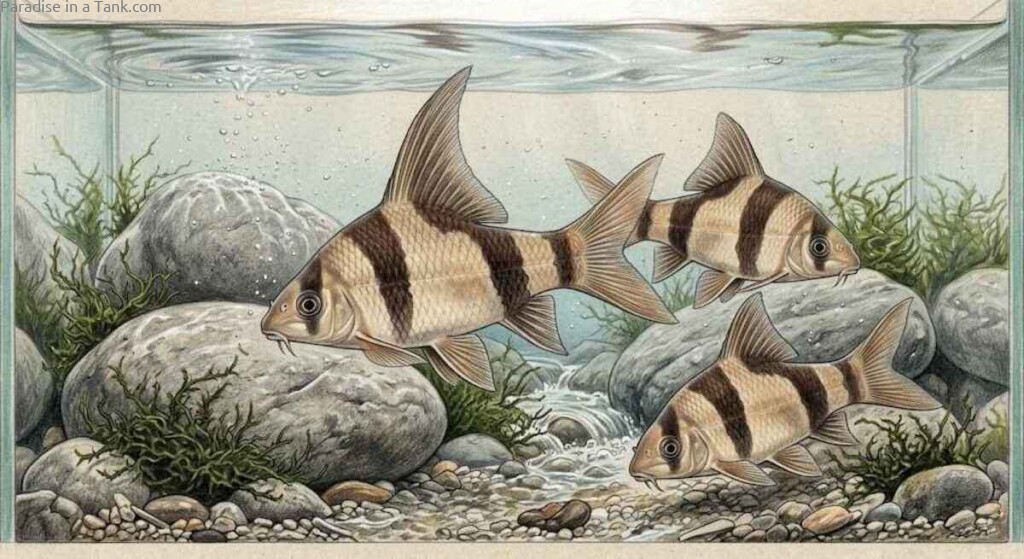
Bring the Ocean Home: The Appeal of Mini-Sharks
Aquarium fish that look like sharks allow you to enjoy the fierce, streamlined appearance of marine predators in a freshwater setup. Species like the Red Tail Shark, Rainbow Shark, and Bala Shark mimic these ocean giants with their tall dorsal fins and tireless cruising styles, offering a thrilling centerpiece for experienced keepers.
For generations, fish keepers have been captivated by the silent, powerful grace of marine sharks. While true sharks are entirely unsuited for the home aquarium due to their massive size and complex saltwater needs, evolution has provided a fascinating alternative. Several freshwater species have developed sleek, torpedo-shaped bodies and upright, triangular dorsal fins that look exactly like the ocean’s most famous predators. Bringing these mesmerizing creatures into your home fulfills that primitive desire to care for a miniature monster without the impossible demands of a true marine predator.
However, you must understand that these fish are not modern decorations; they are evolutionary marvels hardwired with ancient survival mechanisms. Many of these species hail from fast-flowing river systems throughout Asia, where their streamlined profiles allowed them to pierce through heavy currents. In the confines of a glass box, that same evolutionary programming translates into high-speed swimming, intense territorial drives, and specific environmental needs. To keep these mini-monsters thriving, you must shed any casual mindset and step up as a disciplined custodian of nature.
The Evolutionary Contract of the Freshwater “Shark”
When you introduce a shark look-alike into your ecosystem, you are signing an unwritten contract with millions of years of natural selection. These fish carry deep geological histories in their DNA, dictating exactly how they interact with their surroundings. Their tall, erect dorsal fins are not just for show; they act as stabilizers that allow the fish to execute lightning-fast turns and hold their ground against raging river currents. Because they are built for constant movement, keeping them in cramped, stagnant water is a recipe for severe stress and behavioral ruin.
Furthermore, many of these species are fiercely solitary by nature, viewing any similar-looking fish as direct competitors for food and territory. In the wild, a defeated fish can simply swim downstream to find a new home, but in an aquarium, there is nowhere to hide. If you fail to provide adequate space, heavy rockwork, and visual barriers, their ancient instincts will take over, leading to relentless bullying and physical injury. Succeeding with these magnificent creatures requires you to completely adapt your domestic environment to their primitive programming.
Crucial Husbandry Requirements: Why Experience Matters
Caring for freshwater sharks is a rewarding challenge, but it is entirely unsuited for absolute beginners. These species are highly sensitive to fluctuating water parameters and require established, mature biological filtration systems to stay healthy. A sudden spike in raw ammonia or toxic nitrite will quickly devastate their nervous systems, leading to severe illness or sudden fatalities. Aspiring keepers should have at least two to three years of successful fish husbandry experience before attempting to manage the complex social dynamics and physical demands of these shark mimics.
To maintain a stable environment, you must stay vigilant against the gradual accumulation of organic waste and subsequent nitrate buildup. Regular water changes and heavy mechanical filtration are mandatory to replicate the pristine, oxygen-rich waters of their native streams. Additionally, you must carefully monitor water acidity and water hardness, ensuring the environment remains stable and free from sudden shifts. The table below outlines the core spatial and behavioral baselines required to keep these species thriving over the long term.
| Species Common Name | Minimum System Volume | Primary Behavioral Disposition | Ideal Water Level Zone |
|---|---|---|---|
| Red Tail Shark | 55 Gallons | Highly aggressive to conspecifics | Lower to middle layers |
| Rainbow Shark | 55 Gallons | Territorial and highly active | Bottom dweller |
| Flying Fox Fish | 30 Gallons | Moderately territorial with age | Bottom and rock surfaces |
| Roseline Torpedo Shark | 55 Gallons | Active and peaceful schooler | Middle open water |
| Harlequin Shark | 75 Gallons | Strongly territorial and aggressive | Lower level crevices |
| Silver Apollo Shark | 75 Gallons | High-speed, peaceful schooler | Upper water surface |
| Violet Blushing Shark | 125 Gallons | Semi-aggressive schooler | Middle and lower zones |
| Bala Shark | 150 Gallons | Active, large-scale schooler | Middle open water |
| Iridescent Shark | 1000+ Gallons | Massive, skittish open water giant | Full water column |
| Black Sharkminnow | 300+ Gallons | Highly aggressive giant | Lower and middle zones |
| Chinese High Fin Banded Shark | 500+ Gallons | Gentle, coldwater schooling giant | Bottom dweller |
| Siamese Algae Eater | 30 Gallons | Peaceful and active worker | Lower and middle layers |
Top 6 Freshwater Aquarium Fish That Look Like Sharks
Red Tail Shark
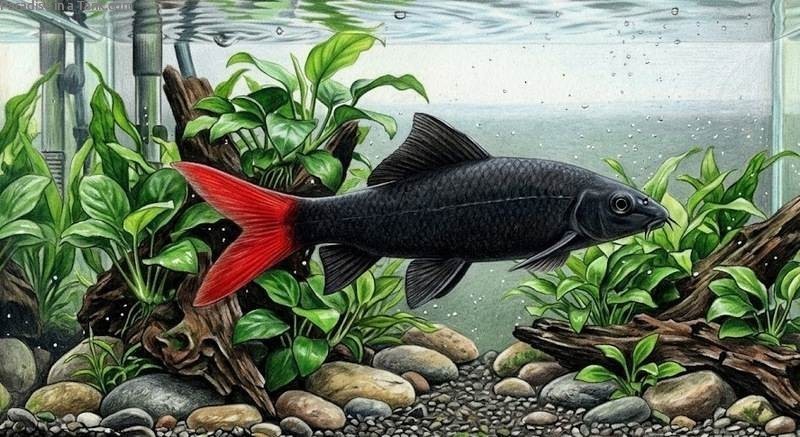
The Red Tail Shark is an absolute showstopper in the aquarium world, boasting a jet-black, velvet body that contrasts vividly with a brilliant crimson tail fin. The sharp, upright placement of their dorsal fin looks remarkably like a marine predator cruising the shallows, bringing a dramatic energy to your aquascape. However, beneath that stunning exterior lies a fiercely territorial creature that will absolutely not tolerate others of its own kind inside the same enclosure. If you attempt to house two of them together, they will engage in non-stop, violent combat until only one remains standing.
To manage their aggressive tendencies, you must carefully choose robust, fast-moving tankmates that inhabit different levels of the water column. You can successfully house them with medium-sized deep-bodied species or semi-aggressive companions that can hold their own without picking fights. However, you must never introduce tankmates with long, flowing fins, as the Red Tail Shark will relentlessly pester and nip at them. Reviewing a comprehensive aquarium fish compatibility guide will help you structure a peaceful community and prevent unnecessary territorial wars.
Rainbow Shark
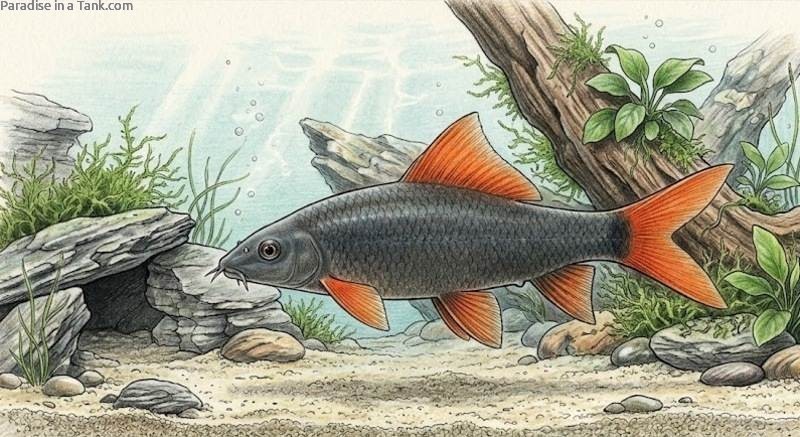
Though frequently confused with its red-tailed cousin, the Rainbow Shark possesses its own distinct, captivating look. While its body retains a dark, smoky coloration, every single one of its fins—including the dorsal, pectoral, anal, and caudal fins—is washed in a vibrant orange or red hue. Their physical profiles are also noticeably more streamlined and slender, giving them an incredibly fast, missile-like appearance as they dart across the substrate. Like most freshwater sharks, they are hardwired to defend their chosen feeding territories with intense ferocity.
Interestingly, you can actually keep multiple Rainbow Sharks in a single enclosure, provided the environment is exceptionally spacious and broken up by dense decorations. You must use piles of driftwood, smooth stones, and dense vegetation to create distinct territory lines that block their line of sight. If one shark cannot see the other, the urge to attack drops significantly, allowing them to coexist without constant bloodshed. If your setup is too small or barren, you run a severe risk of chronic stress, which frequently explains why aquarium fish died suddenly without showing any outward signs of physical disease.
Flying Fox Fish
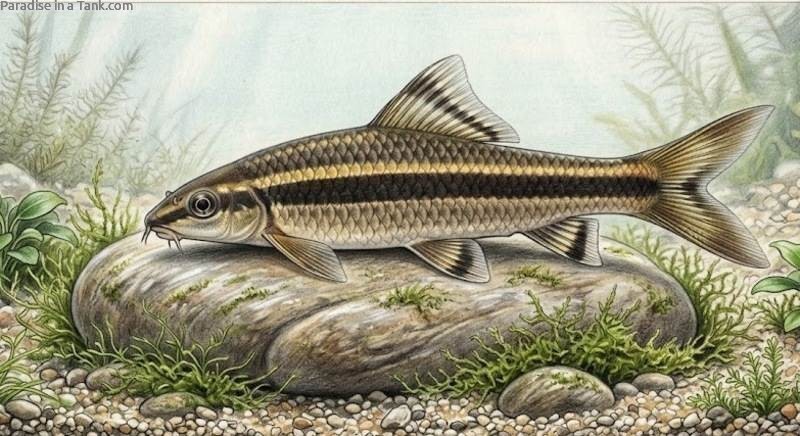
The Flying Fox Fish sports a highly elongated, torpedo-shaped frame designed perfectly for navigating fast, turbulent water currents. Their coloration is a masterclass in natural camouflage, featuring a dark olive or black upper body separated from a bright silver underbelly by a distinct, pale yellow lateral line. Their dorsal, anal, and caudal fins are highlighted by stark black patches, enhancing their predatory silhouette. These active swimmers spend their days constantly scanning surfaces, using their specialized mouths to rasp away at organic growths.
While juveniles are generally peaceful, mature Flying Foxes develop a strong territorial streak as they claim specific rock piles and caves. You can successfully keep groups together in large systems, but in smaller tanks, they will frequently chase and nip at one another. If you choose to keep a solitary individual, it makes an excellent addition to a community tank filled with robust, active species like danios, gouramis, and active loaches. Providing plenty of surface area for them to graze will keep them occupied and significantly reduce their desire to pester their neighbors.
Roseline Torpedo Shark / Denison Barb
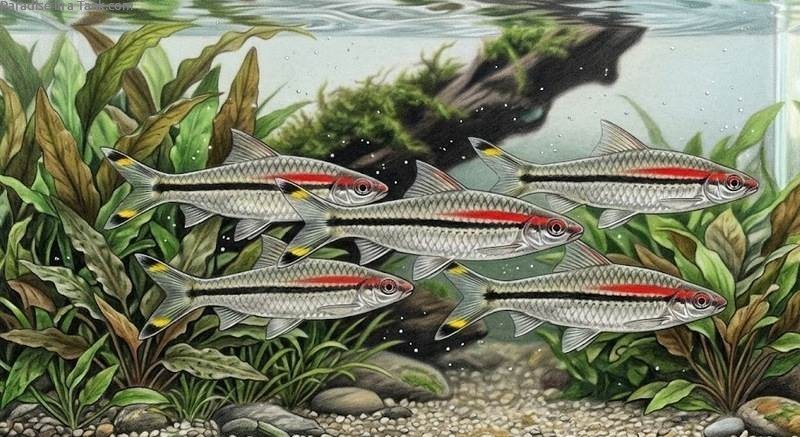
Commonly known to enthusiasts as the Denison Barb, this stunning creature is arguably the most colorful and visually breathtaking species on this list. Their bodies are a brilliant, shimmering silver, highlighted by a bold black lateral line that runs the entire length of their frame. Directly above this line sits a shocking, neon-pink stripe that starts at the snout and flashes backward, terminating right beneath a high, shark-like dorsal fin accented with a bright red tip. Their tail fins finish beautifully with distinct yellow and black tips, making them a true marvel to watch in motion.
Unlike the solitary sharks mentioned previously, the Roseline Torpedo Shark is an obligate schooling species that requires the comfort of its own kind to survive. You must keep them in groups of at least six or more individuals; attempting to keep just one or two will cause extreme psychological stress. Under chronic stress, these high-energy swimmers will rapidly lose their brilliant coloration, stop eating, and experience compromised immune systems. Because they love to dart through open water as a unified group, they are perfect candidates for large systems designed specifically for aquarium fish that swim in schools.
Harlequin Shark
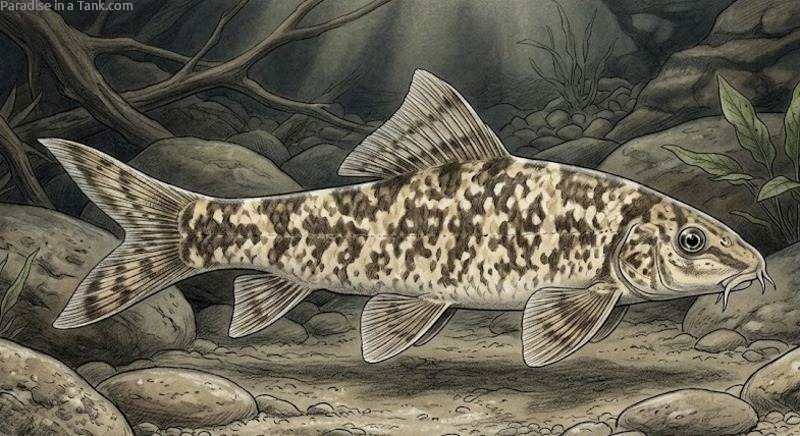
The Harlequin Shark is a master of structural eccentricity, featuring massive eyes in proportion to its head and an exceptionally tall, sail-like dorsal fin. Its body displays a beautiful, mottled pattern of deep black and shimmering old gold, creating a striking mosaic that extends all the way through its fins and tail. This unique camouflage allows them to blend perfectly into the shadows of heavily decorated aquariums. They are incredibly industrious fish, spending hours cleaning the environment by scouring surfaces for algae and microscopic biofilm layers.
Unfortunately, their visual beauty is matched by an incredibly combative and hostile personality toward anything they deem a competitor. The Harlequin Shark will display intense aggression toward similar-looking bottom dwellers, especially Red Tail and Rainbow Sharks, and they will absolutely detest their own kind. They require a dedicated custodian who understands how to provide complex rocky structures to satisfy their desire for isolation. If you give them a vast, intricate habitat to defend, their cleaning habits can provide a wonderful boost to your system’s overall health.
Silver Apollo Shark
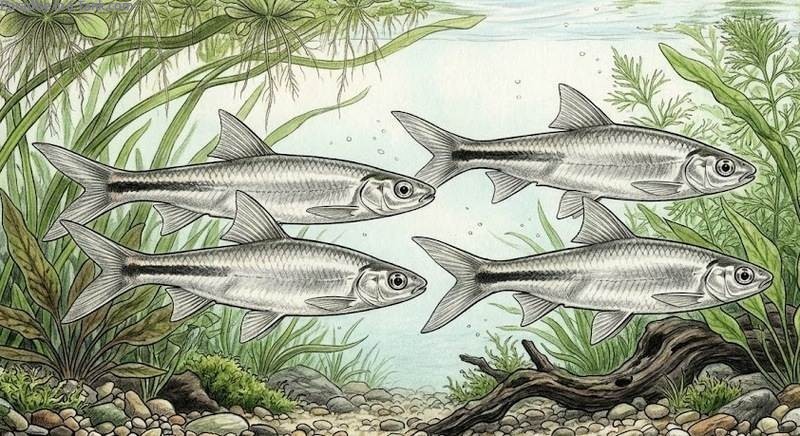
The Silver Apollo Shark looks like a living javelin, possessing an ultra-streamlined, slender body built for explosive bursts of speed near the water’s surface. Their scales shimmer with a highly reflective, metallic silver sheen, accented by a distinct black stripe that runs laterally before curving dramatically upward into the top half of the tail. A secondary matching line marks the bottom lobe of the caudal fin, creating a beautiful, symmetrical frame. These fish are true open-water athletes that require plenty of unobstructed swimming space to expend their massive energy reserves.
Because they are incredibly peaceful yet highly active, Silver Apollo Sharks must be kept in schools to ensure they feel safe and secure. You can easily house them alongside a wide variety of large, non-aggressive community tankmates, provided those tankmates are too large to be viewed as a snack. You must secure your aquarium with a heavy, tightly fitted lid, as these surface-dwelling speedsters are notorious jumpers when startled. Providing a steady water current via powerheads will mimic their native river habitats, keeping them physically fit and behaviorally content.
Giant Monster Species: Pond Fish That Look Like Sharks
Violet Blushing Shark
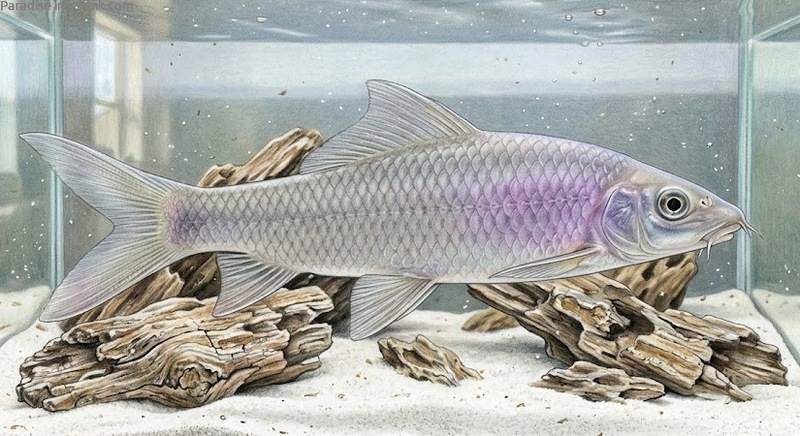
As we transition into species suited for massive systems, the Violet Blushing Shark stands out with its ethereal, almost ghostly physical appearance. Their scales feature a highly reflective, pinkish-silver sheen that catches the light beautifully, contrasted by delicate, semi-transparent fins and tails. Their most striking anatomical feature is their bright, vivid pink gill covers, which look as though the fish is constantly blushing. This unique, light coloration makes them pop dramatically when housed against dark substrates or inside heavily planted aquariums.
Do not let their delicate looks fool you; these are large, powerful, semi-aggressive fish that will easily outgrow standard home aquariums. They possess a strong schooling instinct but require massive amounts of physical space to maintain social hierarchy without injuring one another. Attempting to restrict them to small volumes will result in territorial fighting and severe stress-induced illnesses. They are best reserved for massive custom indoor systems or specialized outdoor ponds where they can cruise together in large, unified groups.
Silver Shark / Bala Shark
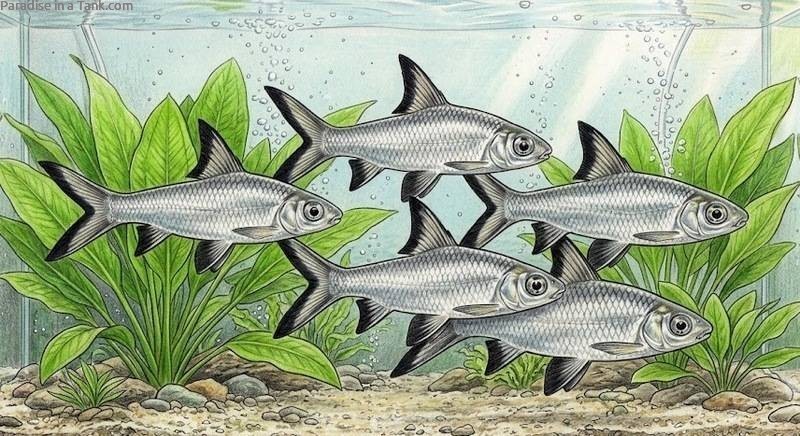
The Bala Shark is perhaps the most universally recognized shark look-alike in the entire pet industry, sporting a magnificent, high triangular dorsal fin that mirrors a marine predator. Their bodies are covered in large, armor-like silver scales that glisten intensely under bright lighting. The true beauty of this species lies in the stark, high-contrast coloration of their fins, which feature deep black outer borders surrounding clean, grey centers. They possess incredibly large eyes, allowing them to remain highly alert and visually track food items across vast distances.
The great tragedy of the Bala Shark is that they are frequently sold as tiny juveniles to unsuspecting keepers who have no idea of their true adult potential. These fish easily reach over a foot in length and are incredibly fast, skittish swimmers that can easily injure themselves by crashing into glass walls when spooked. They are classic examples of massive fish that will quickly overwhelm average home setups, requiring massive investments in space and filtration. Utilizing the benefits of live plants in aquariums can help create natural safety zones to calm their skittish nature, but a massive physical footprint remains mandatory.
Iridescent Shark / Siamese Shark
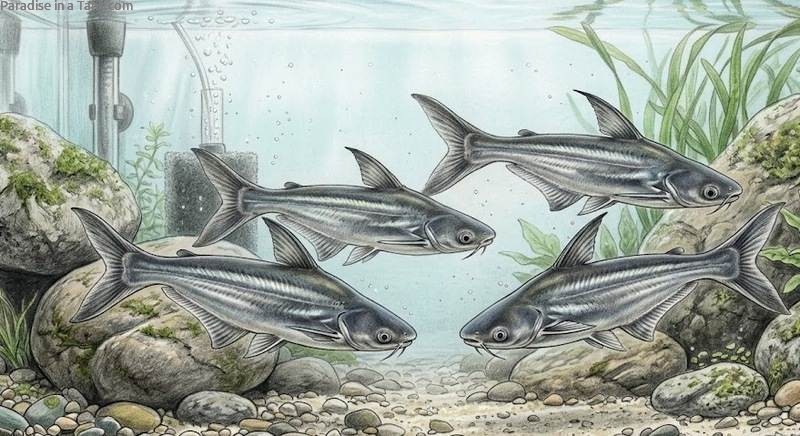
The Iridescent Shark is a true titan of the freshwater world, capable of easily exceeding four feet in length and weighing dozens of pounds at full maturity. When they are young, they display a beautiful, shimmering dark body accented by two brilliant silver stripes running laterally along their flanks. As they mature into adulthood, these bright juvenile lines completely fade away, leaving behind a massive, uniform charcoal-grey giant. While their dorsal fin is relatively small compared to their overall mass, their overall shape closely mirrors a predatory marine shark.
Keeping these gentle giants in a standard glass aquarium is completely impossible and represents a severe violation of basic animal welfare. They are exceptionally skittish, high-energy fish that will panic at sudden movements, frequently ramming into tank walls with enough force to cause fatal head trauma or shatter glass. They belong exclusively to the category of true giants, which you can learn more about in our guide on what are tankbuster fish, requiring massive systems or specialized tropical ponds containing thousands of gallons of water. Only under these massive, specialized conditions can these incredible giants swim safely without living in a constant state of terror.
Black Sharkminnow
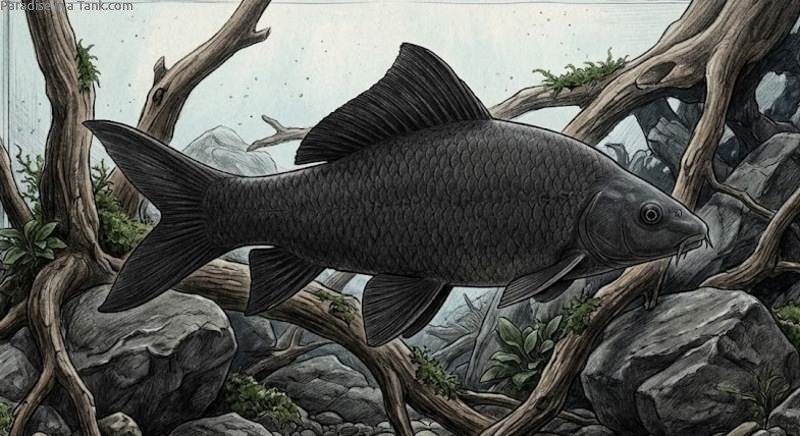
The Black Sharkminnow is a massive, imposing species that commands absolute authority inside any large-scale aquatic ecosystem. Reaching lengths of up to three feet, these fish possess massive, sweeping, jet-black fins that make their already heavy bodies look even larger and more intimidating. Their entire physical form is cast in a deep, uniform obsidian tone, creating a hauntingly beautiful silhouette as they patrol the depths. They are ancient, hardy survivors built to dominate their environment through sheer size and aggressive intent.
Because of their highly combative and territorial disposition, you can only house a single Black Sharkminnow per enclosure. They will relentlessly attack their own kind and any similarly shaped fish that dare to enter their preferred territory. However, you can successfully keep them in massive ponds alongside other giant, robust species that are large enough to ignore their bullying behavior. Managing such a massive animal requires heavy mechanical filtration and a disciplined schedule to prevent a dangerous rise in organic waste.
Chinese High Fin Banded Shark
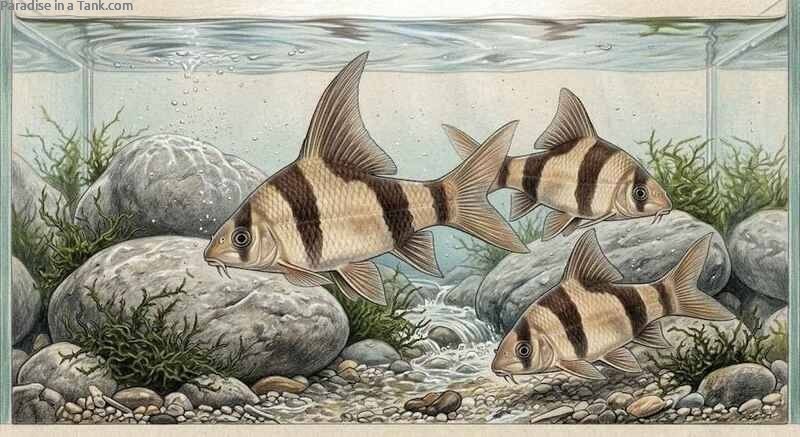
The Chinese High Fin Banded Shark is one of the most drastic examples of morphological transformation in the entire animal kingdom. As juveniles, they feature a towering, sail-like dorsal fin that stands incredibly high above a body marked with bold, high-contrast dark brown and cream bands. However, as they mature into massive adults reaching up to four and a half feet in length, their appearance shifts completely. Their magnificent dorsal fin shrinks significantly in proportion to their body, their striking bands fade into a uniform dusky color, and they develop thick, powerful frames.
Despite their intimidating adult size, these fish are incredibly gentle giants that will never actively hunt or harm their pondmates. They are highly social creatures that feel safest when kept in groups of three or more individuals, meaning their environment must be truly astronomical in size to support them. Furthermore, these are coldwater fish native to river basins that require cool, highly oxygenated water to thrive over their long lifespans. Providing them with a vast, specialized outdoor pond is the only way to responsibly watch this incredible evolutionary transformation unfold.
Siamese Algae Eater
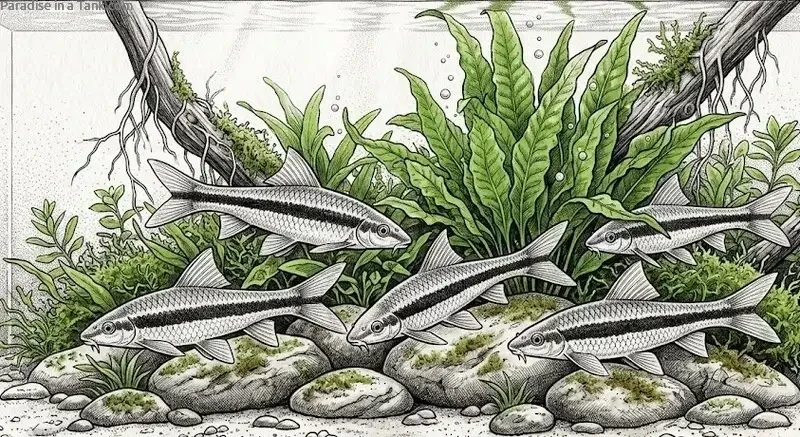
The Siamese Algae Eater is frequently confused with the Flying Fox Fish due to their remarkably similar body shapes and shared lateral striping. However, they are completely separate species with vastly different social behaviors and ecological roles. The Siamese Algae Eater features a sleek, silver body split by a prominent black line that runs from the nose all the way through the fork of the tail. Their fins and tails are almost completely transparent, lacking the dark pigment blocks found on their look-alike counterparts.
Unlike many territorial shark mimics, these industrious workers are highly peaceful and make fantastic additions to community aquariums. They work tirelessly to consume various nuisance growths, making them one of the most effective aquarium fish and invertebrates that eat algae. They are highly social and thrive when kept in small groups, moving together across the substrate to clean the environment. By providing them with a well-oxygenated tank and plenty of surfaces to graze, you will enjoy a peaceful, shark-like helper that actively improves the health of your aquatic home.