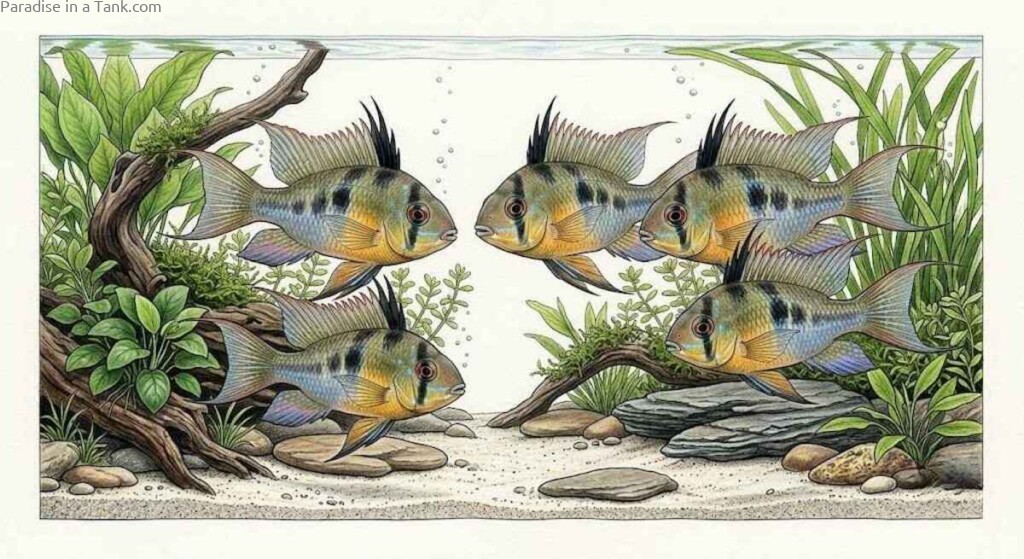
German Blue Rams max out at 2.0–2.5 inches (5.0–6.4 cm) in length, while Bolivian Rams grow slightly larger, reaching a maximum size of 3.0–3.5 inches (7.6–8.9 cm). Both species reach full maturity within 8–12 months when kept in optimized environmental conditions with strict nitrate management under 10 PPM.
Growth Trajectories and Mature Physical Dimensions
Size Benchmarks: Measuring the Compact Scale of Dwarf Cichlids
Understanding the physical boundaries of your fish is the first step toward becoming a responsible custodian rather than a reckless pet keeper. German Blue Rams (Mikrogeophagus ramirezi) and Bolivian Rams (Mikrogeophagus altispinosus) are categorized as dwarf cichlids, meaning they pack all the fiery personality and territorial awareness of large Central and South American cichlids into a beautifully compact frame. However, mistaking their small stature for low maintenance is the fastest way to trigger a catastrophic system failure.
A fully grown German Blue Ram typically plateaus at a modest 2.0 to 2.5 inches. In contrast, the hardier Bolivian Ram possesses a bulkier, deeper-bodied silhouette that pushes onward to 3.0 or even 3.5 inches under immaculate care. Females of both species consistently sit on the lower end of these spectrums, often measuring a full half-inch shorter than their male counterparts. When you observe them skimming the substrate, you are looking at an animal whose biological limits are set by millions of years of evolutionary pressure in slow-moving river systems—they cannot outgrow their genetic constraints, but poor husbandry will absolutely stunt them.
The Full Grown Timeline: Tracking Development Milestones from Juvenile to Adult
When you bring home a juvenile ram from the local fish store, you are typically purchasing a fish that is roughly 2 to 3 months old and hovering around 1.0 inch in length. At this stage, their colors are dull, and their true physical potential is locked behind the stress of commercial shipping and generic diets. The journey from a fragile juvenile to a robust, sexually mature adult occurs rapidly over a strict 8 to 12 month timeline, provided you do not sabotage their environment.
During the first 6 months of life, a young ram experiences its most dramatic skeletal expansion. They require clean water and high-frequency fueling to support this rapid tissue development. If their growth is interrupted by a spike in toxic compounds during this critical window, their internal organs will suffer permanent damage, resulting in a permanently stunted, short-lived fish.
| Timeline Milestone | Physical Signs to Watch For | Average Size Range |
|---|---|---|
| Juvenile (2–3 Months) | Pale coloration, transparent fins, high activity levels. | 1.0–1.2 Inches |
| Sub-Adult (5–6 Months) | Vertical bars darken, hints of blue or yellow iridescent sheen appear. | 1.5–2.0 Inches |
| Mature Adult (8–12 Months) | Full coloration, extended dorsal filaments, active pair-bonding behaviors. | 2.0–3.5 Inches |
Engineering the High-Sensitivity Enclosure System
Enclosure Footprints: Selecting Ideal System Spaces for Paired Colonies
You cannot compromise on the physical boundaries of your aquarium layout. While a single pair of German Blue Rams can technically survive in a standard 20-gallon long aquarium, a 30-gallon or 40-gallon breeder tank is the absolute minimum framework required if you want these animals to thrive. The reason comes down to floor space; dwarf cichlids are heavily bottom-oriented animals that establish two-dimensional territories across the substrate. A taller tank offers absolutely zero value to a ram that needs horizontal territory to escape the sightlines of its mate during periodic domestic disputes.
To correctly understand the social dynamics of these fish, check out our detailed breakdown of the different ram cichlid varieties to see how their wild origins dictate their domestic spacing needs. If you attempt to crowd multiple pairs into a cramped, narrow enclosure, the dominant pair will systematically pester, nip, and chase the weaker individuals until they are driven into chronic stress, which inevitably shuts down their immune systems and leaves them vulnerable to parasitic infections.
The Substrate Imperative: Utilizing Smooth Sand to Support Foraging Behaviors
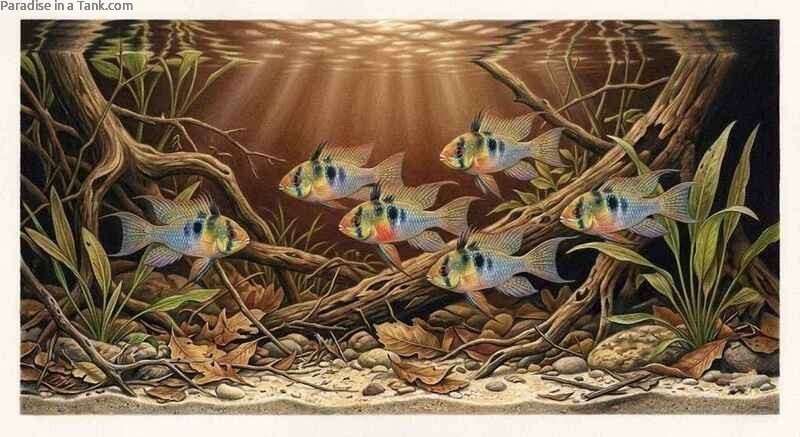
If you are keeping rams on coarse, jagged gravel, you are actively harming them. The genus Mikrogeophagus literally translates to “small earth-eater,” a direct nod to their ancient evolutionary foraging strategy. In the wild, these fish scoop up mouthfuls of loose sand, sift through the grains within their buccal cavity to extract microscopic organisms, detritus, and small invertebrates, and then expel the clean sand back through their gill slits.
When forced to live on sharp gravel, they cannot perform this instinctual behavior. Instead, they scratch their delicate mouths and damage their gill filaments on the rough rocks. These tiny micro-tears quickly become breeding grounds for opportunistic fungal and bacterial pathogens. Always line the bottom of your ram enclosure with a 2-inch layer of smooth, inert aquarium sand. This allows them to plunge their faces into the substrate safely, satisfying their primitive drive to sift and explore without the risk of physical mutilation.
Water Acuity Parameters: Maintaining a 6.0–7.0 pH and 26.0–30.0°C Thermal Matrix
German Blue Rams are biological precision instruments; they do not tolerate sloppy, unstable water chemistry. They have evolved to live in ultra-pure, acidic, and exceptionally warm waters. To keep them successfully, you must lock your system into a strict parameters matrix: a pH range of 6.0–7.0, a total water hardness (dGH) below 5, and a constant thermal environment maintained between 26.0–30.0°C. Bolivian Rams are slightly more forgiving, managing well in a pH up to 7.5 and temperatures around 24.0–27.0°C, but they still require absolute stability.
Operating an aquarium at 28.0°C or higher accelerates the metabolism of your fish, which means they process energy quickly and require clean, oxygen-rich environments. High temperatures also cause dissolved oxygen levels to drop naturally, meaning you must maximize surface agitation using high-quality air stones or surface skimmers. If you allow the pH to fluctuate rapidly or let the temperature drop into the low twenties, the sudden osmotic shock will paralyze the fish’s metabolic functions. Within 48 hours, you will see them pacing around the glass, thrashing against decor, and breathing heavily as their internal systems begin to collapse.
Nitrate Management Protocols: Preventing Stress in Sensitive Environments
Nitrate management is the ultimate barrier that separates casual fish keepers from disciplined custodians. While many common community fish can tolerate nitrate levels hovering around 30 PPM or 40 PPM for extended periods without showing immediate distress, dwarf cichlids will quickly deteriorate under those conditions. For German Blue Rams, any prolonged exposure to nitrate levels above 10 PPM acts as a slow-acting poison that degrades their vascular linings, suppresses their thyroid function, and leaves them completely defenseless against underlying infections.
To maintain this high-acuity environment, you must implement a strict maintenance routine consisting of weekly 30% to 50% water changes using conditioned water that closely matches your tank’s temperature and pH. You cannot rely on chemical media or quick-fix bottled solutions to clear out these organic compounds; you must physically remove the accumulating waste before the nitrogen cycle turns it into an overload of nitrate.
- Critical Water Quality Metrics to Monitor Weekly:
- Ammonia: Must remain at absolute 0 PPM. Any reading above zero indicates a failing biological filter.
- Nitrite: Must remain at absolute 0 PPM. This intermediate compound causes immediate cellular suffocation in dwarf cichlids.
- Nitrate: Must be maintained strictly under 10 PPM for German Blue Rams, and under 20 PPM for the hardier Bolivian Rams.
- Dissolved Oxygen: Must be maintained near saturation via aggressive surface agitation to support high-temperature metabolic rates.
If you want to ensure your rams are healthy enough to display their full adult size, read up on our guide to identifying male and female rams along with spawning behaviors to help you set up an ideal environment for long-term health. Additionally, ensuring a balanced diet is essential to power this rapid development; take a look at our comprehensive ram feeding protocols and tank mate selection strategy to make sure your fish are getting the clean, high-protein nutrients they need to reach their maximum growth milestones safely. By mastering these environmental fundamentals, you will build a pristine, stable ecosystem where your dwarf cichlids can live out their full evolutionary potential.