Visual Sexing Identifiers: Spotting the Physical Differences
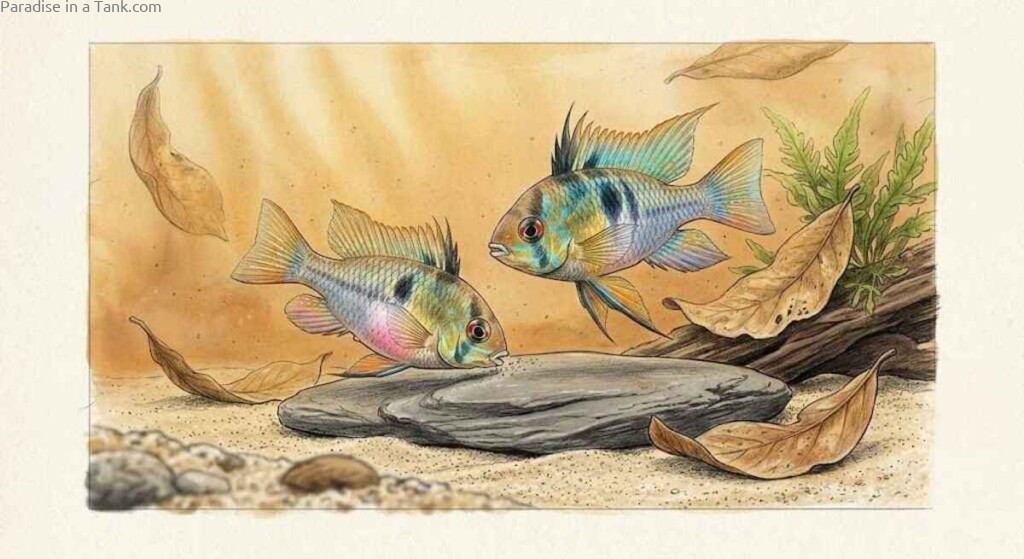
To identify female vs. male German Blue Rams, look at the belly coloration and dorsal fin shape. Females feature a distinct magenta or pinkish belly patch, and their blue iridescent scales run completely through the black shoulder spot. Males grow larger, develop long, extended front dorsal fin rays, and lack blue scales inside their solid black shoulder spot.
Distinguishing between the sexes of Mikrogeophagus ramirezi is a critical skill if you want to move past casual keeping and become a disciplined custodian of these stunning cichlids. These dwarf cichlids carry an evolutionary heritage rooted in the warm, soft, slow-moving waters of the Orinoco River basin in Venezuela and Colombia. In the home aquarium, trying to guess their gender without understanding their anatomical development leads to unnecessary territorial fights and broken breeding expectations.
When you stroll up to a local fish store tank, you are often looking at juvenile specimens that are severely stressed, washed out, or artificially pumped with hormones to enhance color. True visual sexing requires you to look closely at specific physical indicators that mature as the fish reach sexual readiness. If you want to dive deeper into the different color variants and options available before setting up your breeding pairs, checking out the ultimate ram cichlid guide will give you a comprehensive understanding of the broader family tree.
Understanding their physical growth trajectory is equally vital to setting up a healthy ecosystem. Juvenile fish under 4 months old will rarely display reliable sexual traits, meaning you have to wait until they cross the threshold of early maturity before pairing them off. For an accurate breakdown of standard growth metrics, adult lengths, and how they stack up against their hardier cousins, consult our data on German Blue and Bolivian Ram size differences to ensure your tank offers enough spatial volume for adult behaviors.
The Ventral Check: Analyzing the Classic Magenta Belly Patch in Females
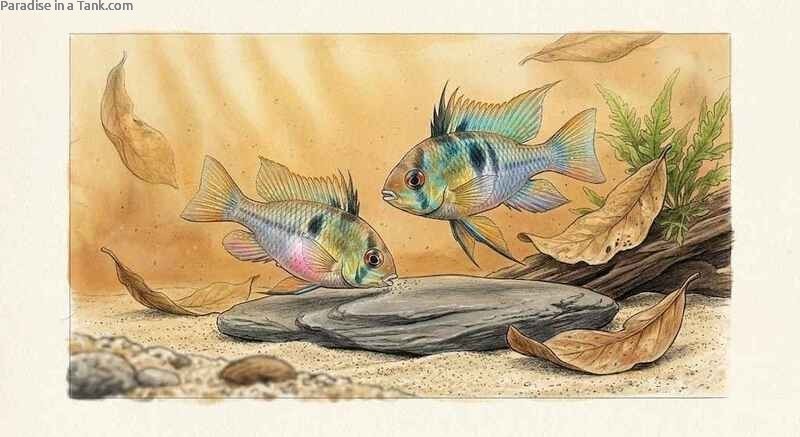
The single most reliable, anatomically absolute way to spot a female German Blue Ram is the presence of a distinct ventral color pattern. As a female approaches sexual maturity, her lower abdominal wall thins and vascularizes, creating a rich, blushing magenta or pink belly patch. This is not a subtle hint; it is a vibrant, unmistakable warning light that her body is actively shifting resources toward egg production.
Furthermore, you must look directly at the large black spot located on the flank of the fish, right below the first few spines of the dorsal fin. In a female ram, the glittering, iridescent blue scales will run completely across and inside this black spot like scattered glitter. In contrast, a male’s black flank spot remains solid, dark, and utterly devoid of these blue spots, serving as a clean biological negative space.
| Sex Identification Metric | Female Characteristic | Male Characteristic |
|---|---|---|
| Abdominal Coloration | Displays a vibrant pink, violet, or deep magenta belly patch. | Abdomen remains uniformly yellow, white, or silver-blue. |
| Flank Spot Iridescence | Electric blue metallic scales run completely through the black spot. | The black shoulder spot is solid and free of blue scales. |
| Overall Silhouette | Stouter, rounder, and noticeably more compact body shape. | Streamlined, elongated, and grows up to 35% larger overall. |
| Ventral Papilla (Tube) | Short, wide, blunt ovipositor tube visible during spawning phases. | Sharp, narrow, and angled backward toward the anal fin. |
During the heat of spawning prep, the female’s ventral region will swell noticeably as her ovaries fill with unfertilized eggs. You will observe her behavior change from passive grazing to a restless patrolling of the tank bottom. If your tank conditions are subpar, with a pH floating above 7.5 or nitrate buildup climbing past 20 ppm, this pink coloration will fade rapidly as the fish enters a state of physiological stress, hiding her true identity from your eyes.
Fin Ray Architecture: Differentiating Elongated Dorsal Extensions in Males
If the belly coloration leaves room for doubt, the structural architecture of the fins provides the next layer of definitive proof. Male German Blue Rams possess highly modified fin structures that evolved as visual flags designed to intimidate rival males and charm passing females. Look directly at the anterior crest of the dorsal fin, specifically the second and third fin rays.
In a dominant, mature male, these specific rays stretch out into long, dramatic, jet-black filaments that tower high above the rest of the fin membrane like proud feathers. The posterior edges of both the dorsal and anal fins also taper into sharp, elongated points that frequently extend well past the base of the caudal peduncle.
Females keep things much more practical and compact. Their second and third dorsal rays are noticeably shorter, maintaining a neat, uniform crest that mimics the natural curve of their bodies, while their anal and dorsal fin tips remain blunt and rounded.
Be warned, however, that looking only at fin extensions can fool you if you are managing a crowded community tank. Submissive or bullied males will actively suppress their extensions, clamping their fins tight against their backs to blend in and avoid taking nasty bites from the dominant territory holder.
Courtship Mechanics and Egg-Laying Site Selections
Once a true male and female lock eyes and claim a territory, their behavior transforms from simple cohabitation into an intense, highly synchronized courtship ritual. This is where you see their ancient evolutionary programming fire up in real-time. The pair will begin a complex dance consisting of rapid head-twitching, intense body shivering, and lateral displays where they flare their gill covers and expand their fins to gauge each other’s physical fitness.
Do not mistake this high-energy posturing for outright aggression. While they may pester and nip at each other occasionally to establish pair bonds, true courtship focuses heavily on mutual environmental modification.
They will swim side-by-side across the substrate, searching for the perfect geographical anchor point to deposit their future brood. To keep their energy levels high during this exhausting courtship phase, you must provide a high-protein, easily digestible diet. Discover how to fuel these high-intensity behaviors by checking out our guide on Ram Cichlid feeding regimens and community tank mate selection to ensure your breeding pair does not starve out during the process.
Visual Hardscape Preparation: Utilizing Flat Stones and Hidden Terracotta Zones
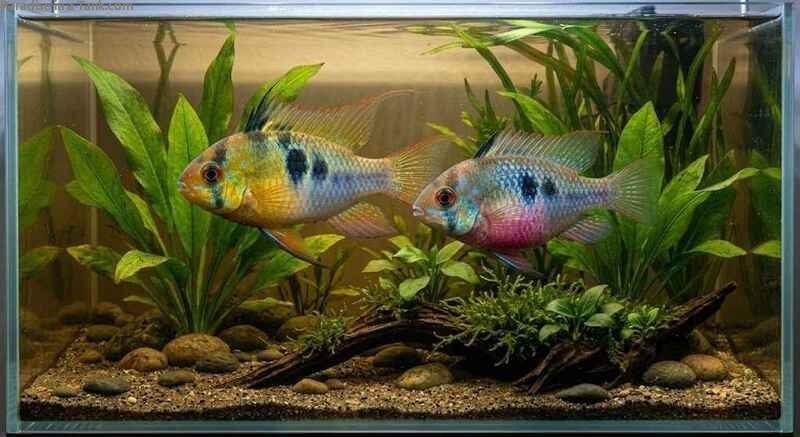
German Blue Rams are open-substrate spawners that require a highly specific, solid foundation to cement their adhesive eggs. They will completely ignore soft, shifting sands or jagged gravel when it comes time to lay. Instead, the pair will select a smooth, flat surface—such as a weathered piece of slate, a flat river stone, or the smooth interior lip of a fallen terracotta pot.
Once the site is chosen, both the male and female turn into meticulous, tireless cleaners. They will spend hours using their mouths to scrape, pick, and clear away any encroaching organic film, detritus, or algae from the rock surface.
You will see them repeatedly bite and spit out grains of sand from the area, ensuring the surface is perfectly prepped so their adhesive eggs can bind directly to the stone without getting suffocated by rotting debris or fungal spores.
If you fail to provide these flat hardscape elements, the pair will become visibly frustrated and stressed. They may resort to digging deep pits in the substrate all the way down to the bare glass bottom of the tank, exposing their future eggs to poor water flow and opportunistic pathogens.
Brood Defenses: Managing Territorial Boundaries in Shared Enclosures
The moment the first egg hits the stone, a switch flips inside the rams’ primitive brains, turning them into fierce, uncompromising defenders of their tiny realm. The female will press her belly flat against the rock, depositing rows of translucent, amber-colored eggs in a neat circular pattern, while the male follows closely behind to fertilize them.
Once the spawning event wraps up, the pair shares defensive duties, dividing their labor to protect the clutch from anything that moves. One partner will hover mere millimeters above the eggs, constantly fanning them with their pectoral fins to keep oxygen-rich water moving over the clutch and prevent harmful bacteria from settling in, while the other patrols the outer perimeter.
In a shared community aquarium, this defensive behavior can quickly turn the tank into a war zone. The rams will mercilessly launch themselves at tank mates ten times their size, thrashing and nipping at any curious tetras or bottom-dwelling corydoras that wander too close to their border lines.
| Spawning Defense Phase | Behavioral Signs to Watch For | Risk Management Action |
|---|---|---|
| Egg Fanning (Days 1–3) | Continuous pectoral fin waving directly over the stone surface. | Maintain low light and avoid changing hardware configurations. |
| Wiggler Relocation (Days 4–5) | Parents dig shallow pits and spit hatched larvae into sand depressions. | Cover all exposed filter intakes with dense pre-filter sponges. |
| Free-Swimming (Days 6+) | Parents guide a hovering cloud of fry along the tank floor. | Use visual barriers like driftwood to block lines of sight. |
If you do not provide thick patches of live plants, dense driftwood root structures, or tall rock formations to break up visual lines of sight, the constant stress of defending their brood from tank mates will eventually break the parents’ resolve. When pushed to their psychological limits by constant perceived threats, the stressed parents will often make a sudden, horrifying defensive choice: they will turn around and gobble up their own eggs or wriggling fry to keep those resources from falling to outside predators.
Fry Care Optimization: Formulating Rations for Free-Swimming Offspring
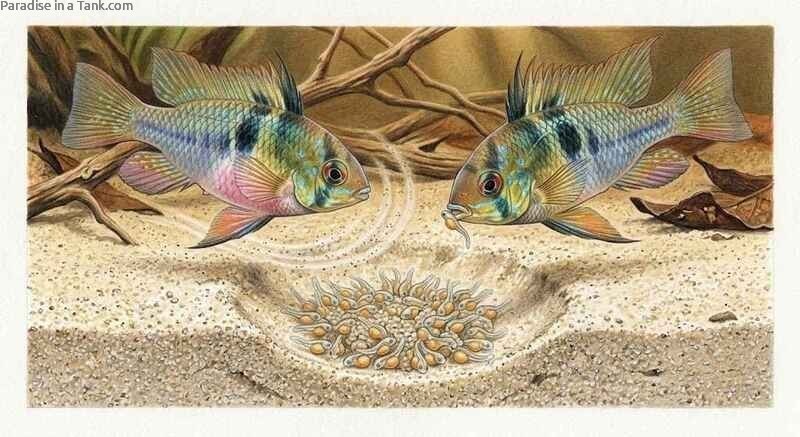
Roughly 3 to 5 days after the initial spawn, the eggs will hatch into what keepers call “wigglers”—tiny, vibration-heavy larvae that cannot swim yet and remain anchored to the spot via a temporary yolk sac. During this delicate phase, the parents will often pick up the wigglers in their mouths and move them between pre-dug sand pits to keep opportunistic microbes off balance.
The true test of your husbandry skills arrives around day 6, when the fry completely consume their yolk sacs and rise up into a hovering, free-swimming cloud of miniature fish. These fry are microscopic, incredibly fragile, and completely incapable of swallowing standard crushed flakes or commercial pellets.
To keep them alive, you must cultivate a continuous supply of live, microscopic foods. Your front-line weapon is freshly hatched Artemia nauplii (Baby Brine Shrimp), harvested within 24 hours of hatching when their nutritional yolk sacs are richest in vital lipids.
Feed the fry cloud at least 3 to 4 times a day using a long pipette to gently puff the food directly into their swimming zone. You must accompany this heavy feeding schedule with rigorous water quality control.
Because fry require immaculate water to grow, keep a close eye on your parameters; letting ammonia or nitrite creep past 0 ppm, or allowing nitrate to climb above 10 ppm, will quickly wipe out the entire spawn overnight. Perform small, daily 10% water changes using aged, temperature-matched water, dragging your siphon line carefully to avoid sucking up the tiny, vulnerable fish. With patience, clean water, and disciplined feeding habits, you will watch that tiny hovering cloud mature into a stunning, vibrant next generation of cichlids ready to rule their own aquatic domains.