An Introduction to Thorichthys meeki
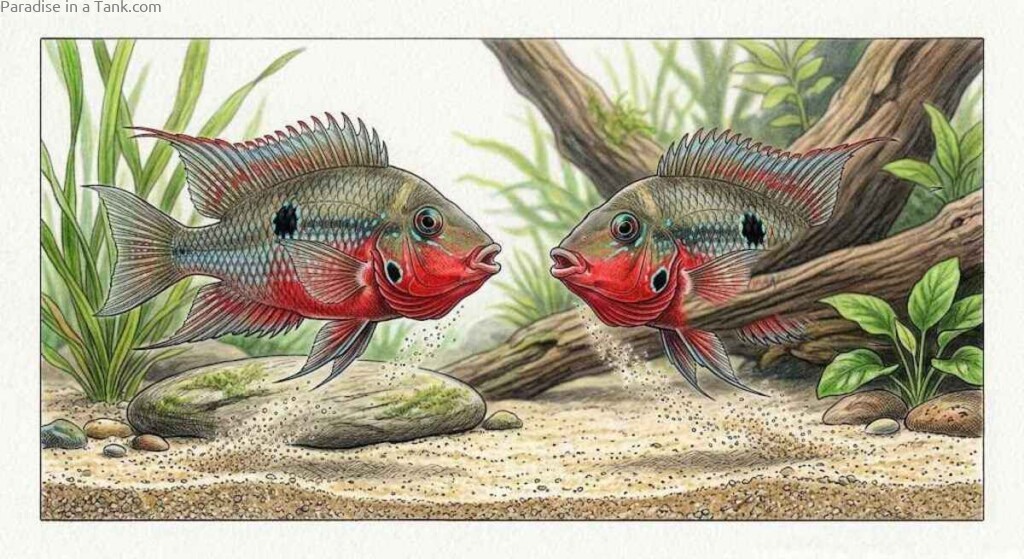
The Firemouth Cichlid (Thorichthys meeki) is a classic Central American freshwater fish known for its fiery red gular throat, striking operculum eye-spots, and territorial flare displays. Thriving in temperatures of 75–82°F, a pH of 7.0–8.0, and water hardness of 10–20 dGH, this species requires clean water, soft substrate, and structured territory.
Few aquarium fish command a room quite like a fully mature Firemouth Cichlid firing on all cylinders. You step up to the front glass, and instantly, this fiery six-inch gladiator drops its branchiostegal membrane, expands its throat into a crimson balloon, and stares you down with intense iridescent blue eyes. It is pure theater. Yet behind that explosive posturing sits one of the most misunderstood, remarkably adaptable Central American cichlids in the entire hobby.
If you have ever brought one of these beauty-and-brawl species home only to watch it sulk in a corner, fade to a washed-out gray, or persistently tear up your expensive rooted aquatic plants, you are not alone. I have been right where you are standing, questioning if my water parameters were completely broken or if I had bought an unnaturally aggressive monster. The truth is simple: Thorichthys meeki does not adjust its ancient genetic wiring to fit our sterile glass boxes. We have to build an ecosystem that respects millions of years of evolutionary history.
Understanding their physical needs requires stripping away the clinical aquarium manual nonsense and getting down to raw biology. When you feed them the wrong food, lock them in cramped quarters, or force them onto sharp gravel, they suffer quietly until bacterial infections or stress kill them. Once you master their environmental cues, you unlock a dynamic creature that displays mesmerizing parental care, vivid coloration, and endless personality without slaughtering every tankmate in sight.
Evolutionary History: The Central American River Heritage
To truly grasp what makes Thorichthys meeki tick, you have to look at where its bloodline was forged. These cichlids are native to the Yucatan Peninsula of Mexico, extending down through northern Guatemala and Belize. These are not dark, slow-moving Amazonian blackwater rivers packed with decaying leaves and soft, acidic water. Instead, they hail from slow-flowing river systems, limestone-rich cenotes, spring-fed ponds, and quiet canal bottoms carved through mineral beds.
Because their natural waters carve through dense limestone shelf rock, Firemouths evolved in exceptionally hard, alkaline water with a steady pH range between 7.0–8.0 and general hardness levels floating between 10–20 dGH. Their natural habitats feature wide, shallow banks littered with fine silty sand, scattered river stones, waterlogged timber, and dense patches of detritus. The current is usually gentle to moderate, giving these fish ample room to sift through sandy substrate without fighting rushing rapids.
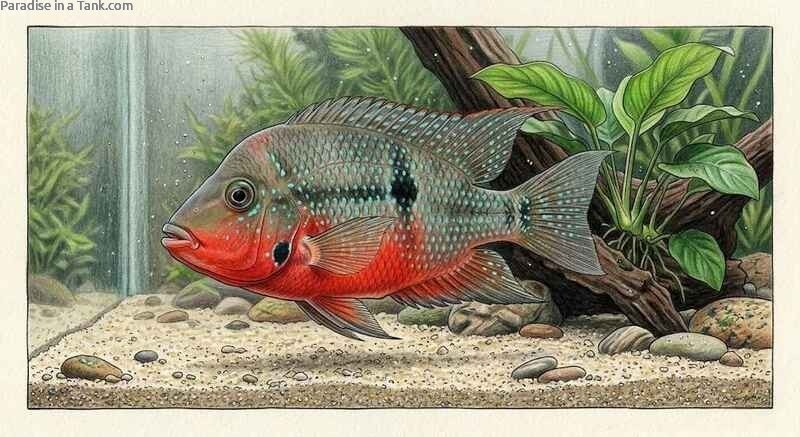
In these wild river networks, water clarity ranges from crystal-clear spring pools to murky, sediment-heavy shallows during heavy seasonal rainstorms. Firemouths spent millions of years carving out a niche as benthivorous sifters and micro-predators, constantly plunging their snouts into soft riverbed silt to pick out tiny crustaceans, insect larvae, worms, and organic debris. Every physical attribute they possess—from their downward-slanted jaw structure to their brilliant flared gill covers—is an evolutionary tool designed to keep them fed and defended against larger river monsters.
When you bring a Firemouth into your home, you are taking custody of a wild lineage hardwired for resource competition in muddy river pockets. If you drop them into soft, acidic water with zero dissolved minerals, their metabolic systems struggle to handle osmotic balance. Beneficial biological bacteria like Nitrosomonas and Nitrobacter break down waste in the filter, but managing nitrate buildup relies on you. Nitrates build up, their immune systems crash, and pathogenic bacteria swiftly invade their slime coat. Respecting their ancestral river heritage is not optional; it is the fundamental baseline of keeping them alive for a decade or more.
Morphological Identifiers: Spotting the Brilliant Red Throat and Operculum Markings
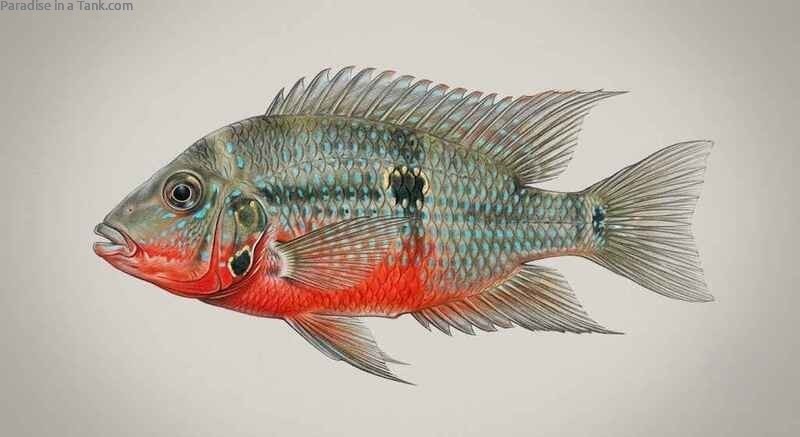
The defining physical feature of Thorichthys meeki is, without a doubt, the breathtaking fiery red pigmentation that saturates the underside of the jaw, lower gill covers, and belly. This intensely bright red coloration is not just for visual show; it is an active survival and communication mechanism. During high-stress interactions or territorial boundary disputes, the Firemouth lowers its hyoid apparatus and extends its branchiostegal membranes outward, creating an illusion of a massive, bloody gaping mouth designed to intimidate rivals.
On the sides of their gill covers, you will notice a dark, iridescent black spot encircled by a shimmering metallic gold or turquoise ring. This physical marking is known as an operculum eye-spot, or ocellus. In nature, when a Firemouth flares its throat toward an opponent, these dual eye-spots stretch outward laterally, mimicking the face of a much larger, highly dangerous predator. It is a brilliant biological bluff that allows them to win territorial standoffs without having to engage in violent, physical jaw-locking battles that could leave them crippled.
Beyond their throat and gill markings, the body of Thorichthys meeki displays an intricate palette of silvery-blue and olive-grey base scales, overlaid with 5–7 dark vertical bars running down the flanks. Depending on the fish’s mood and dominant status, a dark horizontal lateral band may also stretch from behind the eye straight to the tail root. Their dorsal, anal, and caudal fins are edged in bright red margins and flecked with spangles of electric turquoise that flash brilliantly under direct lighting.
Understanding their body language prevents owner panic. When a Firemouth drops its dark bars and washes out to a pale silver-gray, it is communicating acute distress, illness, or submissive retreat from a dominant bully. Conversely, when its throat turns a deep, blood-red hue and its vertical bars darken into crisp obsidian, your fish is asserting total dominance and peak health. Paying close attention to these vivid visual cues allows you to catch water quality shifts or social bullying long before physical damage occurs.
Distinguishing Key Varieties and Profiles within the Species
- The Classic Red Standard: Analyzing the natural primary color distribution.
The typical commercial Firemouth Cichlid represents the classic Central American wild profile, featuring a rich, saturated salmon-to-vermilion throat that extends past the pelvic fins. In high-quality specimens, the lower half of the head and entire abdomen glow with dense red lipochrome pigments, while light blue scales form a peppered pattern along the middle flank. Their body scales retain a solid metallic luster under 6,500K daylight LED illumination. Ensuring proper coloration requires providing a clean environment and high-grade nutrients, which you can explore in detail through our firemouth cichlid diet and feeding routine guide. Maintaining this vivid coloration in standard wild-type lines comes down to diet and stress management. When fed poor-quality cereal flakes lacking natural carotenoids, that intense red throat rapidly fades into an unsightly, dull pale orange. Furthermore, maintaining pristine water chemistry with zero detectable ammonia, zero nitrite, and nitrate levels kept strictly under 20 PPM keeps their slime coat crystal clear, allowing those iridescent turquoise scale highlights to reflect light at maximum intensity. - The Rare Variations: Identification markers for localized geographic variants and distinct color morphs.
While the classic red standard dominates the hobby, dedicated collectors often seek out distinct geographic variants harvested from isolated river systems in Central America. For example, specimens collected from the El Petén region of Guatemala frequently exhibit a deep, blood-crimson underside that extends all the way back to the peduncle, accompanied by darker, almost black vertical striping. Meanwhile, populations from certain Mexican cenotes display a softer, neon-orange throat with significantly denser turquoise spangling across the cheeks and forehead. Genetic line-breeding in captivity has also produced specialized color morphs, including xanthic (yellow-bodied) variations and high-coverage blue forms where the metallic spangling covers over 80% of the body flanks. These unique variations often carry distinct growth expectations and subtle temperamental differences, which you can analyze further in our comprehensive female vs male firemouth cichlid identification traits directory. Inspecting localized variants closely reveals subtle head shape differences, with riverine populations showing more streamlined, elongated snouts built for digging against currents. - Sexing Profiles: Visceral physical markers to tell males from females.
Determining the sex of Thorichthys meeki can be challenging with juveniles, but mature adults display stark, unmistakable physical differences. Dominant adult males grow noticeably larger, reaching lengths of up to 6 inches, and develop a higher, steeper dorsal profile with a slight nuchal hump behind the forehead. Their dorsal and anal fin rays extend into dramatically long, flowing filament points that trail past the base of the tail fin. Furthermore, male coloration is significantly more intense, showing deeper red throats and glowing cheek spangles.
| Physical Attribute | Adult Male Profile | Adult Female Profile |
|---|---|---|
| Maximum Body Length | Reaches 5.5–6.0 inches at full maturity. | Maxes out smaller at 3.5–4.5 inches. |
| Fin Morphology | Dorsal and anal fins end in long trailing filaments. | Fins are rounded without extended extensions. |
| Throat & Belly Pigment | Intense, deep blood-red extending past pelvic fins. | Paler, muted salmon-red confined to the lower jaw. |
| Venting Shape | Narrow, pointed genital papilla angled backward. | Wide, blunt, cylindrical genital papilla when egg-laden. |
Females remain considerably smaller and stockier, rarely exceeding 4.0–4.5 inches in total length. Their dorsal and anal fins are visibly rounded at the tips, lacking the dramatic trailing extensions seen on males. Female throat coloration is generally more muted, taking on a soft salmon or orange tint rather than a fiery crimson. During breeding cycles, a female's abdomen turns noticeably plump, and her ovipositor extends as a short, thick, blunt tube, whereas the male's genital papilla remains a tiny, sharp, backward-pointing cone.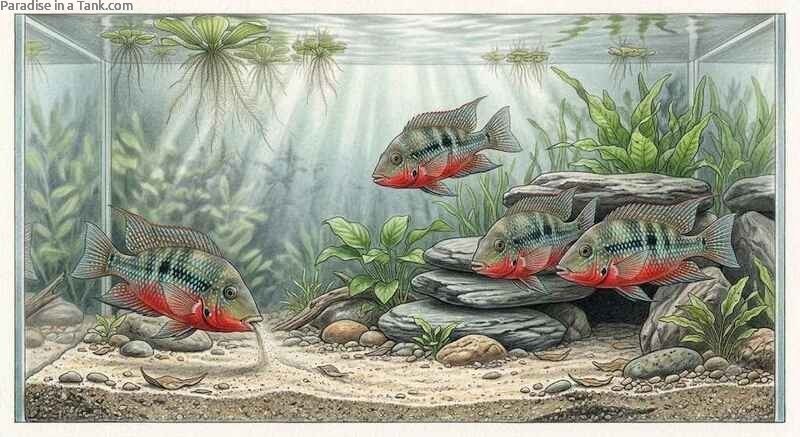
General Tank Layout and Natural Territory Management
Designing an aquatic home for Firemouth Cichlids requires a deep appreciation for territorial dynamics and physical substrate needs. You cannot simply throw a pair into a bare glass box with a handful of sharp gravel and expect peace. To give a single Firemouth or a bonded pair room to establish clear boundaries, explore our complete firemouth cichlid tank size and growth requirements guide to plan your long-term setup accurately. Proper spatial planning eliminates constant aggression and gives your fish room to display natural behaviors.
The substrate you choose is literally a matter of life and death for this species. Because Firemouths are natural sand-sifters, you must use smooth, fine-grained pool filter sand or natural aquarium sand. Do not use coarse, sharp-edged epoxy-coated gravel. When Firemouths plunge their mouths into sharp gravel to sift for food, the rough edges slice their delicate gill filaments and mouth tissue, opening up direct pathways for severe fungal infections and mouth rot. A smooth sand bed allows them to scoop, sift, and spit substrate naturally without suffering tissue damage.
- Substrate Selection: Use fine, smooth river sand at a depth of 2–3 inches to allow natural digging and sifting behavior.
- Hardscape Territory Dividers: Position smooth granite river rocks, dark slate caves, and twisting driftwood roots to break direct sightlines across the tank length.
- Planting Strategy: Opt for tough, hardy epiphytes like Anubias or Java Fern tied securely to wood; rooted plants will be relentlessly uprooted during territorial excavations.
- Filtration & Flow: Employ heavy canister filtration providing 6–10 times tank volume turnover per hour with moderate surface movement to handle high bio-load without blustering the fish.
Territory structure is your best weapon against domestic cichlid violence. Use tall pieces of driftwood, smooth slate slabs, and large river stones to divide the bottom footprint into distinct visual zones. If two territorial males can lock eyes constantly from opposite ends of the aquarium, they will spend all day pacing the glass and fighting along the boundary line. Creating visual barriers allows each fish to claim its own cave or rock pile, reducing encounters to occasional theatrical flared-throat bluffs rather than shredded fins and missing scales.
Lighting should be kept soft and dim, or shaded using floating plants like Frogbit or Salvinia. Bright, harsh lighting makes Firemouths extremely skittish, causing them to bolt into rocks and pale out their magnificent colors. Pair moderate lighting with heavy mechanical and biological filtration to handle their messy eating habits and steady waste production. Keep up with 30–50% weekly water changes, vacuuming away trapped food debris from the sand surface to prevent ammonia spikes and dangerous nitrate accumulation.
When you respect their biology, honor their Central American river heritage, and construct an environment tailored to their natural instincts, the Firemouth Cichlid will reward you with years of captivating behavioral displays. Keep your water clean, your substrate soft, and your territories clearly defined, and you will enjoy one of the most magnificent, iconic showstoppers the freshwater hobby has ever known.