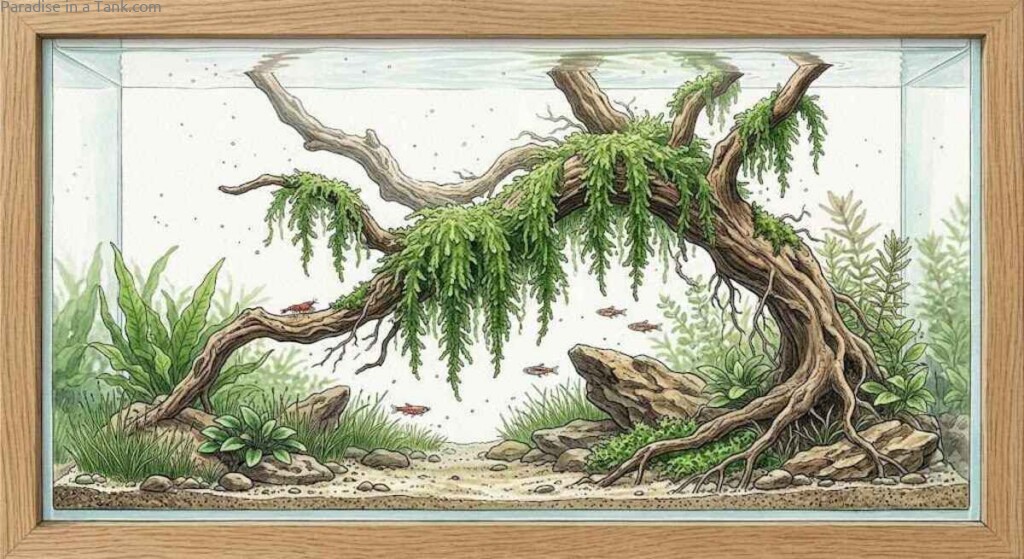
Selecting the right aquatic moss depends on your specific aquascaping goals, lighting levels, and maintenance commitment. Java Moss offers an indestructible, fast-growing shelter ideal for breeding setups; Christmas Moss produces dense, pine-like fronds for intricate walls; Flame Moss provides striking vertical growth for hardscape contrast; and Weeping Moss creates dramatic, downward-arching willow effects.
Java Moss (Taxiphyllum barbieri) Profile
- Appearance & Texture: Stringy, chaotic, and disorganized growth.
Java Moss (Taxiphyllum barbieri) does not care about symmetry, neatness, or aesthetic elegance. Left to its own devices, it explodes in a tangle of thin, stringy stems that branch out wildly in every direction. The stems are wrapped in micro-scale leaves that feel slightly rough and wire-like to the touch. Rather than forming clean, lush cushions, it weaves itself into a dark green, dense mat that looks like an underwater bramble patch. This raw, unkempt structural habit is not a flaw; it is an evolutionary survival design that creates thousands of micro-crevices.
In a natural habitat, this chaotic tangling serves as an biological catch-all, trapping drifting organic particulates, detritus, and microscopic organisms. Within your home aquarium, that same tangled mesh becomes an immediate sanctuary for vulnerable inhabitants. Baby shrimp and freshly hatched fish fry scamper deep inside the dark matrix where larger predators physically cannot wedge their jaws. However, if you let it run wild without periodic trimming, the inner core of the mass will eventually get choked off from light and water flow. When that happens, the bottom layers rot into a brown, sludgy mass that releases accumulated waste back into the water column.
- Growth Rate & Care Level: Extremely fast; nearly indestructible.
If you are looking for a plant that thrives on neglect and survives catastrophic aquatic mistakes, this is your baseline standard. Java Moss grows at a relentless pace under almost any tank condition. It flourishes in low-light environments with as little as 10–15 PAR, requires zero supplemental CO2 injection, and tolerates water parameters ranging from a pH of 6.0–8.0. It adapts to temperature ranges from 18–28°C without skipping a beat, making it equally comfortable in unheated shrimp tanks or warm community aquariums.
Because of its rapid cellular growth, Java Moss functions as a natural bio-filter by continuously pulling excess nutrients directly from the water column. It rapidly absorbs biological waste products, helping you stabilize dissolved compounds and prevent sudden nitrate buildup between routine maintenance cycles. You can literally throw a handful of this moss loose into a bare-bottom tank, ignore it for a month, and return to find it doubling in size. The only real threat to Java Moss is suffocating hair algae or heavy sediment accumulation, which smothers its microscopic rhizoids and prevents nutrient uptake through the leaves. To explore broader aquatic plant options and husbandry strategies, check out our comprehensive guide to freshwater aquarium mosses for long-term tank success.
- Best Use Case: Breeding tanks, shrimp tanks, and beginner setups.

Given its rugged resilience and chaotic growth habit, Java Moss excels in utility-focused aquarium setups rather than high-end contest aquascapes. It is the absolute gold standard for dwarf shrimp breeding tanks, providing an endless foraging surface where juvenile Neocaridina and Caridina shrimp can continuously graze on rich bio-films. The sheer density of the vegetation guarantees survival rates for tiny hatchlings that would otherwise be gobbled up by adult fish.
Egg-scattering fish species, such as Danios, Tetras, and Barbs, benefit immensely from a floor carpeted with Java Moss. Female fish drop their eggs over the tangled mesh, allowing the heavy adhesive eggs to fall deep into the safety of the foliage before the parent fish can turn around and devour them. Furthermore, if you are a absolute beginner setting up your very first tank, Java Moss provides an immediate boost of biological stability without demanding expensive fertilizers, specialized substrate, or high-intensity lighting systems.
Christmas Moss (Vesicularia montagnei) Profile
- Appearance & Texture: Highly structured, triangular, overlapping fronds.
In stark contrast to the untamed wilderness of Java Moss, Christmas Moss (Vesicularia montagnei) is a masterclass in geometric precision. When provided with stable conditions, this species grows in distinct, rigid fronds that branch outwards in perfectly organized triangular patterns. The foliage closely mirrors the overlapping branches of a miniature fir tree, featuring deep emerald-green leaves that feel supple yet crisp. The fronds grow close together, creating a luxurious, velvet-like tapestry that drapes elegantly across any surface it attaches to.
As the plant matures, the individual triangular fronds stack neatly on top of one another, forming rich, three-dimensional layers with incredible visual depth. This architectural structure makes Christmas Moss one of the most aesthetically pleasing mosses available in the hobby. However, this dense overlapping design carries a physical responsibility for the keeper. Because the fronds form a solid canopy, floating debris, uneaten fish food, and loose fish waste settle onto the upper surface very easily. If you allow organic sludge to sit on top of the fronds for weeks, light gets blocked from reaching the lower leaves, causing the underlayer to decay into a foul-smelling brown mess that unhinges the entire moss pad from its hardscape anchor.
- Growth Rate & Care Level: Moderate growth; requires slightly cooler water and better lighting.
Christmas Moss grows at a noticeably slower pace than Java Moss, taking its time to establish firm biological roots on wood or rock work. To achieve those iconic, triangular fir-tree patterns, you must supply moderate lighting levels (20–40 PAR) and maintain stable water parameters. While it can survive in low-light environments, low illumination causes the plant to lose its compact structure; the fronds stretch out, turn stringy, and start mimicking the chaotic look of Java Moss.
Temperature control is another crucial factor for maintaining high health and vivid coloration. Christmas Moss thrives best in cooler water, ideally between 20–25°C. When water temperatures consistently hover above 26°C, the growth rate stalls, the fronds lose their rigid structure, and the plant becomes far more susceptible to melting or rot. Maintaining a neutral to slightly acidic pH between 6.5–7.2, along with clean water low in dissolved organics, ensures steady development. While pressurized CO2 is not strictly mandatory, introducing a modest supply of dissolved CO2 speeds up growth dramatically and produces noticeably bushier, thicker fronds.
- Best Use Case: Dense aquascaping walls and detailed driftwood “tree” canopies.
Christmas Moss is celebrated worldwide by professional aquascapers for its incredible ability to create realistic natural landscapes within the glass boundaries of a display tank. Its most popular application is in constructing living green walls. By sandwiching fresh trimmings between two sheets of flexible plastic mesh and securing them against the rear glass, Christmas Moss will push its fronds through the grid, completely disguising the plastic within a few months to yield a breathtaking, vertical jungle backdrop.
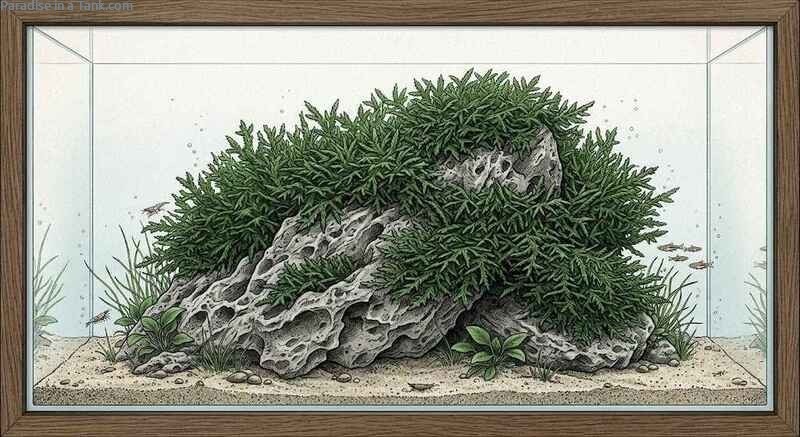
Another iconic use case is crafting realistic miniature tree canopies. Aquascapers tie small clumps of Christmas Moss onto the upper branches of sprawling spiderwood or manzanita driftwood setups. As the moss attaches and expands, the downward-drooping, overlapping triangular fronds perfectly mimic the full leaf canopy of an ancient oak or pine tree. If you want to learn exact tying techniques using cotton thread, fishing line, or aquatic gel adhesives, review our step-by-step tutorial on how to properly attach moss to aquarium hardscape to avoid common attachment failures.
Flame Moss (Taxiphyllum sp.) Profile
- Appearance & Texture: Tightly bound, vertical, flame-like twisting shoots.
Flame Moss (Taxiphyllum sp.) offers a completely unique architectural silhouette that breaks every standard rule of aquatic plant growth. Unlike most mosses that spread laterally across rocks or cascade downwards over wood, Flame Moss grows strictly upward in tight, spiraling columns. As the vertical shoots push toward the light source, they naturally twist and curl around themselves, perfectly mimicking the flickering motion of rising campfire flames. The leaves are small, closely packed along the central stems, and display a rich, deep green hue that adds immediate drama to any aquascape.
Because the stems grow tightly bound together in a upright vertical direction, Flame Moss creates distinct, defined hedge-like clumps rather than sprawling carpets. The physical texture is surprisingly firm and springy to the touch. When placed in areas with moderate water flow, the tips of the vertical shoots sway gently back and forth in the current, heightening the illusion of flickering green fire under the water.
- Growth Rate & Care Level: Slow to moderate.
Flame Moss develops at a deliberate, slow-to-moderate speed. This controlled growth rate is actually a major advantage for aquascapers who want a low-maintenance plant that maintains its shape for months without requiring weekly trimming sessions. It is a forgiving plant that adapts well to light levels ranging from low to medium (15–35 PAR), though medium lighting encourages much tighter spirals and more intense vertical growth.
To keep Flame Moss healthy, aim for a water temperature between 20–26°C and a stable pH of 6.0–7.5. It does not demand pressurized CO2, but providing light gaseous carbon and light liquid fertilization will make the green coloration far more vibrant and accelerate stem elongation. One critical physical detail to watch for is dust and debris collection. Because Flame Moss forms tight, vertical clumps, particulate matter suspended in the water column can easily drop down between the upright shoots. Regular water changes accompanied by gentle siphoning over the tops of the shoots are essential to keep the spaces between the vertical stems free of suffocating detritus.
- Best Use Case: Midground accents and creating vertical texture against hardscapes.
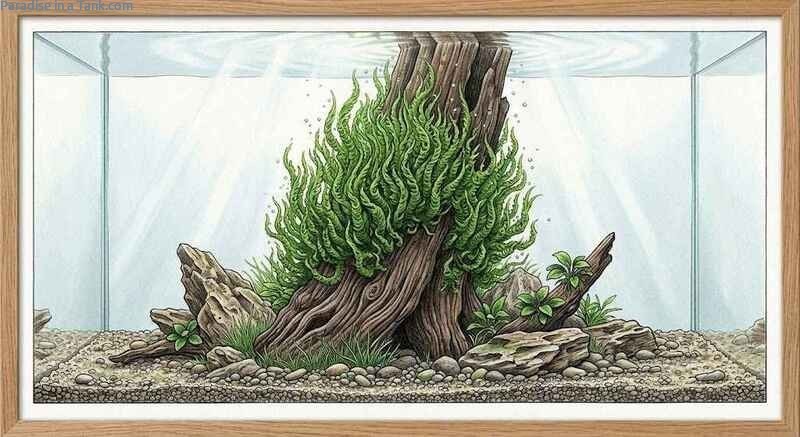
The unique upright growth habit of Flame Moss makes it an exceptional tool for midground placement and hardscape integration. Aquascapers frequently attach Flame Moss to horizontal branches of driftwood or flat rock ledges positioned in the middle region of the tank. As the moss grows vertically, it establishes a sharp, eye-catching structural contrast against low-growing foreground carpets and broad-leafed background plants like Amazon Swords or Anubias.
It is also ideal for creating natural, living background hedges or filling narrow vertical gaps between heavy stone formations. By tying small tufts of Flame Moss into the crevices of Dragon Stone or Seiryu Stone, you can soften hard mineral edges with fiery green accents. Because it grows predictably upward rather than creeping outwards to invade neighboring plant space, Flame Moss gives you precise control over your underwater garden layout.
Weeping Moss (Vesicularia ferriei) Profile
- Appearance & Texture: Pronounced downward-arching, teardrop growth.
Weeping Moss (Vesicularia ferriei) is famous for its distinct, drooping growth pattern that brings a sense of serene, ancient natural beauty into an aquarium. Unlike Java Moss which grows chaotically, or Flame Moss which shoots toward the sky, Weeping Moss grows laterally before heavily arching downward under its own weight. The fronds feature small, rounded leaves packed closely together along soft stems that naturally bend toward the substrate, creating a striking cascading effect reminiscent of a terrestrial Weeping Willow tree.
The texture of Weeping Moss is remarkably soft and dense. As new growth emerges from the tips of the shoots, it continuously droops downward, forming overlapping tiers of rich, vibrant green foliage. When fully established on elevated hardscape, the cascading foliage catches light on its outer curves while casting soft shadows beneath, creating a dynamic play of light and shade that adds depth to the aquarium.
- Best Use Case: High driftwood perches to simulate willow trees.
The absolute best way to showcase the beauty of Weeping Moss is by anchoring it to elevated perches high up in the aquarium layout. Mounting small patches onto the upper bends of tall driftwood branches or high stone ledges allows the downward-arching fronds to hang freely in the open water column. Over time, the cascading shoots form lush, weeping curtains of green that flow gracefully over the sides of the hardscape.
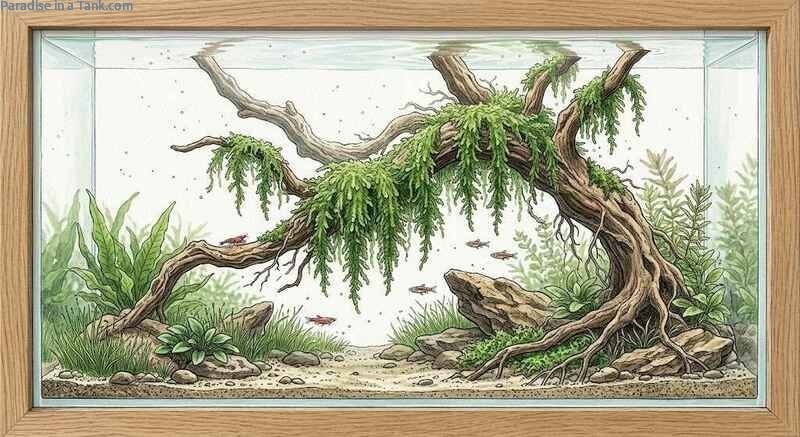
This downward growth habit makes Weeping Moss the ultimate choice for aquascapers attempting to build realistic underwater bonsai or riverbank tree designs. Beyond its aesthetic appeal, these dense, hanging curtains of foliage provide prime shaded zones for shy fish species, such as Ember Tetras, Pygmy Corydoras, and Otocinclus, who appreciate cover from bright overhead aquarium lights. To maintain its teardrop shape, occasionally trim the lowest hanging tips with sharp aquatic curved scissors; this stimulates fresh, bushy side branching and keeps the cascading canopy looking full and healthy.
Side-by-Side Comparison Matrix
To help you choose the ideal moss species for your specific aquarium parameters, equipment setup, and design goals, refer to the straightforward comparison table below.
| Moss Species | Lighting Needs | Growth Rate | CO2 Requirement | Attachment Difficulty |
|---|---|---|---|---|
| Java Moss (Taxiphyllum barbieri) | Low (10–20 PAR) | Extremely Fast | None Required | Very Easy |
| Christmas Moss (Vesicularia montagnei) | Medium (20–40 PAR) | Moderate | Optional (Recommended for fast growth) | Moderate |
| Flame Moss (Taxiphyllum sp.) | Low to Medium (15–35 PAR) | Slow to Moderate | Optional | Easy |
| Weeping Moss (Vesicularia ferriei) | Medium (20–35 PAR) | Moderate | Optional | Moderate |
Armed with an understanding of these growth habits, care requirements, and visual structures, you can confidently select the perfect moss to transform your aquarium into a thriving, self-sustaining underwater ecosystem.