Anatomical Sexing: Spotting the Differences
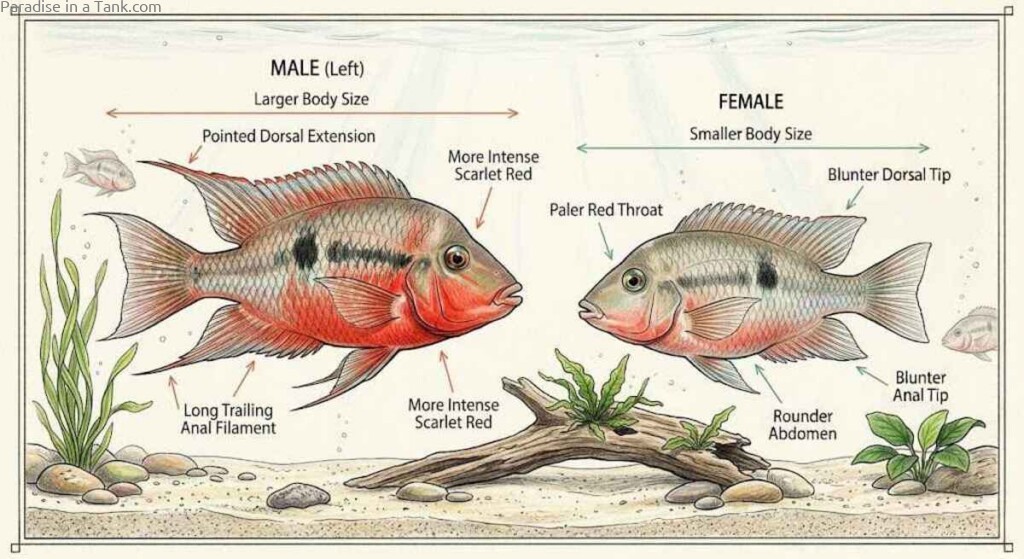
To accurately distinguish male from female Firemouth cichlids (Thorichthys meeki), examine dorsal fin extensions, throat intensity, and abdominal contour. Mature males display elongated, pointed dorsal rays with brilliant scarlet throat coloration, growing up to 6 inches (15 cm). Females remain smaller at 4–5 inches (10–13 cm), featuring blunter fin edges and a visibly rounded belly.
When you stand in front of a crowded pet store tank, trying to identify male and female Firemouth cichlids can feel like a complete guessing game. Juvenile fish often look identical, hiding their gender secrets until they fully settle into a mature home aquarium. However, once these Central American cichlids reach 2.5–3 inches (6–8 cm) in length, clear anatomical differences start to emerge.
Understanding sex identification isn’t just an academic exercise for your living room. Knowing whether you are bringing home a dominant male or a gravid female dictates how you design your aquarium territory, manage aggression, and structure community dynamics. By looking closely at fin architecture and body profiles, you can confidently tell the sexes apart without stressing your fish.
Dorsal Extensions: The Pointed Fin Architecture of Mature Males
The most reliable physical indicator of a male Firemouth cichlid lies in the dramatic trailing edges of the dorsal and anal fins. As a male reaches sexual maturity, the soft rays at the back of these fins elongate into sharp, sweeping filaments. These trailing fin extensions often reach past the base of the caudal peduncle, giving the male an elongated, athletic silhouette that commands attention.
Females maintain a much more compact, practical fin structure throughout their entire lives. Their dorsal and anal fins terminate in smooth, gentle curves rather than long, needle-like points. While a female might show vivid coloration when ready to spawn, her fins will never develop the flowing, exaggerated extensions seen on dominant males.
Beyond fin geometry, overall body shape provides another immediate physical clue for dedicated hobbyists. Males build up substantial physical mass in the cranial region, occasionally developing a slight hump above the eyes as they mature. Females retain a lower, more streamlined profile overall, though their bellies swell and take on a distinctly rounded, pear-shaped contour when carrying eggs. If you are setting up a dedicated breeding setup, pairing this anatomical knowledge with our comprehensive detailed Firemouth cichlid care blueprint ensures your pair thrives in optimal water conditions.
Look closely at the full, uncropped profile of an adult male swimming peacefully across a sand substrate, where his complete fin structure and elongated dorsal tip are fully visible against surrounding driftwood structures.
Behavioral Distinctions: Flare Mechanics and Gill Cover Distension
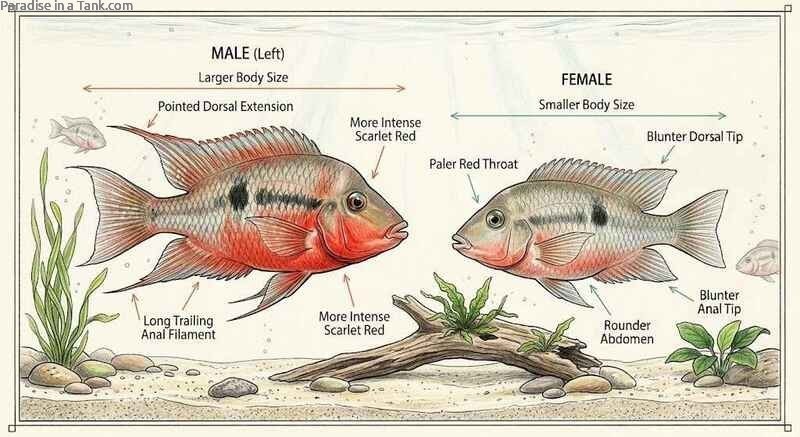
Physical traits tell half the story, but behavioral displays during territory disputes reveal the rest. Firemouth cichlids get their common name from the shocking, cherry-red membrane hidden beneath their gill covers (opercula). When a male wants to assert dominance, he drops his hyoid apparatus and pushes his branchiostegal membranes outward, creating a terrifying, balloon-like red mask.
While both sexes possess this flare mechanism, males deploy it far more aggressively and frequently. A male will lock eyes with a rival, drop his throat membrane, and flare his bright opercular spots—dark, iridophore-rich patches that mimic giant eyes. This dramatic posture makes the male look twice his actual size, warning intruders to step back from his chosen rock cave.
Females flare their gills too, but usually only when actively defending an established clutch of eggs or repelling an overeager suitor. Their displays are brief and defensive, whereas male flaring is an active, territorial display of chest-thumping dominance. Males will also engage in tail-beating displays, thrashing their caudal fins against the water to send physical shockwaves toward rivals.
Watching these behavioral interactions closely will quickly confirm your anatomical assessments. If you notice a particular fish constantly pacing the tank boundaries and flaring at its own reflection, you are almost certainly looking at an eager male claiming prime real estate. Providing ample swim space is vital here, so make sure to check out our complete breakdown on Firemouth cichlid tank sizing and growth requirements to prevent territory wars from turning dangerous.
The Specialized Color Variant Compendium
The Striking Blue Flash and Black Gullet Profiles
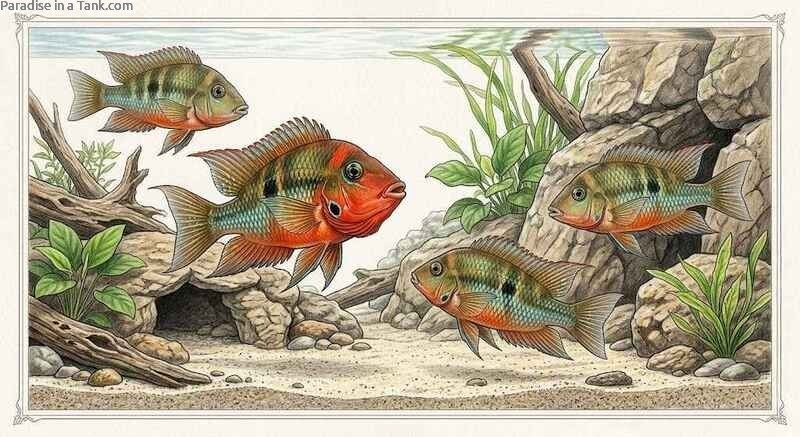
Beyond standard wild-type coloration, Thorichthys meeki exhibits fascinating visual diversity depending on geographic origin and selective breeding. The classic profile features a dusky gray-green body adorned with iridescent turquoise and blue scales that shimmer like tiny sequins under full-spectrum lighting.
In high-quality specimens, this blue flash extends along the flank, creating a stark contrast against the fiery red underbelly. The red pigment starts at the jaw line, coats the entire throat, and runs along the abdominal floor back to the anal fin base. In dominant males, this red color is intensely saturated, resembling hot burning coals.
Another key visual feature is the dark lateral band and black gullet detailing. A row of dark blotches runs from behind the eye to the tail, often merging into a solid black stripe when the fish is stressed or spawning. The interior of the mouth and deep throat cavity display a rich, dark pigment, making every open-mouthed yawn or flare look strikingly dramatic.
To keep these stunning blue hues and deep red throat pigments at their absolute peak, high-grade nutrition is essential. Feeding a rich mix of carotenoid-packed foods directly enhances these natural iridophores, which is why following our specialized nutritional strategies for Firemouth cichlids is so critical for color maintenance.
Observe the complete body profile of a fully grown Firemouth cichlid displaying its vibrant blue body scales and deep red throat while floating effortlessly over smooth river stones in a spacious aquarium layout.
Isolated Anomalies: The Yellow and Albino Variations
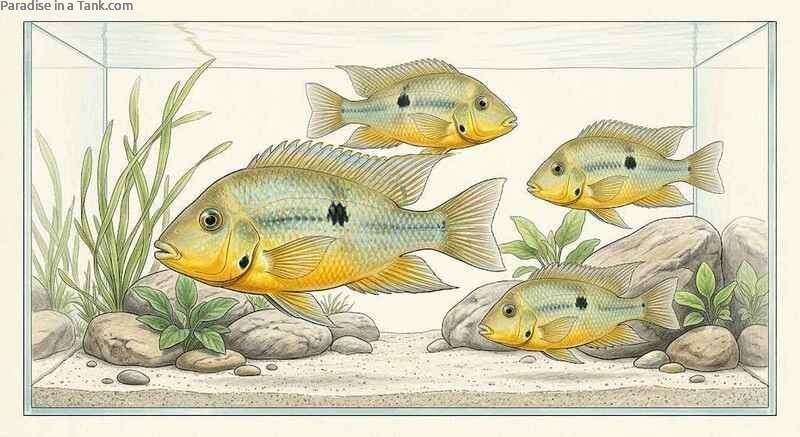
While the red-and-turquoise wild form dominates the aquarium trade, rare color anomalies occasionally emerge in specialized breeding strains. The Yellow Firemouth variant replaces the traditional deep red throat pigment with a brilliant canary-yellow or deep amber wash. This genetic variation retains the classic blue body iridescence, but trades the fiery throat for a bright golden chest.
Albino Firemouths represent another captivating, though delicate, genetic anomaly. These fish completely lack melanin, resulting in a pinkish-white body, translucent fins, and striking ruby-red eyes. The famous red throat patch remains visible in albinos as a soft pastel pink or orange flush, glowing against their pale skin.
Because albino specimens lack protective dark pigments, they are significantly more sensitive to intense aquarium lighting. If you keep albino or yellow anomalies, you must provide plenty of shaded retreats, driftwood overhangs, and dim lighting to prevent chronic stress and eye damage.
These specialized variations require exact water parameters to thrive without fading. Maintain your water chemistry within a stable pH range of 7.0–8.0 and keep nitrate levels consistently below 20 PPM. Regular water changes prevent dissolved organic waste like ammonia and nitrite from dulling the brilliant iridophores of these unique morphs.
| Color Variant | Primary Body Color | Throat & Chest Pigment | Eye & Marking Features |
|---|---|---|---|
| Standard Wild Type | Grayish-green with blue iridophores | Fiery cherry red | Dark opercular spot with golden border |
| Blue Flash Profile | Deep metallic slate blue | Intense crimson to scarlet | High-density blue body sequins |
| Yellow Variation | Pale olive to champagne | Bright canary yellow | Standard dark lateral spots |
| Albino Anomaly | Translucent pinkish-white | Soft pastel orange flush | Ruby red eyes with zero melanin |
Tank Mate Coordination: Cross-Compatibility Rules for Central and African Species
Selecting proper tank mates for Firemouth cichlids requires a clear understanding of territorial boundaries and physical hardware. Firemouths are generally considered mild-mannered compared to notoriously aggressive Central American heavyweights like Jaguar cichlids or Red Devils. However, they are still armed with sharp pharyngeal teeth and territorial instincts that emerge during breeding cycles.
When housing Firemouths with other Central American species, choose mid-sized, semi-aggressive tank mates that won’t bully them or fall victim to their threats. Excellent choices include Convict cichlids, Salvini cichlids (in large tanks), Rainbow cichlids, and robust dither fish like Swordtails or giant tetras. These fast-moving dithers break up line-of-sight and draw out shy Firemouths.
Combining Central American Firemouths with African cichlids, however, is a dangerous recipe for tank disaster. African rift lake cichlids from Lake Malawi or Lake Tanganyika require completely different water chemistry, higher pH levels (8.0–8.5), and extreme mineral hardness. Furthermore, African Mbuna cichlids possess hyper-aggressive, relentless hyper-territorial behaviors that will quickly stress, batter, and kill a Firemouth.
You can view a well-balanced community tank where the complete, uncropped body of a Firemouth cichlid swims comfortably alongside compatible Central American tank mates amidst lush aquatic plants and natural stone caves.
By respecting their natural ecological boundaries and providing clean, well-filtered water, you will create a peaceful, stunning display where your Firemouth cichlids can flourish for years to come. Jump into your tank setup with confidence, observe their behavioral cues, and enjoy custodian life with these remarkable Central American icons!