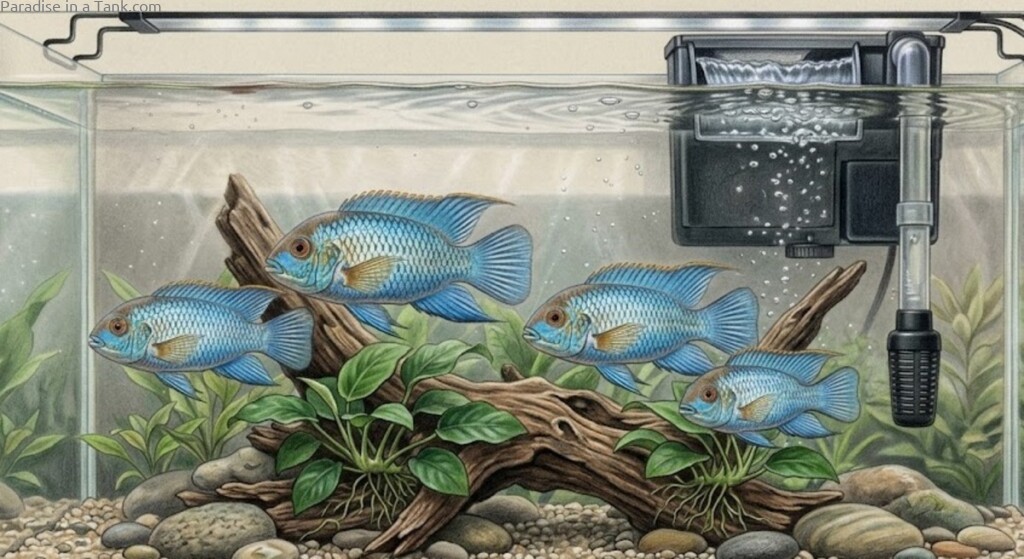
Growth Trajectories and Adult Physical Dimensions
Electric Blue Acaras reach a mature adult length of 12.0–15.0 cm, with males typically topping out at 15.0 cm and females remaining closer to 10.0–12.0 cm. Under proper environmental conditions, juveniles grow rapidly at a rate of 1.0–1.5 cm per month, reaching full sexual maturity and physical size within 8–12 months.
Understanding the physical trajectory of Andinoacara pulcher is essential for preventing structural overcrowding and maintaining long-term biological stability. While many hobbyists purchase juveniles as 2.5–3.8 cm glittering ribbons of blue in a local display tank, these cichlids do not stay small for long. Their bodies are built like heavy-set oval discs, expanding not just in length but in sheer muscular depth and lateral thickness. A fully grown individual demands a substantial footprint to accommodate its active swimming habits and territorial displays.
If you are setting up a comprehensive habitat for these vibrant cichlids, reading the ultimate blue acara guide will give you a complete foundational overview of their baseline husbandry requirements before you dive into physical sizing metrics.
Max Size Benchmarks: Realities of the 15.0 cm Mature Silhouette
When evaluating the full potential footprint of an adult Electric Blue Acara, you must look past simple snout-to-tail measurements. A mature male boasting a 15.0 cm frame possesses significant body mass, complete with a high dorsal ridge and a deep, stocky chest profile. Females present a slightly more compact, oval silhouette, rarely exceeding 12.0 cm, but they match the males in muscular mass per centimeter during active egg-binding cycles.
The physical presence of these cichlids means they displace considerable water and generate a high metabolic payload. Expecting a full-grown 15.0 cm individual to thrive in a cramped grow-out setup is a direct path to physical stuntedness, compromised immunity, and intense territorial aggression. When space shrinks, their natural instinctual boundaries shatter, turning mild territorial posturing into violent physical collisions.
| Life Stage | Age Range | Average Length (cm) | Physical Characteristics & Body Markers |
|---|---|---|---|
| Early Juvenile | 1 to 3 Months | 2.5–5.0 cm | Slender body profile, faint iridescent sheen, fast swimming velocity. |
| Sub-Adult | 4 to 7 Months | 5.0–9.0 cm | Deepening chest mass, vivid electric blue iridescence, early fin elongation. |
| Young Adult | 8 to 12 Months | 9.0–12.0 cm | Sexual maturity reached, visible sexual dimorphism, distinct forehead slope. |
| Fully Mature Adult | 12+ Months | 12.0–15.0 cm | Thick muscular frame, fully developed dorsal trailing threads, broad profile. |
To properly evaluate mature size and prepare for long-term breeding space, review our guide on female vs male blue acara identification and spawning to spot early structural differences between growing sexes.
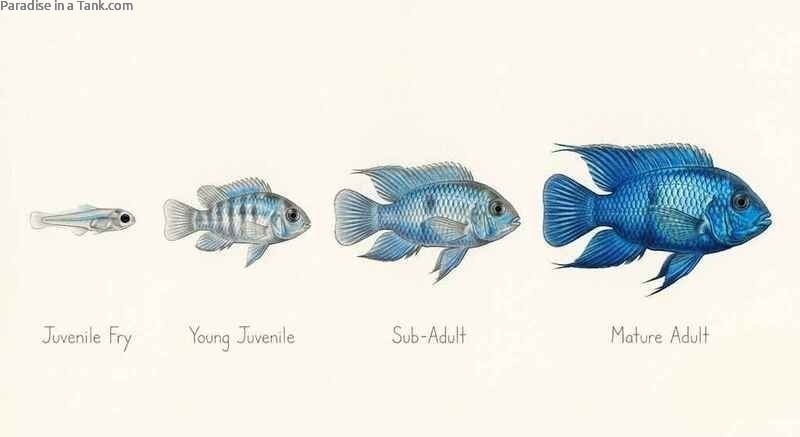
The Full Grown Timeline: Tracking the Growth Milestones of Juvenile Inhabitants
Tracking juvenile development requires monitoring both linear length expansion and metabolic demands. During the first 1 to 3 months of life, a healthy juvenile will experience an explosive growth surge, gaining up to 1.5 cm every 30 days when supplied with high-protein sustenance and pristine water quality. During this window, their high cellular turnover rate leaves no room for poor water conditions or skipped maintenance routines.
Between 4 and 7 months, the growth velocity shifts from rapid linear stretching to structural broadening. The skeletal frame hardens, the head profile steepens, and the classic electric blue iridescence thickens across the scales. By month 8, most individuals sit comfortably between 9.0–12.0 cm. Growth slows down dramatically after month 12, with the remaining growth focused on thickening muscle tissue and extending delicate fin filaments rather than adding length.
- Month 1 to 3 (Explosive Surge): Growth averages 1.0–1.5 cm per month; rapid scale pigmentation and high metabolic processing.
- Month 4 to 7 (Frame Broadening): Growth averages 0.5–1.0 cm per month; lateral muscular expansion and early territorial display behaviors.
- Month 8 to 12 (Maturation Phase): Growth slows to 0.2–0.5 cm per month; physical attainment of full sexual capability and adult coloration.
- Month 12+ (Maintenance Phase): Minimal linear extension; development of pronounced fin rays and thick dorsal profiles in dominant males.
Engineering the Enclosure System Architecture
System Footprints: Why Active Pairs Mandate a 110-Liter (30-Gallon) Minimum
A single adult Electric Blue Acara can technically reside in a standard 75-liter container during extended quarantine, but long-term housing for a single specimen requires at least 110 liters (30 gallons). If you intend to house a compatible pair, a 150-liter (40-gallon) breeder tank is the true operational baseline. The crucial dimension here is horizontal surface area rather than vertical height. These fish patrol the lower and middle regions of the water column, establishing physical perimeter lines around rock structures and sunken wood.
When confined to systems lacking adequate floor space, the instinctual drive to defend territory overrides normal social behaviors. In tight quarters, a male will relentlessly chase a female, causing severe scale loss, split fins, and chronic elevated cortisol levels. Providing a wide base allows you to establish natural physical barriers, letting inhabitants divide the environment into distinct micro-territories without constant physical conflict.
Mechanical Filtration Demands: Clearing Debris Without Creating Excessive Surface Currents
Because a 150-liter tank holding 15.0 cm cichlids processes substantial biological loads, your filtration system must handle mechanical particulate removal and biological nitrification effortlessly. Electric Blue Acaras are enthusiastic foragers that sift through sand and break down heavy foods, releasing fine debris into the water column. A high-capacity canister filter or a robust hang-on-back unit rated for at least 4 to 6 times total system volume turnover per hour is mandatory to keep particulate organic matter under control.
However, high filtration capacity must not translate into turbulent, washing-machine surface currents. Andinoacara pulcher originate from slow-moving river basins and calm oxbow lakes across South America. Excessive directional flow forces these broad-bodied fish to burn precious caloric energy simply maintaining posture, leading to physical exhaustion and metabolic stress. Use spray bars or directional flow diverters to spread returning water evenly across the surface, maintaining high dissolved oxygen levels without pushing your fish around the tank.
To balance heavy organic waste production with proper nutritional intake without overloading your filtration setup, consult our comprehensive resource on blue acara feeding routines and tank mate selection for targeted dietary guidelines.
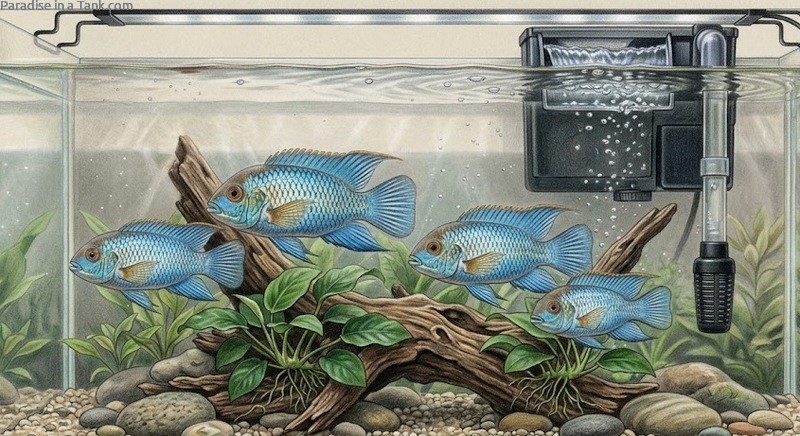
Water Acuity Parameters: Maintaining a 6.5–7.8 pH and 22.0–28.0°C Matrix
Maintaining precise water chemistry parameters is directly tied to healthy cellular growth and structural skeletal development in juvenile acaras. Acidic or overly alkaline extremes disrupt internal osmotic regulation, while unstable temperatures directly affect metabolic rates. You must stabilize your ecosystem within a controlled thermal range of 22.0–28.0°C, using reliable dual heaters to prevent sharp temperature drops that trigger opportunistic fungal or protozoan infections.
Water hardness should sit comfortably between 3–12 dGH, with a balanced pH range of 6.5–7.8. The primary danger to growth performance is organic waste accumulation. Ammonia and nitrite must remain at absolute 0 ppm at all times, as even trace levels cause microscopic gill filament damage and stunted skeletal growth. Keep nitrate buildup strictly below 20 ppm through consistent weekly water refreshes of 25–30%.
- Target Temperature: 22.0–28.0°C (Ideal sweet spot for steady growth: 25.0°C).
- Target pH Threshold: 6.5–7.8 (Avoid sudden shifts greater than 0.2 units per day).
- Target Carbonate Hardness: 3–12 dGH (Provides essential minerals for bone and scale formation).
- Nitrogenous Waste Limits: Ammonia: 0 ppm; Nitrite: 0 ppm; Nitrate buildup: strictly under 20 ppm.
Substrate Selections: Utilizing Smooth Substrates to Prevent Excavation Injuries
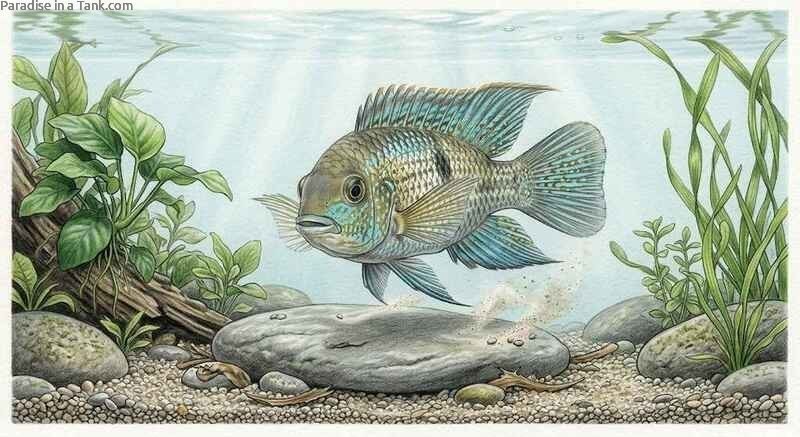
Electric Blue Acaras possess a deep evolutionary hardwiring to sift, excavate, and remodel their benthic environment. During daily foraging and territorial pit-digging prior to spawning, an adult will scoop up mouthfuls of substrate, churn it inside its oral cavity to filter out organic material, and blast the residual particles out through its gill covers. Standard sharp gravel or crushed coral acts like liquid sandpaper against their delicate gill rakers and soft mouth tissues.
Using coarse or sharp-edged gravel inevitably leads to micro-lacerations around the mouth, predisposing your fish to severe bacterial mouth rot or saprolegniasis fungal outbreaks. The solution is to carpet the aquarium floor with soft, fine pool filter sand or smooth, rounded river quartz of 1.0–2.0 mm grain size. Fine sand allows the acaras to execute their natural excavation instincts safely, sifting substrate through their gills without risking physical injury. Smooth substrate satisfies their ancestral programming while keeping their protective mucosal slime coat intact.
Providing ample horizontal footprint, clean filtration without strong currents, stable water parameters, and soft substrate creates the perfect environment for your Electric Blue Acara to grow into a robust, vibrant 15.0 cm specimen.