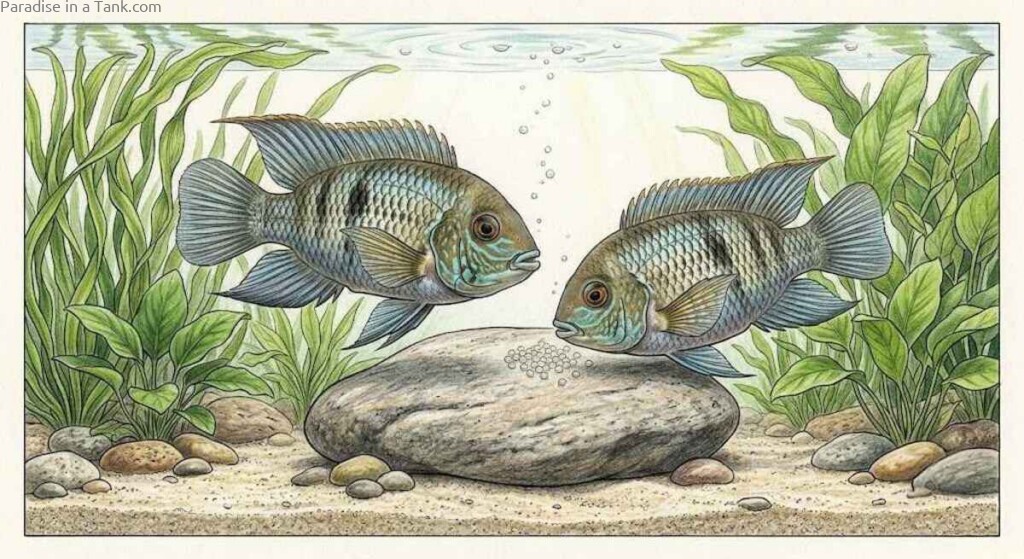
Anatomical Sexing: Spotting the Physical Differences
To sex adult Blue Acaras accurately, examine their dorsal fin shape, body silhouette, and vent structure: mature males develop extended, sharply pointed dorsal and anal fins alongside a deeper body profile with a subtle cranial hump, whereas females maintain rounded fin tips, a softer egg-swollen abdomen, and a blunt, pinkish ovipositor during breeding phases.
Sexing South American cichlids is notoriously tricky for beginners, especially when viewing young juveniles under harsh aquarium lighting. You buy a group of five small acaras, hope for a true pair, and spend weeks staring at fin tips while worrying whether a violent territory fight is courtship or outright bullying. I have been there, staring into a tank late at night wondering why my supposed “pair” is tearing each other’s scales off instead of cleaning rocks.
The truth is that young acaras hide their sexual identity behind identical iridescent scales and juvenile body contours. It is an evolutionary defense mechanism designed to prevent hyper-aggressive adult males from singling out young competitors in natural river systems. However, as your fish cross the 2.5–3.0 inch threshold, their physical structures undergo distinct hormonal shifts. By evaluating the anatomy methodically—rather than guessing based on temperament alone—you can separate males from females with absolute certainty before introducing nesting hardware. If you are starting fresh with this species, reviewing a comprehensive Ultimate Blue Acara Guide provides the foundational water chemistry and tank requirements necessary before attempting any dedicated breeding project.
| Sex | Primary Fin Morphology | Body Silhouette & Contour | Venting Characteristics |
|---|---|---|---|
| Mature Male | Extended, pointed dorsal and anal rays trailing past caudal base | Broad, deep-bodied frame with prominent forehead slope | Narrow, pointed, forward-angled genital papilla |
| Mature Female | Short, rounded dorsal and anal tips ending near caudal peduncle | Compact, streamlined frame with rounded, swollen abdomen | Wide, blunt, cylindrical ovipositor angled downward |
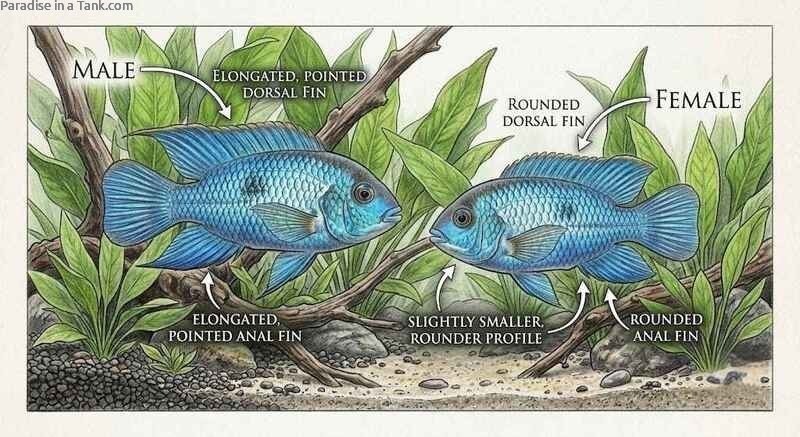
Fin Extensions: The Pointed Dorsal Architecture of Mature Males
The dorsal fin serves as a primary billboard for visual signaling in the cichlid world. In mature male Blue Acaras, the trailing edge of the soft dorsal fin extends into dramatic, needle-like filament tips. These elongated fin rays frequently reach past the base of the tail fin, creating a sweeping, heroic profile as the male parades across his territory.
This pointed fin structure is driven by androgenic hormones that harden and lengthen the soft skeletal fin rays during sexual maturation. As the male flares his body to ward off rivals or entice a mate, these extended filaments catch ambient light, displaying vibrant cyan and electric blue iridescence. If you look closely at the anal fin, you will notice an identical structural pattern: the male’s anal fin tapers into a long, sharp point that mirrors the upper dorsal extension.
Females, by contrast, retain a functional, hydrodynamically sensible fin structure. Their dorsal and anal fins remain rounded at the trailing edges, rarely reaching more than a fraction of an inch onto the caudal peduncle. When a female curves her body during nest cleaning, her fins form a smooth, continuous arc rather than a trailing streamer. Do not rely on fin length alone in young fish under 2.0 inches, as juvenile males often display rounded fins until their growth spurt begins. For a full breakdown on tracking juvenile development milestones, take a look at our analysis of Electric Blue Acara size and growth rates to ensure your fish are sexually mature before attempting sexing protocols.
Body Profiles: Differentiating Blunt Snouts from Softer Female Silhouettes
Beyond fin morphology, overall frame geometry offers clear clues once you train your eye to recognize subtle muscular distributions. Adult males construct thicker, heavier muscular shoulders and a steeper head incline. This creates a distinct, blunt snout profile that slopes abruptly upward into a robust dorsal crown, occasionally forming a slight, muscular nuchal hump when dominant males are actively holding territory.
Females maintain a distinctly balanced, hydrodynamic silhouette from snout to tail. Their head profile rises at a gentler, softer angle, lacking the thick muscular mass across the nape that characterizes full-grown males. This softer slope transitions into an abdominal region that tells a distinct physiological story.
As a female acaras matures internally, her ovaries expand significantly within the visceral cavity, packing hundreds of developing ova into her posterior abdomen. This anatomical expansion creates a visibly rounded, dropped belly line that remains plump even after a brief fasting period. A well-conditioned female looks bottom-heavy and wide when viewed from directly above, whereas a male maintains a wedge-shaped profile that is broad at the gills and narrow at the tail.
Understanding these body profile differences prevents disastrous housing mistakes. Placing two deep-bodied, broad-shouldered males into a small tank guarantees bloody jaw-locking matches and torn skin. Conversely, housing two plump females results in unfertilized egg clutches that rot on flat surfaces, turning white within 40 hours and harboring harmful fungal spores that pollute your water column.
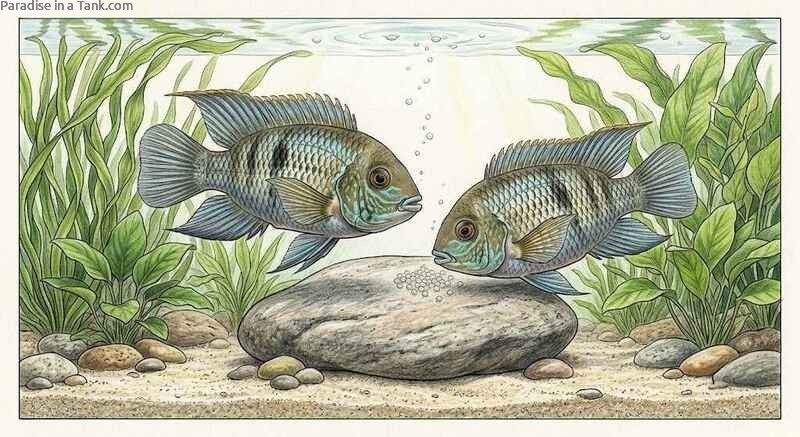
Courtship Mechanics and Nesting Site Selections
Hardscape Preferences: Flat Slate Layers vs. Clean Smooth Rocks
Once a true pair forms, their behavioral mechanics shift overnight from casual swimming to aggressive environmental engineering. Blue Acaras are substrate-spawning cichlids hardwired by millions of years of river basin evolution to select hard, stationary, non-porous surfaces for egg deposition. They do not scatter eggs randomly into plants, nor do they mouthbrood their young in open water. They demand a solid foundation.
Your choice of breeding slate or rock direct determines spawning success and fry yield. Smooth, flat natural slate pieces laid horizontally or angled at a gentle 15–30 degree incline represent the ideal spawning platform. Slate provides a dense, stable, non-toxic micro-surface that allows the female to press her ovipositor flat against the stone, laying tight, uniform adhesive egg rows without gaps or slippage.
Smooth river cobbles can also work, but their rounded geometry creates physical challenges. If a rock is too spherical, the female struggles to maintain a consistent deposit rhythm, leading to misaligned egg clutches that fall into dark crevices where water circulation stalls. Stationary slate layers allow both parents to hover mere millimeters above the eggs, continuously fanning their pectoral fins to drive fresh, oxygenated water across the clutch while removing airborne particulate matter.
Avoid porous rocks like lava rock or jagged holey limestone. Jagged textures shred the delicate skin of the female’s extended ovipositor during the high-pressure rubbing motions of egg laying. Furthermore, porous surfaces trap rotting organic debris and waste, creating localized bacterial pockets where harmful microbes like Flavobacterium flourish, quickly destroying delicate egg membranes before hatching can occur.
Before placing slate into your breeding setup, scuff the surface lightly with clean gravel and boil it in pure water. Never use chemical soaps or detergents on hardscape. The parents will spend hours scrubbing the selected stone with their mouth structures, scraping off algae and biofilm until the rock is pristine. If you notice your pair obsessively picking at a single slate piece with extended mouths, spawning will usually occur within 24–48 hours.
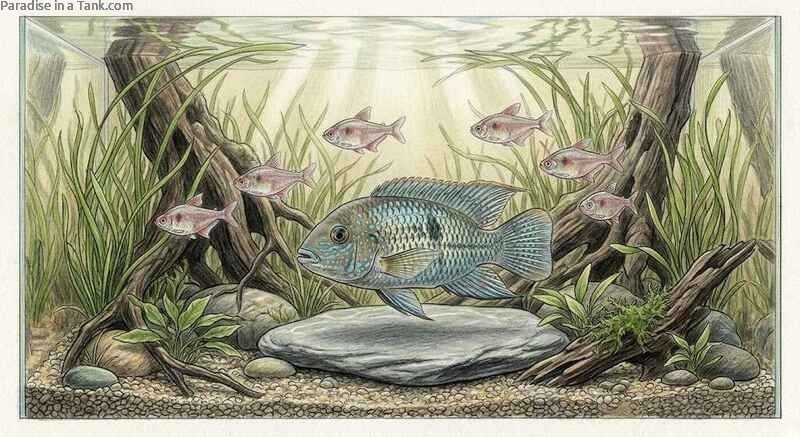
Managing Territorial Boundaries to Support Fry Safety
When Blue Acaras enter active spawning mode, their natural calm temperament vanishes. They transform into fierce, hyper-vigilant guardians driven by primitive parental instincts. A pair that previously coexisted peacefully with community tank mates will suddenly claim a 12-to-18-inch territorial bubble around their chosen slate, attacking any fish that breaches the invisible perimeter.
To protect both your breeding pair and their tank mates, you must design clear visual barriers using wood, tall plants, or vertical rock structures. Line-of-sight breaks are essential in a multi-species aquarium. If a neighboring fish can see the nest continuously, the acara pair will remain in a state of high stress, thrashing across the tank to chase intruders instead of fanning their eggs.
This constant stress leads to catastrophic failures. Stressed parents frequently turn on each other, blaming their partner for the perceived threat, or worse, they will eat their own egg clutch in a desperate move to reclaim spent nutrients before fleeing. Establishing physical boundaries reduces defensive pacing and allows the male to patrol the outer perimeter while the female tends to the eggs.
Maintaining proper nutrition and selecting low-threat tank mates also keeps territorial aggression manageable during breeding cycles. Reviewing our guide on Blue Acara feeding routines and tank mate compatibility will help you select peaceable, non-predatory tank companions that won’t provoke high-stakes territorial battles.
When the eggs hatch after roughly 48 to 72 hours at 78°F (25.5°C), the parents transport the wriggling larvae via their mouths into pre-dug pit nests in the substrate. During this vulnerable “wriggler” stage, the parents’ protective instincts reach an absolute peak. Keep human hand movements inside the tank to a bare minimum, as sudden disruptions can trigger the parents to swallow the helpless fry.
Long-Term Pigment Preservation for Active Breeding Pairs
Active breeding takes a massive physiological toll on adult Blue Acaras. Repeatedly laying hundreds of eggs, producing nutrient-rich seminal fluid, and constantly fanning nests drains internal glycogen stores and wears down outer skin layers. Without proper care, once-vibrant breeding pairs quickly turn pale, washed out, and lethargic, losing the brilliant metallic cyan sheen that makes this species so captivating.
Pigment degradation is primarily caused by two factors: nutritional deficiencies and environmental water degradation. The brilliant iridescent blue coloration in acara scales relies on iridophores—specialized pigment cells containing structural guanine crystals that reflect light. To maintain these cells, the fish require high levels of natural carotenoids, astaxanthin, and quality marine proteins in their daily diet.
Relying solely on cheap, store-bought dry flakes during heavy spawning cycles starves the fish of essential fatty acids and natural pigments. Feed your active pairs high-grade krill, spirulina-enriched brine shrimp, and bloodworms alongside frozen diets. This nutritional backing fuels rapid egg production while keeping the iridescent scales firing with vivid luster.
Equally critical is water quality management during active spawning cycles. High nitrate accumulation above 20 PPM suppresses immune response, corrodes delicate fin margins, and causes the iridescent blue scales to darken into a dull, stress-induced slate grey. High organic load also promotes bacterial growth that attacks skin mucosal layers, leaving breeding pairs vulnerable to opportunistic fungal infections.
Maintain rigid, low-impact maintenance habits. Perform small, frequent water changes of 15–20% twice weekly rather than massive 50% shifts that shock spawning pairs and ruin water parameter stability. Keep your water chemistry stable at a pH of 6.8–7.5, water hardness at 6–12 dGH, and temperature locked between 76–80°F (24.4–26.7°C). By combining stable water parameters with rich nutrition and ideal spawning hardware, your Blue Acaras will thrive, maintaining brilliant color while successfully raising batch after batch of healthy fry.