An Introduction to the Icon of South American Basins
Green Terror Cichlid care requires an enclosure of at least 55 gallons for a single adult, a pH level between 6.5–8.0, and water temperatures held at 75–80°F. These heavy-bodied South American cichlids demand clean water, powerful biological filtration, and a sandy substrate layout to accommodate their aggressive digging and territorial nature.
When you first lay eyes on a fully grown adult Green Terror, you are looking at pure evolutionary perfection. Native to the western coastal slopes of South America, these cichlids have earned an infamous reputation in the aquarium trade for their explosive aggression, striking iridescence, and unyielding territorial drive. However, keeping one successfully in a home aquarium isn’t about slapping together a random glass box with a basic hang-on-back filter and hoping for the best. If you mess up their water quality or misread their physical needs, you will end up with a stressed, disease-ridden fish thrashing against the glass or floating belly-up before you even know what went wrong.
Natural History: Understanding the Stream Networks of Ecuador and Peru
To truly understand what makes a Green Terror tick, you have to look closely at where they evolved over millions of years. These powerhouse cichlids originate from the Pacific coastal river basins of western Ecuador and northwestern Peru, specifically systems like the Esmeraldas, Guayas, and Tumbes river networks. These environments aren’t soft, quiet, pristine blackwater streams like the Rio Negro; they are dynamic, energetic water systems where seasonal rains violently wash organic debris, clay, and gravel downstream, altering the aquatic landscape overnight.
In these wild Ecuadorian and Peruvian river channels, survival is a non-stop, high-stakes brawl. The waters fluctuate between slow-moving, warm floodplain pools during the dry season and turbulent, high-flow river rapids during torrential monsoons. Because these habitats are densely packed with competing fish species, predator pressure is intense, and high-quality breeding territory is always at a premium. The Green Terrors are remarkably tough, deep-bodied, and relentless. They evolved muscular jaw mechanics to crush hard-shelled invertebrates like snails and freshwater crabs, along with a protective layer of thick, heavy scales that act like physical body armor against enemy bites and abrasive river rocks.
When you bring a Green Terror into your living room, you are bringing that ancient evolutionary contract along with it. They are genetically wired to treat every corner of their glass tank as a vital piece of river territory that must be guarded at all costs. Their aggressive tendencies, restless digging behavior, and intense territorial posturing aren’t random behavioral flaws or bad moods—they are primitive survival mechanisms refined over thousands of generations in the wild rivers of South America. If you try to force them into a cramped, sterile tank with delicate plants and poor filtration, their instinctual stress response will shatter their immune system, leading directly to systemic bacterial infections, severe hole-in-the-head disease, or devastating territorial battles.
Morphological Overview: Deciphering the Heavy-Bodied Profile and Nuchal Hump
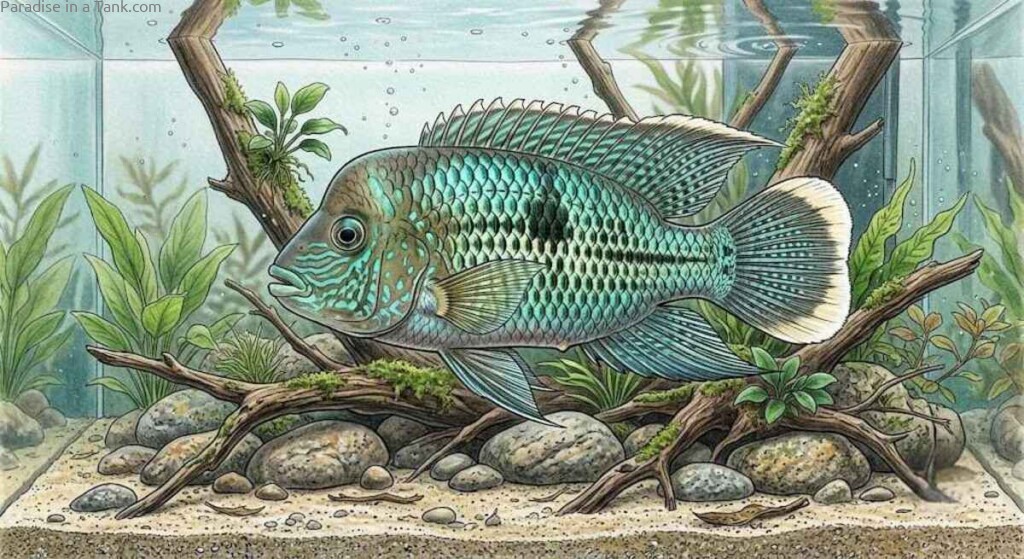
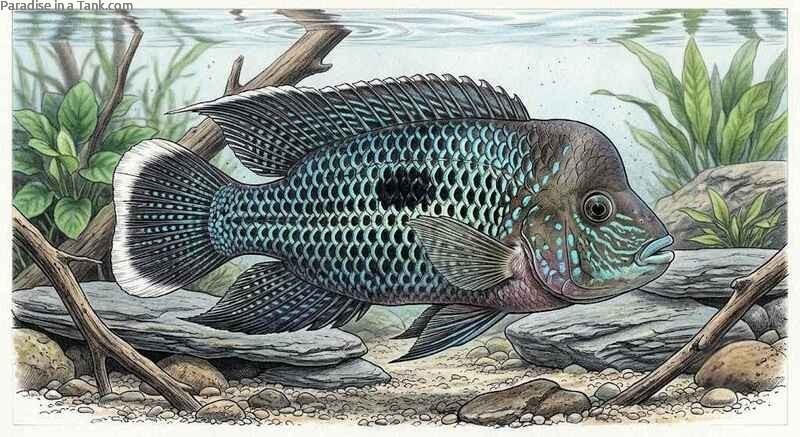
Physically, a healthy adult Green Terror is a spectacular sight that commands immediate attention in any room. They sport a broad, laterally compressed profile built for sudden bursts of speed and forceful physical impacts. Their body armor is decorated with brilliant electric blue and metallic green scales that shimmer like polished jewels under aquarium lighting, contrasted against a deep olive-green body base. Their dorsal and caudal fins are proudly tipped with vibrant margins of gold, orange, or stark white, creating a brilliant contrast that signals their physical dominance to rival fish across the aquarium.
As male specimens mature into full adulthood, they develop a distinct, prominent swelling on their forehead known as a nuchal hump or cranial crest. This physical structure is composed of dense fatty tissue and fluid, serving as a visual beacon of reproductive dominance and physical maturity within their social hierarchy. A large, well-defined nuchal hump signals to females and competing males that the individual is a thriving top-tier predator in peak physical condition. In contrast, females remain noticeably smaller, displaying a somewhat slimmer profile, slightly muted body coloration, and shorter, rounded fin extensions.
Understanding the exact physical trajectory of your fish is critical for long-term tank planning. To track their growth milestones and structural development accurately over time, read our detailed guide on Green Terror size and growth benchmarks to ensure your setup keeps pace with their physical maturation.
Paying close attention to these morphological cues allows you to spot health problems early. A sunken stomach, a shrinking nuchal hump, or faded iridescent scales are early physical red flags indicating severe internal parasites, poor nutrition, or high nitrate buildup. When a Green Terror is thriving in clean, optimal water chemistry, its body glows with unbelievable color, its fins stay fully flared, and it will swim right up to the front glass to challenge you every time you step into the room.
Defining the Variants: Gold Saum, White Saum, and True Terrors
Navigating the world of Green Terrors can quickly become confusing for casual hobbyists because the trade frequently mislabels distinct species and color variants under a single common name. For decades, multiple distinct fish have been lumped together, leading to mismatched care expectations and surprise behaviors.
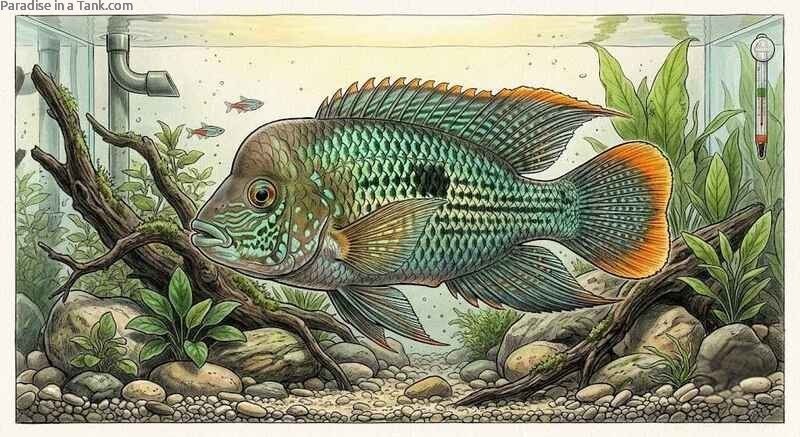
- The Gold Saum Standard: Spotting the dominant bright orange tail border. This is by far the most widely available variant in the pet trade, scientifically identified as Andinoacara rivulatus. It is easily recognized by the brilliant, thick neon-orange or golden band that edges the top of the dorsal fin and the trailing edge of the tail fin.
- The White Saum Variant: Identifying the striking silver-edged caudal fins. Often mislabeled as a completely separate species, the White Saum is actually a stunning color morph of Andinoacara rivulatus. Instead of warm orange tones, the fin margins display a crisp, metallic silver-white border that creates a breathtaking ice-like aesthetic.
- The Rare True Terror: Differentiating Andinoacara stalsbergi from common morphs. The genuine “True” Green Terror is a completely distinct species native to Peru. Unlike the Gold and White Saums, Andinoacara stalsbergi features a dark olive or near-black body scale pattern where the blue-green iridescence is centered inside the scales rather than on the margins, trimmed with a delicate white fin border.
To avoid buying the wrong fish for your tank goals, inspect the physical characteristics of each variant closely before making a purchase. If you want to dive deeper into the exact anatomical differences, geographical origins, and temperament nuances between these distinct fish, explore our comprehensive breakdown on True Green Terror vs Gold Saum variant differences to make sure you know exactly what you are bringing home.
| Variant Identification | Scientific Name | Edge Margin Color | Scale Pattern Distribution | Wild Origin Range |
|---|---|---|---|---|
| Gold Saum | Andinoacara rivulatus | Bright Golden-Orange | Metallic green patches over olive base | Western Ecuador & Peru |
| White Saum | Andinoacara rivulatus | Pure Silver-White | Metallic blue patches over dark olive base | Coastal Ecuadorian streams |
| True Green Terror | Andinoacara stalsbergi | Thin Crisp White | Dark centered scales with bright iridescent rims | Pacific slopes of Peru |
General Large-Scale Aquascape Design and Enclosure Strategies
Designing a home for a Green Terror demands a heavy-duty mindset. You aren’t setting up a gentle community tank; you are engineering an aquatic fortress that can withstand the raw physical strength of a powerful, digging, territorial cichlid. A single adult male requires a absolute minimum enclosure size of 55 gallons, though a 75-gallon to 100-gallon aquarium is far better if you want to see natural territorial behaviors without triggering glass-bashing aggression. If you intend to keep a mated pair or attempt a large South American community setup, you must start with a tank capacity of 125 gallons or larger to prevent brutal fights and territory wars.
Substrate selection is one of the most critical decisions you will make during the layout phase. Green Terrors love to dig, sifting through the bottom layer relentlessly as part of their natural foraging and nest-cleaning instincts. Avoid sharp, coarse gravel at all costs; its jagged edges will scrape their delicate mouthparts, leading to painful bacterial infections and mouth rot. Instead, use a deep layer of smooth, natural river sand or fine pool filter sand. They will scoop up mouthfulls of sand, spit it out in piles, and redesign the tank layout according to their own internal blueprints—embrace this behavior rather than fighting it.
When structuring the aquascape, use heavy, stable materials like large smooth river boulders, driftwood branches, and thick ceramic caves. You must secure all rockwork directly to the bottom glass of the tank before adding the sand substrate. If you balance heavy rocks on top of a deep layer of sand, your cichlid will eventually dig underneath them, causing a catastrophic underwater rockslide that can easily crack your glass tank walls or crush your fish. Build distinct line-of-sight barriers using vertical pieces of Malaysian driftwood or large stone pillars. These visual dividers allow subordinate fish to hide out of view, breaking the direct line of sight from an aggressive dominant male and drastically lowering tank stress.
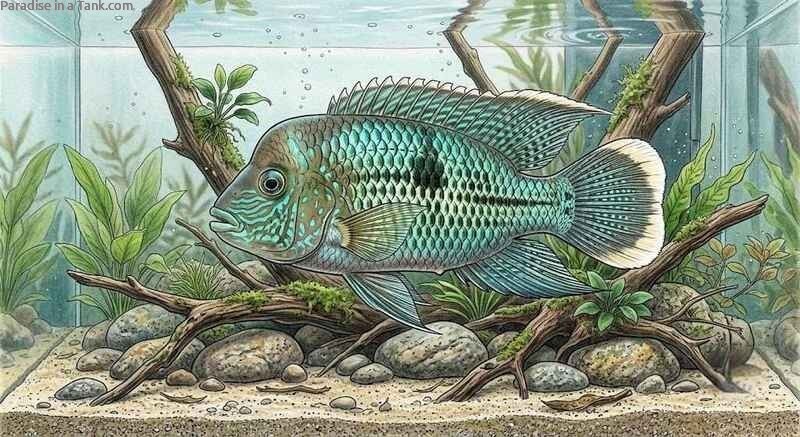
Live aquatic plants generally do not survive in a Green Terror aquarium. These fish view rooted plants like Amazon Swords or Cryptocoryne as annoying obstacles in their territory, systematically ripping them out by the roots or shredding their leaves into floating debris within minutes. If you are determined to include live greenery, stick to extremely tough, non-rooted epiphyte species like Anubias or Java Fern. Anchor them tightly to heavy driftwood pieces using fishing line or cyanoacrylate gel, placing them high up on the wood out of primary digging zones.
Water chemistry and biological filtration require relentless maintenance to keep these heavy-bodied eaters healthy. Green Terrors produce a massive biological load, generating huge amounts of organic waste, heavy poop, and uneaten food debris that quickly breaks down into toxic ammonia and nitrite. To maintain crystal-clear water and stable water chemistry, rely on high-capacity canister filters or a heavy-duty sump system rated for at least twice the volume of your aquarium. Beneficial nitrifying bacteria like Nitrosomonas (which convert deadly ammonia into nitrite) and Nitrobacter (which convert nitrite into less toxic nitrate) must be established through a full biological cycle before introducing your fish.
Maintain your water parameters within these strict environmental safety thresholds:
- Water Temperature: 75–80°F (24–27°C) using a reliable, guarded submersible heater to prevent fish from burning themselves.
- pH Range: 6.5–8.0 (aim for a stable 7.2–7.5 midpoint for optimal health).
- Water Hardness: 5–18 dGH to support proper osmoregulation.
- Nitrate Threshold: Keep nitrates strictly below 20 ppm through weekly 30–50% water changes to prevent hole-in-the-head disease.
Managing their intense environmental drives goes hand in hand with maintaining an effective daily management routine. To complement your tank setup with the right feeding strategies and compatible tank mates, review our guide on Green Terror feeding protocols and tank mate selection to build a safe, well-balanced aquatic ecosystem.
Building a habitat that respects the ancient evolutionary needs of your Green Terror is the single most rewarding effort you can undertake as a fish keeper. When you provide them with ample swimming room, smooth sand, rockwork visual barriers, and pristine water quality, their stress disappears, their colors explode into brilliant shades of blue and gold, and their fascinating personalities shine through every single day. Take the time to set up their tank correctly from day one, and you will enjoy a stunning, responsive aquatic partner for many years to come.