The Great Taxonomic Mix-Up: Rivulatus vs. Stalsbergi
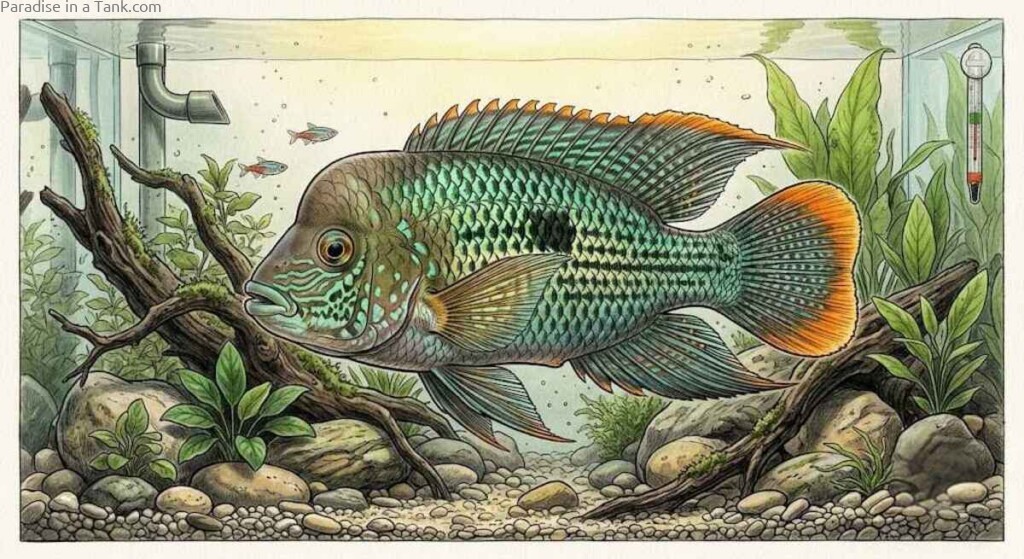
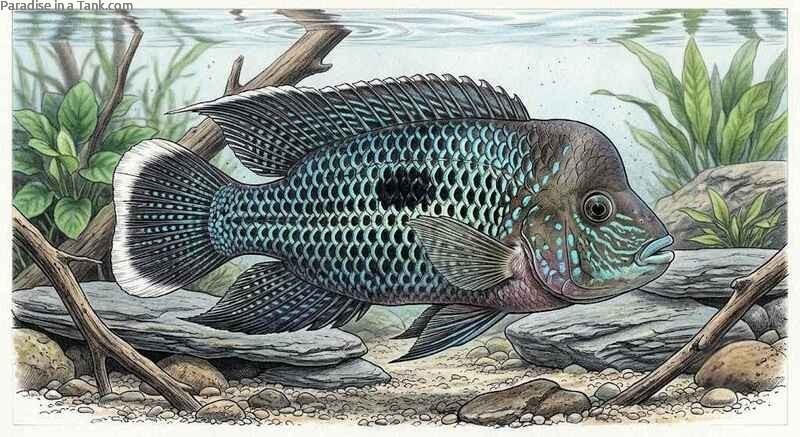
To distinguish a true Green Terror from a Gold Saum, evaluate scale illumination and fin coloration: true Green Terrors (Andinoacara stalsbergi) feature dark scale centers with glowing blue-green edges and white fin margins, whereas Gold Saums (Andinoacara rivulatus) show brilliant iridescence in scale centers framed by dark borders and bright orange-gold fin margins.
For decades, the South American cichlid trade has operated under a cloud of taxonomic confusion that leaves even seasoned hobbyists scratching their heads. When you walk into a local fish store, nearly every tank labeled as a “Green Terror” actually houses Andinoacara rivulatus, commonly known as the Gold Saum or Orange Saum. The genuine historic Green Terror, scientifically classified as Andinoacara stalsbergi, is an entirely distinct species native to the trans-Andean coastal river drainages of western Peru.
Understanding this biological divide requires peeling back layers of commercial mislabeling that trace back to early aquarium literature. When wild cichlids were first imported from South American river systems, collectors and distributors lumped several morphologically similar species under a single terrifying trade name. As a result, millions of aquarists have brought home what they believed was a true historic terror, unaware that they were actually culturing a closely related Ecuadorian cousin with fundamentally different biological markers.
If you are currently setting up a large aquarium for these formidable cichlids, taking time to master a comprehensive Green Terror care overview will give you the baseline knowledge required to keep either species thriving long-term. Both species belong to the family Cichlidae and share aggressive territorial traits, yet their precise environmental origins create distinct physiological differences. While Andinoacara rivulatus thrives in warm, sluggish lowlands of western Ecuador and extreme northwestern Peru, Andinoacara stalsbergi evolved in cool, fast-flowing coastal streams with significantly higher mineral content.
This evolutionary divergence has left clear physical footprints on their bodies. From scale geometry to fin tissue pigmentation, nature has stamped each species with unmistakable signatures. Learning how to read these biological markers allows you to instantly bypass retail mislabeling, verify specimen lineage, and provide tailored environmental conditions that prevent chronic stress, immune collapse, and premature death in your home aquarium setup.
Scale Pattern Geometry: Analyzing Light Centers vs. Dark Centers
The most reliable anatomical test for separating Andinoacara stalsbergi from Andinoacara rivulatus lies in the structural pigmentation of their scales. When you observe a cichlid’s flank under bright, full-spectrum lighting, pay close attention to how light reflects off individual scale plates across the midbody.
In a true Green Terror (Andinoacara stalsbergi), the geometry of the scale pattern is visually inverted compared to its popular cousin. Each scale features a dark, heavily melanized center surrounded by a brilliant, light-reflecting blue-green outer rim. This creates a striking, reticulated mosaic effect reminiscent of chainmail armor, where the body appears dark with a shimmering electric grid woven over the top.
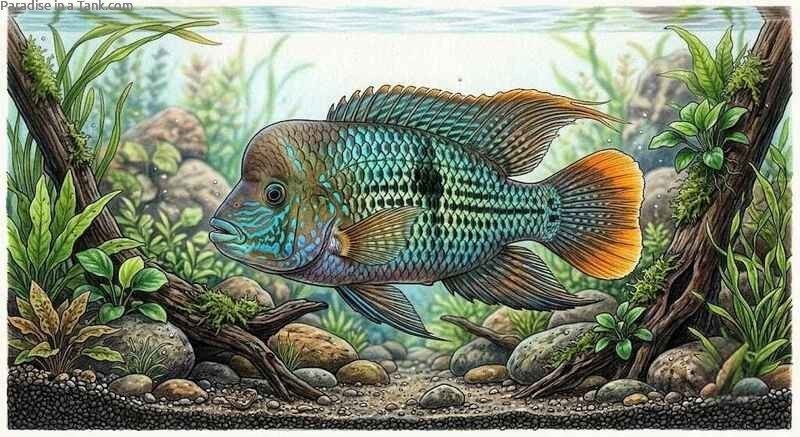
In contrast, the Gold Saum (Andinoacara rivulatus) exhibits the exact opposite color mapping. The center of each scale glows with an intense turquoise, golden-green, or emerald iridescence, while the outer edge of the scale plate is framed by a dark pigment border. This produces a radiant, mirror-like flank where bright spots dominate the body and dark lines serve merely as subtle dividers between neighboring scales.
| Biological Characteristic | True Green Terror (Andinoacara stalsbergi) | Gold Saum (Andinoacara rivulatus) |
|---|---|---|
| Scale Center Pigmentation | Dark brown to deep black core. | Iridescent turquoise or green-gold core. |
| Scale Rim Border | Bright glowing blue or metallic cyan edge. | Dark melanized outline framing the scale. |
| Overall Body Aspect | Dark armored aesthetic with metallic lattice overlay. | Bright shimmering flank with subtle dark contrast lines. |
| Native Habitat Range | Arid coastal river basins of western Peru. | Tropical river basins of Ecuador and northern Peru. |
| Typical Wild Water Temp | Cool water ranges of 20–24°C (68–75°F). | Warm water ranges of 24–28°C (75–82°F). |
To evaluate these patterns accurately, you must ensure the fish is comfortable and displaying its natural mood colors. Subordinate, terrified, or sick specimens will temporarily flood their skin with stress melanin, obscuring the delicate boundaries between scale centers and rims. Give the specimen 15–20 minutes to settle into a well-lit holding container before attempting a close visual audit of scale geometry.
Caudal Fin Margins: How Edge Trims Reveal True Species Integrity
Beyond scale geometry, the outermost margins of the caudal (tail) and dorsal fins offer an immediate visual shortcut for species verification. In aquarium parlance, the German word “Saum” translates to “hem” or “seam,” directly referencing the bold color trim running along the edges of these fin structures.
The Gold Saum (Andinoacara rivulatus) earned its name due to the brilliant orange, red, or deep gold band running along the upper border of its dorsal fin and the trailing edge of its caudal fin. This vibrant margin is caused by dense concentrations of carotenoid pigments within the fin tissue. Even in young juveniles measuring just 3–4 cm (1.2–1.5 inches), this reddish-orange rim is usually clearly visible to the naked eye under clean white light.
True Green Terrors (Andinoacara stalsbergi), on the other hand, completely lack orange or red carotenoid trims along their fin margins. Instead, stalsbergi displays a crisp, snow-white or icy-silver band bordering the dorsal and caudal fins. This stark white trim creates a dramatic contrast against their dark, lattice-patterned bodies, giving the fish a sleek, frosty silhouette that is utterly distinct from the warm golden hues of rivulatus.
Understanding these physical differences becomes especially critical when managing a juvenile’s overall tank footprint and life stages. Checking a detailed Green Terror growth trajectory reveals that both species grow rapidly, reaching 20–30 cm (8–12 inches) at maturity, meaning visual misidentification early on can lead to severe overcrowding if you fail to account for adult dimensions.
It is worth noting that environmental factors like diet can occasionally confuse novice keepers. Feeding high-carotenoid foods rich in astaxanthin to a white-trimmed fish will not turn its fins orange, because stalsbergi lacks the biological receptors to deposit orange pigment into its fin margins. If a specimen displays even a faint trace of orange or yellow along its tail seam, you are unequivocally looking at a member of the rivulatus complex.
Profiling the Modern Selective Breeding Morphs
The Striking White Saum and Royal Green Terror Modifications
As commercial aquaculture expanded across Southeast Asia and Florida fish farms, breeders began selectively line-breeding Andinoacara rivulatus to isolate naturally occurring genetic mutations. This selective pressure birthed several distinct color variants that frequently confuse aquarists trying to distinguish wild species from man-made aquarium strains.
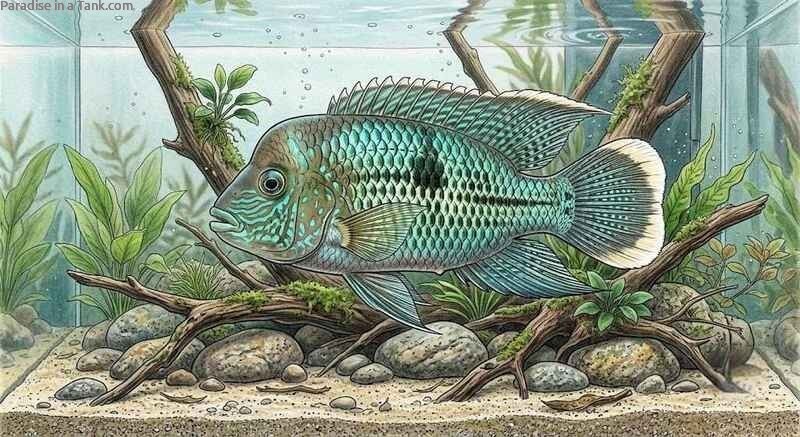
The most widespread variant is the White Saum. While wild Andinoacara rivulatus typically showcase vibrant orange or gold fin seams, occasional wild individuals express a recessive gene that replaces orange carotenoids with pure white or silver tissue along the fin margins. By breeding these naturally occurring white-edged rivulatus together, farms established stable lines of White Saums.
It is critical not to confuse a White Saum (Andinoacara rivulatus) with a true Green Terror (Andinoacara stalsbergi). While both feature white tail edges, the White Saum retains the scale geometry of rivulatus—meaning bright scale centers with dark outer borders. A true stalsbergi combines white fin margins with dark scale centers and light outer borders, alongside a noticeably longer, more elongate head profile and finer vermiculation patterns across the gill covers.
Another popular commercial strain is marketed under names like the “Royal Green Terror” or “Super Color Terror.” These specimens are not distinct species or hybrids, but rather intensely line-bred rivulatus selected over generations for exaggerated turquoise coverage across the face and midbody. These fish often feature metallic blue striping that completely covers the cheeks, extending down to the branchiostegal membranes under the throat.
- White Saum Variant Risks: Higher rate of inbreeding depression, reduced immune resistance to systemic bacterial pathogens like Aeromonas, and reduced lifelong fecundity.
- Super Color Strain Threats: Increased risk of genetic spinal curvature, heightened intra-species aggression in males due to elevated testosterone expression, and increased susceptibility to intestinal parasites.
- Wild-Type Hybrid Warnings: Unscrupulous breeders occasionally cross White Saums with Gold Saums, resulting in muddy, uneven fin margins that show dirty yellow or patchy orange-white seams.
The Compact Anomalies: Evaluating the Short-Body Balloon Morph Variant
In recent years, the ornamental fish trade has seen a surge in “short-body” or “balloon” morphs of large South American cichlids. These fish undergo selective line-breeding for a severe skeletal mutation known as lordosis or scoliosis, which drastically compresses the vertebral column and forces the internal organs into a cramped abdominal cavity.
Evaluating a Short-Body Gold Saum requires looking past the flashy colors to analyze its compromised internal mechanics. The shortened spine forces the swim bladder into an abnormal angle, impairing the fish’s ability to regulate buoyancy efficiently. These short-body morphs often display a frantic, wobbly swimming motion, burning twice as many calories as normal wild-type specimens just to maintain position in moderate water currents.
From an environmental and physiological standpoint, keeping short-body morphs presents severe welfare challenges:
- Organ Compression Stress: Compressed gastrointestinal tracts lead to frequent swim bladder inflation failures, severe constipation, and fatal intestinal impactions when fed dry, low-fiber commercial pellets.
- Reduced Spawning Efficiency: Females frequently suffer from egg binding (dystocia) because the shortened pelvic cavity prevents normal egg passage during spawning events.
- Diminished Defensive Capability: Unable to swim with natural speed or agility, short-body morphs are easily cornered, harassed, and battered to death by standard tank mates or dominant wild-type cichlids.
If you choose to keep these compact anomalies, you must adjust your husbandry protocols significantly. Maintain water currents at low levels using spray bars, keep water parameters extremely clean with zero ammonia and nitrite, and implement a specialized dietary regimen heavy on soaked pellets and high-fiber frozen foods to keep their compromised digestive systems moving smoothly.
Sexing Profiles: Visceral Markers to Tell Males from Females
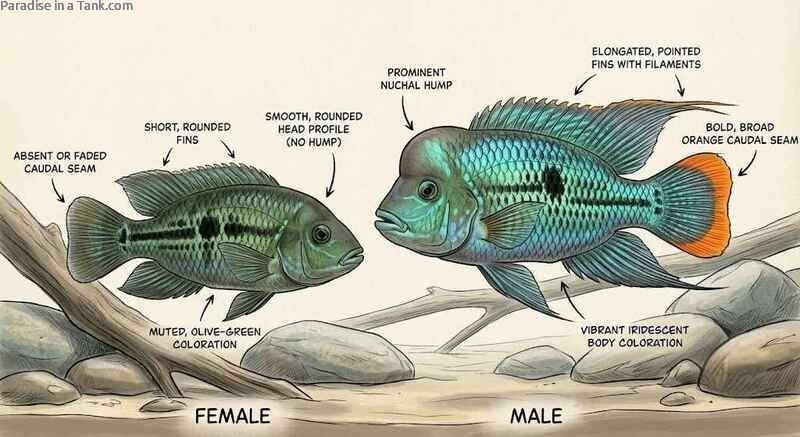
Determining the sex of Andinoacara species requires analyzing a combination of physical body structures, color intensity, and behavioral posture. While juvenile cichlids under 7–8 cm (2.8–3.1 inches) look virtually identical, sexual dimorphism becomes increasingly obvious as fish approach sexual maturity at around 10–12 months of age.
In adult males of both Andinoacara rivulatus and Andinoacara stalsbergi, the most dramatic physical marker is the development of a prominent nuchal hump (occipital swelling) on top of the head. This hump consists of dense fatty tissue and fluid reserves that expand during breeding cycles, driven by surging androgen levels. Females never develop a large nuchal hump, maintaining a smooth, sloped forehead line throughout their lives.
Coloration and fin morphology provide additional clues for rapid field sexing:
- Dorsal and Anal Fin Extensions: Adult males develop long, pointed extensions on the soft rays of their dorsal and anal fins that frequently trail past the base of the caudal fin. Female fin tips remain rounded and rarely extend past the start of the tail base.
- Facial Iridescence and Masking: Males possess dense, unbroken metallic turquoise worming (vermiculation) across their gill plates and snouts. Females display muted, broken facial lines with significant dark background skin showing through.
- Body Profile and Abdominal Contour: Females exhibit a deeper, more rounded pelvic profile designed to accommodate developing ovary tissue. Males maintain a streamlined, muscular, torpedo-like body contour.
- Urogenital Papilla Structure: During spawning, the male’s papilla emerges as a thin, pointed, backward-pointing spike, whereas the female’s vent extends into a thick, blunted, broad cylinder designed for laying large egg clutches.
To minimize territorial clashes between males, keeping a structured community requires a targeted Green Terror diet and compatibility plan that accounts for the aggressive drive of dominant males guarding territory against rivals.
Sourcing Integrity: What to Look For When Evaluating Specimens for Sale
When standing in front of a holding tank at an aquarium shop or evaluating photos from an online importer, you need a disciplined evaluation framework to ensure you purchase a healthy, genetically sound specimen rather than a stressed, diseased, or mislabeled fish.
Start by examining the overall physical posture and swimming mechanics of the group. Healthy Andinoacara specimens are naturally curious, highly assertive, and intensely aware of their surroundings. They should hold their fins fully erect, lock eyes with you as you approach the front glass, and actively defend small patches of substrate or gravel. A fish hovering motionless in a top corner with clamped fins or resting heavily on the bottom substrate is exhibiting clear signs of systemic stress or organ failure.
Run a rigorous physical diagnostic down the fish’s body using this observational checklist:
- Eyes and Ocular Clarity: The cornea must be crystal clear with no cloudiness, swelling, or bulging (exophthalmia). The pupil should react quickly to light shifts.
- Gill Plate Movement: Operculum covers should open and close in a smooth, steady rhythm (around 40–60 beats per minute). Avoid specimens showing rapid flaring, gasping at the surface, or red inflamed gill filaments indicative of ammonia burns or gill flukes (Dactylogyrus).
- Substrate Depressions and Dorsal Muscle Mass: Inspect the muscular ridge running along the top of the back directly above the lateral line. If the muscle is sunken or pinched (“knife-backed”), the fish is suffering from chronic internal parasites, such as Hexamita, or long-term starvation.
- Fecal Trail Integrity: Look at the urogenital area. Healthy feces appear as thick, dark brown or dark green solid tubes. White, stringy, hollow, or segmented fecal trails indicate active intestinal flagellate infections or internal bacterial enteritis.
- Fin Tissue and Base Margins: Fins should be translucent and crisp without frayed edges, white cottony growths (Saprolegnia), or red blood-streaked veins running through the rays.
| Inspection Factor | Indicator of Healthy Specimen | Indicator of Diseased or Compromised Specimen |
|---|---|---|
| Behavior & Awareness | Bold, alert, defends territory, begs for food. | Lethargic, hides behind heaters, clamped fins. |
| Dorsal Musculature | Full, rounded muscle mass along upper spine. | Sunken, razor-thin back profile (“knife-back”). |
| Fecal Output | Thick, solid, dark brown or green drop. | Stringy, white, clear, or floating fecal casts. |
| Skin & Scale Condition | Smooth, iridescent, fully intact scale rows. | Missing scales, excess mucus coat, white spots. |
| Mouth Structure | Clean jaw alignment without sores or growths. | Cottony mouth fungus, swollen or eroded lips. |
If your goal is specifically to acquire a true Green Terror (Andinoacara stalsbergi), deal exclusively with specialized wild-import vendors who can provide precise collection locality data from Peruvian drainages like the Rio Tumbes or Rio Chira. True stalsbergi are rare in mainstream retail channels and command significantly higher prices than commercial Gold Saums. Expect to pay premium rates for wild-caught or wild-F1 stock, and double-check all physical characteristics—specifically dark scale centers and white fin margins—before completing your purchase.
Once you bring your chosen specimen home, isolate it in a dedicated quarantine system for a minimum of 3 to 4 weeks. Observe its feeding response, monitor its waste output, and maintain pristine water parameters with zero ammonia, zero nitrite, and nitrates below 20 ppm. By validating species integrity early and committing to disciplined husbandry from day one, you will enjoy a stunning, long-lived apex predator that stands as a true crown jewel in your home aquarium.