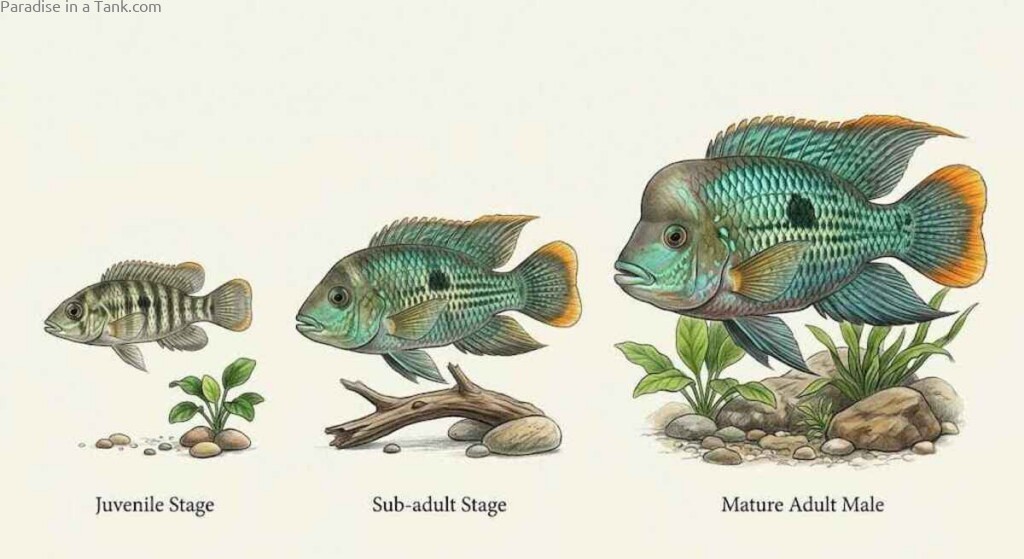
Growth Trajectories and Final Physical Dimensions
Male Green Terror cichlids reach a maximum adult size of 25–30 cm (10–12 inches), while females stay significantly smaller at 15–20 cm (6–8 inches). Growth occurs rapidly during the first year, averaging 1.5–2.5 cm (0.5–1.0 inch) per month under optimal conditions before tapering off as the fish approaches physical and sexual maturity around 18–24 months.
To truly understand the trajectory of Andinoacara rivulatus, you must look past the tiny, shimmering 5 cm juveniles sitting in pet shop display tanks. Those eager little fish are biological time bombs wrapped in iridescent emerald scales. In their natural habitat within the river basins of Ecuador and Peru, these fish evolved as apex predatory cichlids built to muscle through fast waters and dominate territory. When you bring one home, you are taking on millions of years of predatory genetics hardwired into a muscular frame that will expand far faster than most beginner fish keepers anticipate.
If you want your specimen to thrive into a robust, vibrant adult, mastering the broader parameters of the ultimate Green Terror care guide is essential for long-term health. Ignoring their relentless expansion leads directly to stunted spinal columns, aggressive territorial meltdowns, and premature organ failure.
Max Size Benchmarks: How Large Do Males and Females Actually Grow?
Sexual dimorphism in Andinoacara rivulatus is pronounced, impacting not only the total length of the fish but also its overall physical mass and structural footprint. A mature male Green Terror is a thick, deep-bodied tank of a fish that easily reaches 25 to 30 cm in total length. Exceptional wild specimens and well-cared-for captive males can occasionally push past 30 cm, boasting a massive structural profile, elongated dorsal and anal fin filaments, and a pronounced nuchal hump (a storage organ of fatty tissue that swells on the forehead as dominant males mature).
Females present a much more compact physical profile. A fully grown female typically caps out between 15 and 20 cm in length. While smaller in stature, females develop deep abdominal cavities designed to hold hundreds of eggs, making them noticeably rounder through the midsection when conditioned for spawning. They lack the extreme bulk and aggressive cranial hump of the males, but their territorial fire is every bit as intense.
It is also worth noting that many hobbyists confuse true Andinoacara rivulatus with closely related variants that exhibit slightly different growth patterns. Differentiating between color morphs and true species lines is critical, which is why reviewing the details on identifying True Green Terrors versus Gold Saums helps ensure you are accurately calculating the final biomass of your specific fish.
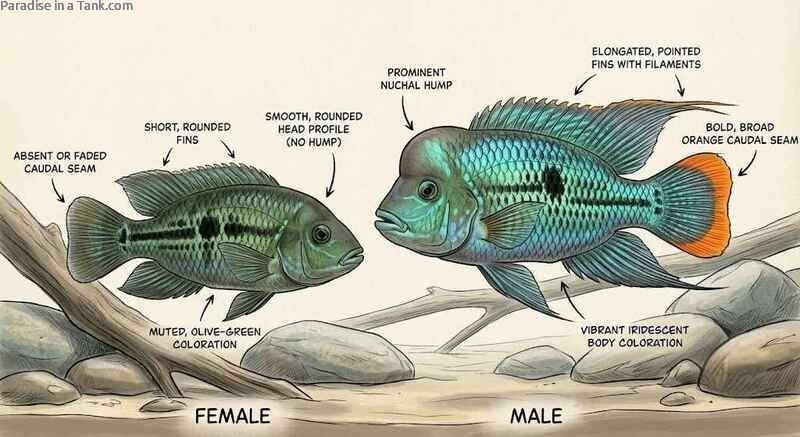
| Gender Profile | Average Length (cm / inches) | Key Physical Markers | Development Timeline |
|---|---|---|---|
| Mature Male | 25–30 cm (10–12 inches) | Prominent cranial nuchal hump, extended fin filaments, deep chest mass. | Reaches maximum size between 18–24 months. |
| Mature Female | 15–20 cm (6–8 inches) | Thicker abdominal contour, shorter fins, richer dark barring during breeding. | Reaches maximum size between 12–18 months. |
The Full Grown Timeline: Tracking the Growth Milestones of Juvenile Inhabitants
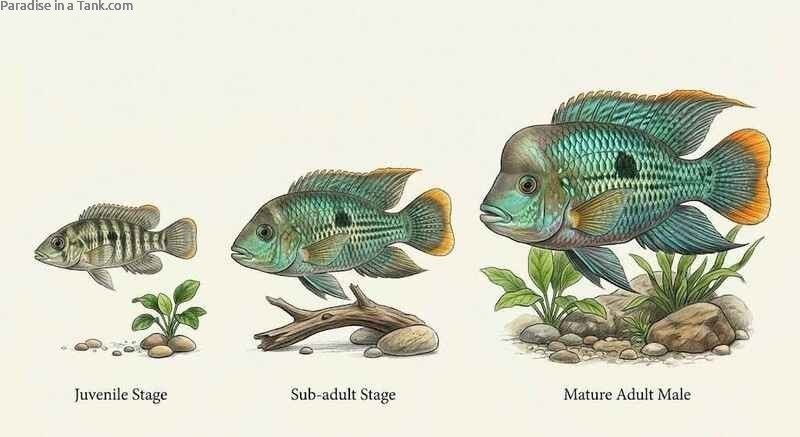
The journey from a fragile juvenile to a dominant adult occurs in distinct, measurable developmental phases. During the first 6 months of life, a young cichlid burns through energy at a staggering rate. Under steady water quality and proper nutrition, a juvenile will surge from a 2.5 cm fry to a aggressive 10–12 cm adolescent in what feels like the blink of an eye. During this initial surge, you can almost watch them grow daily as they gobble up food and constantly test boundaries.
As the fish passes the 12-month mark, its linear growth slows down noticeably, shifting from length accumulation to structural thickening. Between 12 and 24 months, the fish enters its adult filling-out phase. Males begin developing their thick neck muscles and broad forehead humps, while their coloration shifts from muted grey-green striping to intense electric blue, orange, and metallic green spangling.
- Months 1–6 (Juvenile Stage): Rapid linear growth rate of 1.5–2.5 cm per month; fish reaches 10–12 cm.
- Months 7–12 (Adolescent Stage): Growth tapers to 0.8–1.2 cm per month; sexual maturity begins; fish reaches 15–18 cm.
- Months 13–24 (Adult Maturation Stage): Growth shifts toward bulk and muscle mass; reaches final benchmark length of 20–30 cm.
- Months 25+ (Maintenance Phase): Linear growth ceases; metabolic energy goes into tissue repair, fin extension, and crest maintenance.
If your fish stalls out at 10–12 cm and shows no sign of growth for months on end, your environment is actively choking its genetic potential. Stunting is not a harmless cosmetic delay; it is a lethal physiological condition where the outer skeleton stops growing while internal organs continue to expand, leading to a slow, painful death.
Engineering the Large-Scale Cichlid Enclosure
Minimum System Volumes: Why Mature Specimens Mandate 280 Liters (75 Gallons)
You cannot keep a 25 cm, highly aggressive cichlid in a standard 110-liter (30-gallon) tank. Doing so is an invitation to biological disaster. A mature specimen demands a absolute minimum enclosure volume of 280 liters (75 gallons) for a single individual. If you intend to house a male and female pair or attempt a community configuration, you must immediately scale up to a 470-liter (120-gallon) footprint or larger.
The reason for this strict spatial requirement boils down to simple physics and water chemistry. A giant, active cichlid produces massive amounts of organic waste every single day. In a small volume of water, metabolic excrement causes rapid spikes in toxic compound levels. Furthermore, these fish are intensely territorial animals that require distinct line-of-sight breaks and physical swimming lanes. Constricting them to small spaces drives their stress hormones through the roof, triggering unprovoked, lethal aggression toward any companion in the tank.
- 280 Liters (75 Gallons): Bare minimum boundary for a single solitary adult specimen.
- 470 Liters (120 Gallons): Minimum recommended footprint for a breeding pair or robust community tank.
- 600+ Liters (150+ Gallons): Ideal volume for long-term stability, reduced aggression, and easy water quality maintenance.
Hardscape Anchoring: Preventing Glass Damage from Large Excavating Fish
Green Terrors do not simply swim around decor; they actively reconstruct their environment. They are bulldozers with fins. When a 25 cm male decides to dig a spawning pit or establish a territorial boundary, he will grab mouthfuls of substrate, scoop out kilograms of gravel, and aggressively thrash against rock structures to move them out of his way.
If you pile heavy slate, river stones, or heavy driftwood directly on top of a deep substrate bed, your fish will eventually dig underneath those rocks, undermining their structural support. It takes only one displaced base rock to cause a catastrophic stone collapse directly into the glass base or sidewalls of your aquarium.
To avoid structural failures, always place your heavy hardscape rocks directly onto the bare glass floor (or on top of a protective sheet of high-density eggcrate plastic) before pouring in your substrate layer. This ensures that no matter how much gravel your fish moves, the heavy stones remain permanently anchored and cannot tip over into the glass.
Water Acuity Benchmarks: Managing High Bio-Loads with Heavy Turnover Filtration
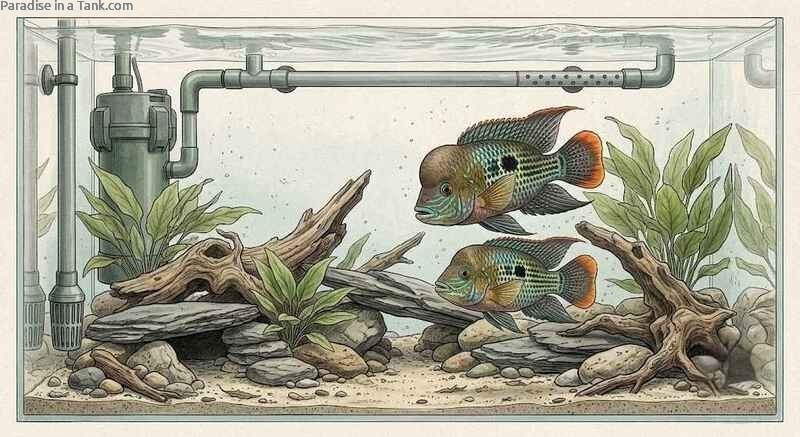
Feeding a large cichlid high-protein foods results in hefty metabolic output. Leftover food particles, heavy feces, and massive urea production quickly overload standard mechanical and biological filtration. Maintaining pristine water conditions requires a filtration system capable of turning over the full volume of the tank 8 to 10 times per hour.
A standard hang-on-back filter will quickly clog, stall, and fail under this kind of bio-load. Canister filters packed with dense biological media (such as sintered glass rings or porous ceramic matrix) are mandatory. These filter media beds host massive colonies of beneficial nitrifying bacteria like Nitrosomonas and Nitrobacter, which constantly process toxic ammonia into nitrite, and subsequently convert nitrite into less harmful nitrate.
Alongside robust filtration, a disciplined feeding regimen is crucial to prevent unconsumed food from rotting on the substrate. Implementing a structured schedule using tailored Green Terror feeding protocols and tank mate coordination guidelines ensures your fish receives dense nutrition without fouling the water chemistry.
To keep nitrogenous waste within safe zones, establish a strict maintenance routine that targets key bio-load indicators:
- Ammonia Threshold: Exactly 0 PPM at all times; any positive reading signals a broken biological filter.
- Nitrite Threshold: Exactly 0 PPM at all times; highly toxic to fish gills and bloodstream oxygen transport.
- Nitrate Target Boundary: Keep consistently below 20 PPM through weekly 30–50% water changes.
- Filter Turnover Rate: Aim for a total mechanical and biological flow rate of 8–10 times the total tank volume per hour.
Environmental Triggers: Maintaining Optimal Temperature and 6.8–8.0 pH Thresholds
In tropical South American river systems, environmental stability is maintained by massive water volumes. In a captive aquarium, however, rapid fluctuations in water temperature or chemistry act as severe stressors that instantly compromise a fish’s immune system. To keep your cichlid operating at peak physical health, you must establish and hold tight environmental baselines.
The optimal water temperature range for Andinoacara rivulatus is 24–26°C (75–79°F). Running your tank cooler than 24°C slows down the fish’s metabolic process, inducing lethargy, suppressing appetite, and inviting opportunistic parasite infections like Ich (Ichthyophthirius multifilis). Conversely, running temperatures consistently above 28°C accelerates the fish’s metabolism to unsafe levels, driving up territorial aggression, reducing dissolved oxygen saturation in the water, and prematurely shortening the animal’s lifespan.
When it comes to water chemistry, these cichlids are remarkably adaptable compared to delicate Amazonian discus, but they still require stable parameters. Aim for a pH range between 6.8 and 8.0, with general hardness (GH) maintained between 5 and 15 dGH. Rapid shifts in pH are far more dangerous than an imperfect reading. A sudden drop of 0.5 in pH causes severe osmotic shock, strips away the protective slime coat, and leaves the skin open to secondary bacterial infections.
Invest in a reliable digital heater, keep a backup unit on hand, test your water parameters weekly with a liquid test kit, and treat your aquarium like the delicate ecosystem it really is. When you respect the biological scale, environmental requirements, and physical growth bounds of the Green Terror, you will be rewarded with one of the most stunning, personable, and dominant display fish in the freshwater hobby.