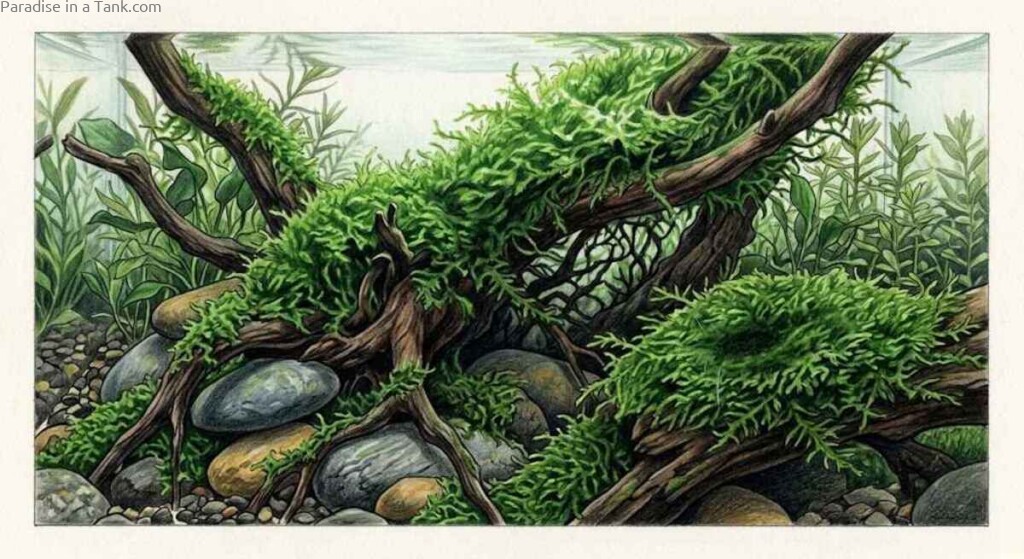
Introduction to Freshwater Aquarium Mosses
Aquarium mosses are rootless bryophytes that thrive in water temperatures between 65°F–80°F, pH levels of 6.0–7.5, and low to moderate lighting. They absorb dissolved nutrients like nitrate directly through their delicate fronds, making them ideal for water purification, fry protection, and creating lush natural aquascapes without demanding heavy maintenance.
Freshwater aquarium mosses represent one of the most versatile, resilient, and visually captivating plant groups available to aquarists today. Unlike traditional rooted plants that rely on dense gravel beds and nutrient-heavy root tabs, mosses belong to an ancient botanical division known as bryophytes. They do not possess true vascular roots, seeds, or flowers. Instead, they cling to hardscape surfaces using microscopic anchoring filaments called rhizoids, drawing everything they need to survive directly out of the water column.
When you bring moss into your aquarium, you are inviting millions of years of evolutionary efficiency into your tank. Mosses adapt seamlessly to micro-climates, filling structural gaps between jagged rocks, twisting driftwood, and dark corners where standard stem plants wilt and rot. However, their simplicity can be deceptive. While mosses are famously hard to kill outright, growing a clean, vibrant, pest-free specimen requires a firm grasp of their unique biological needs. Ignore their structural tendencies, and your velvety green accent will quickly transform into a tangled trap for decaying detritus and choking hair algae.
The Role of Moss in the Aquarium Ecosystem (Fry Hiding Spots & Biofilm Cultivation)
Beyond their undeniable visual appeal, aquarium mosses serve as functional biological powerhouses within closed aquatic ecosystems. The intricate, branching architecture of moss fronds creates thousands of tiny interstitial spaces. These tiny physical pockets act as mechanical micro-filters, capturing floating organic particles and organic debris before it settles into your substrate.
For breeding tanks and community aquariums, this dense structural matrix is nothing short of a lifesaver. Shyness is a survival mechanism for vulnerable newborn organisms like baby shrimp and fish fry. Newly hatched fish fry and tiny dwarf shrimp rely on dense moss clumps as physical shields against hungry adult tankmates. Without these micro-refuges, vulnerable fry get snapped up within minutes of emerging. Furthermore, the massive surface area of a healthy moss colony provides the perfect breeding ground for microscopic organisms, particularly microscopic bacteria, single-celled protozoa, and infusoria.
These tiny microscopic organisms form a nutrient-rich layer known as biofilm. Biofilm coats every single tiny leaflet of the moss frond, offering an endless, round-the-clock buffet for delicate grazing mouths. Baby cherry shrimp and larval fish do not need to hunt aggressively across the tank; they simply sit tucked deep inside the safety of the moss frond and continually scrape off microscopic biofilm, drastically boosting survival rates during their critical first weeks of life.
Rootless Anatomy: How Moss Absorbs Nutrients Through the Water Column
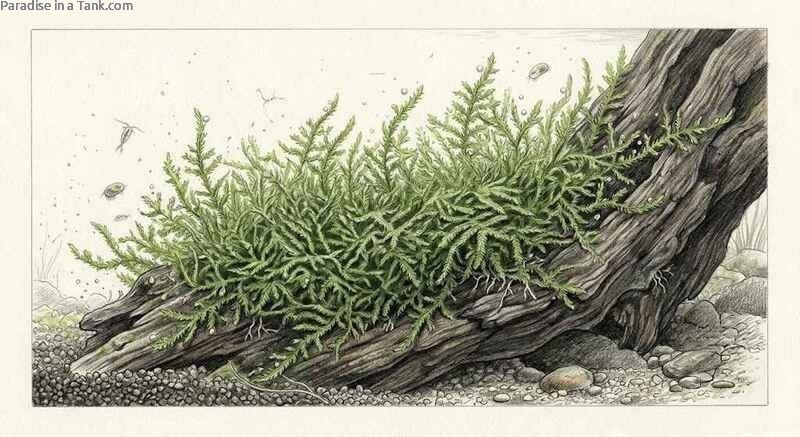
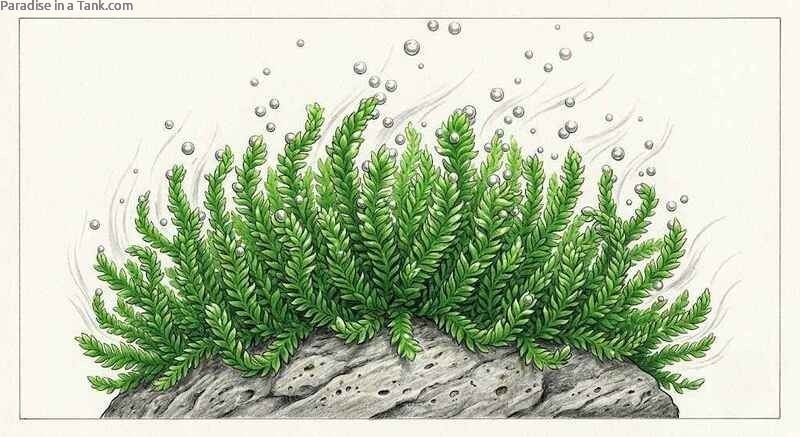
To grow healthy moss, you must discard everything you know about terrestrial gardening. Traditional aquatic plants use vascular internal tubing to draw nutrients up from their root systems into their leaves. Mosses completely lack these internal transport pipelines. They do not have true roots to draw nourishment from rich soils. What look like root hairs on the underside of a moss frond are actually rhizoids. Rhizoids serve a single, non-nutritional purpose: mechanical anchorage. They function like tiny biological crampons, locking the moss firmly onto rough bark or porous stone.
Because mosses lack roots and internal vascular pipelines, every single cell on every tiny leaf is directly exposed to the surrounding water column. Nutrient absorption happens through simple cellular diffusion. Ammonia, nitrate, phosphate, and trace minerals like potassium enter the leaf tissues directly across permeable cell walls. This anatomical reality means that soil fertilizing tabs buried deep in your gravel will do absolutely nothing for your moss. If nutrients are not present in the water surrounding the fronds, the moss starves. However, this same high-surface absorption rate makes mosses exceptionally efficient biological filters that actively strip excess nutrients out of your water.
The Big Four: Top Aquarium Moss Varieties
While there are dozens of bryophyte species circulating through the trade, four distinct varieties dominate modern aquascaping. Each species offers a unique structural growth habit, texture, and aesthetic effect. Choosing the right variety depends entirely on whether you want a wild tangled jungle, neat evergreen branches, striking vertical flames, or cascading green waterfalls. For a detailed side-by-side comparison of growth habits and light requirements, check out our comprehensive guide comparing Java Moss, Christmas Moss, and Flame Moss before picking your centerpiece species.
- Java Moss (Taxiphyllum barbieri): The hardy, fast-growing beginner standard. Java moss features delicate, irregularly branched green fronds that form loose, chaotic clumps. It tolerates extreme parameter swings, thrives in low light, and rapidly attaches to almost any surface.
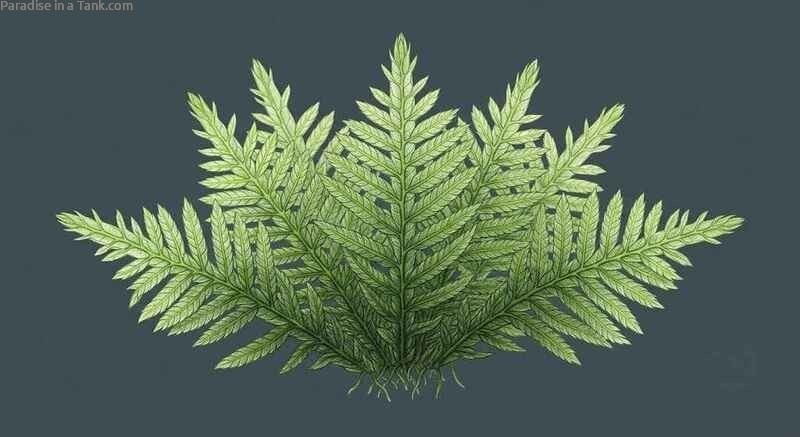
- Christmas Moss (Vesicularia montagnei): Dense, triangular fronds resembling fir tree branches. Named for its distinct fern-like fronds that overlap into overlapping Christmas tree shapes, this species grows slower and neater than Java moss, requiring moderate lighting to form tight, compact pads.
- Flame Moss (Taxiphyllum sp.): Unique vertical, upward-twisting growth patterns. Flame moss grows strictly upward in tight, spiraling green shoots that resemble tiny green flames. It rarely branches laterally, making it ideal for creating vertical texture along background walls and thick logs.
- Weeping Moss (Vesicularia ferriei): Downward-draping growth perfect for elevated driftwood branches. Characterized by distinctly drooping, tear-drop frond tips, weeping moss grows downward over edges, producing a striking weeping willow effect when attached to high driftwood branches.
Water Parameters & Ideal Growth Conditions
Understanding water chemistry and light dynamics is the boundary between keeping a dirty, brown blob and cultivating a thriving emerald carpet. Mosses are tough, but they are highly sensitive to sudden parameter shifts and improper lighting schedules.
| Parameter Variable | Recommended Target Range | Biological Impact on Moss Health |
|---|---|---|
| Water Temperature | 65°F–75°F (Limit: 80°F) | Cooler water boosts oxygen levels and prevents center tissue decay. |
| pH Range | 6.0–7.5 | Neutral to slightly acidic water optimizes cellular nutrient intake. |
| General Hardness (GH) | 3–10 dGH | Provides essential dissolved calcium and magnesium for structural stability. |
| Nitrate Levels | 5–15 PPM | Supplies necessary nitrogen for lush leaf production without fueling algae. |
| Light Intensity | 15–30 PAR (Low to Moderate) | Supports steady photosynthesis while keeping nuisance algae at bay. |
Lighting: Low to Moderate Needs (Why High Light Triggers Hair Algae)
One of the most common mistakes novice aquarists make is blasting their aquarium moss with high-intensity LED light under the mistaken impression that more light equals faster growth. High lighting on aquarium moss is a direct recipe for disaster. Mosses evolved in shaded forest streams, beneath canopy overhangs, and on damp riverbanks. Their cellular machinery is tuned for efficient light collection under low to moderate lighting conditions (roughly 15–30 PAR).
When you hit moss with intense light, two devastating things happen. First, the plant becomes overwhelmed by photosynthetic stress, causing the fronds to turn pale yellow or brown. Second, mosses grow at a naturally slow to moderate pace compared to aggressive stem plants. High light introduces far more energy into the water column than the moss can physically utilize. Opportunistic hair algae and filamentous green algae immediately step in to consume the excess light energy. Because hair algae weaves directly through the microscopic fronds of the moss, physically removing it without destroying the underlying plant is virtually impossible. Keep your lighting low to moderate, and limit photoperiods strictly to 6–8 hours daily.
Temperature (65°F–80°F) and Gentle Water Flow Requirements
Temperature plays a major role in cellular respiration and growth density. While mosses can survive across a wide range of 65°F–80°F, they show a clear preference for cooler water between 65°F–72°F. In warmer water approaching 80°F, dissolved oxygen levels plummet while the plant’s metabolic rate speeds up. This metabolic mismatch forces the moss to consume its stored energy faster than it can produce it, leading to thin, leggy fronds and center rot.
Water movement is equally critical. Mosses require a gentle, consistent water current to sweep away trapped organic detritus and replenish fresh dissolved nutrients around their unrooted fronds. However, avoid placing moss directly in front of heavy powerhead blasts or filter outlets. High turbulent flow will tear delicate fronds off their hardscape mounts, flinging moss fragments across your tank to take root in unwanted corners. A gentle, circulating flow keeps the fronds clean, oxygenated, and firmly anchored.
CO2 and Liquid Fertilizer Dosing for Accelerated Growth
Carbon dioxide (CO2) injection and liquid fertilizer dosing are completely optional for basic moss survival, but they act as major accelerators if you desire dense, bright green frond pads. Without CO2, mosses grow at a modest speed, maintaining a darker green shade. Introducing pressurized CO2 at modest levels (10–15 PPM) dramatically accelerates growth rates, encouraging fronds to branch far more densely into compact, pillow-like structures.
When dosing liquid fertilizers, exercise strict restraint. Remember that mosses consume tiny amounts of macro and micronutrients directly from the water column. Excessive doses of iron, phosphate, or liquid nitrogen will instantly trigger massive outbreaks of staghorn or brush algae on the moss leaves. Use a lean liquid fertilizer regime, dosing roughly half or one-quarter of the manufacturer’s recommended strength once a week after water changes.
How to Attach and Plant Aquarium Moss
Because mosses do not possess true roots, you cannot simply dig a hole in your gravel substrate and bury them. Burying moss stems beneath heavy gravel or sand chokes off light and water flow, causing the buried tissue to turn black and rot away within days. Instead, you must anchor the moss onto hardscape surfaces until its natural rhizoids grow out and lock down. If you need step-by-step physical techniques for attaching moss to driftwood, rocks, or mesh carpets, master these three reliable methods:
- Cyanoacrylate Super Glue: The fastest method for spot-attaching to dry rocks. Gel-based cyanoacrylate super glue is 100% aquarium safe because it cures instantly upon contact with moisture, forming an inert bond. Dab a tiny dot of gel glue onto a dry stone or wood surface, press a small clump of moss firmly onto the dot for 10 seconds, and submerge it. The glue will turn slightly white underwater, but expanding moss fronds will quickly hide the bond site within a few weeks.
- Cotton Thread / Fishing Line: Wrapping thin layers over driftwood branches. For large driftwood branches, spread moss out in a thin, single-layer mat over the wood. Wrap dark cotton thread or thin 2-lb monofilament fishing line tightly around the wood, spacing wraps roughly a quarter-inch apart. Cotton thread slowly biodegrades over 4–6 weeks—by which time the rhizoids have attached naturally—while clear fishing line remains permanently hidden beneath lush growth.
- Stainless Steel Mesh: The secret to creating lush foreground moss carpets. Sandwich a thin, even layer of moss between two sheets of grade-316 stainless steel wire mesh, securing the edges with cable ties or bending the mesh corners down. Place the flat mesh directly onto your substrate. Over several weeks, vertical shoots will grow up through the grid openings, forming a perfectly uniform, heavy green carpet that stays weighted on the tank floor.
Maintenance, Trimming & Algae Control
A newly planted moss setup looks fantastic, but long-term success depends on disciplined ongoing maintenance. Without regular care, even the healthiest moss pad will turn against itself.
The Danger of Overgrowth: Why Thick, Untrimmed Moss Rots From the Center Out
The most destructive trap for hobbyists is allowing moss pads to grow unchecked into thick, heavy pillows. As the outer layers of moss grow toward the light, they expand and create a dense, light-proof umbrella over the lower stems anchored to the wood or rock below.
Cut off from light, oxygen, and fresh water circulation, these interior anchor fronds slowly suffocate and die. The tissue turns yellow, then brown, and finally breaks down into a foul, muddy sludge. Because the base is rotting away, the entire top layer of healthy moss loses its physical anchor. One day, a sudden bump from a passing fish or filter current will cause the massive, beautiful moss pad to detach entirely and float away, leaving behind a bare, slimy piece of driftwood. Prevent this structural collapse by using sharp curved aquascaping scissors to trim moss regularly, keeping pads under 1–2 inches in thickness.
Algae Prevention: Using Amano Shrimp and Cherry Shrimp as Dedicated Moss Cleaners
Because mosses trap detritus and grow at a moderate pace, they are constantly vulnerable to micro-algae colonization. Chemical algae treatments, liquid carbon glutaraldehyde glues, and copper-based algicides should never be used in a moss tank—these chemicals break down the delicate single-cell leaf structures of mosses, causing them to turn brown and melt.
Instead, employ a natural biological cleanup crew. Amano shrimp (Caridina multidentata) and Neocaridina cherry shrimp (Neocaridina davidi) are undisputed masters of moss maintenance. Their tiny, delicate claws act like mechanical tweezers, picking through individual fronds to pluck out trapped fish waste, fine detritus, and emerging hair algae without damaging the plant tissue. A small colony of 5–10 shrimp per 10 gallons will keep your moss completely free of debris and sparkling green year-round.
Propagation Techniques
Propagating aquarium moss is remarkably easy and virtually foolproof due to the plant’s high cellular regeneration capacity. Unlike delicate flowering plants that require specific node cuttings or seed collection, every single healthy piece of moss frond contains the genetic programming required to generate an entirely new plant colony.
To propagate your moss, simply remove a dense pad from the tank and lay it flat on a damp paper towel. Using clean, sharp aquascaping shears, snip the fronds into small fragments roughly a half-inch to one inch in length. Do not be afraid to cut aggressively; chopping the fronds actually stimulates dormant lateral buds, forcing the plant to throw out multiple new growing points.
Once chopped, gather the tiny fragments and distribute them thinly onto new pieces of stone, porous ceramic rings, or driftwood. Anchor them securely using the super glue or wrapping methods detailed earlier. Place the newly seeded hardscape into a brightly shaded area of your aquarium with gentle water flow. Within 7 to 14 days, tiny bright-green growth tips will emerge from each cut end, giving rise to brand-new, dense moss colonies ready to transform your aquascape. Maintain low light, clean water, and steady trimming, and your moss will reward you with an enduring, vibrant underwater forest for years to come.