Choosing the Right Enclosure Type
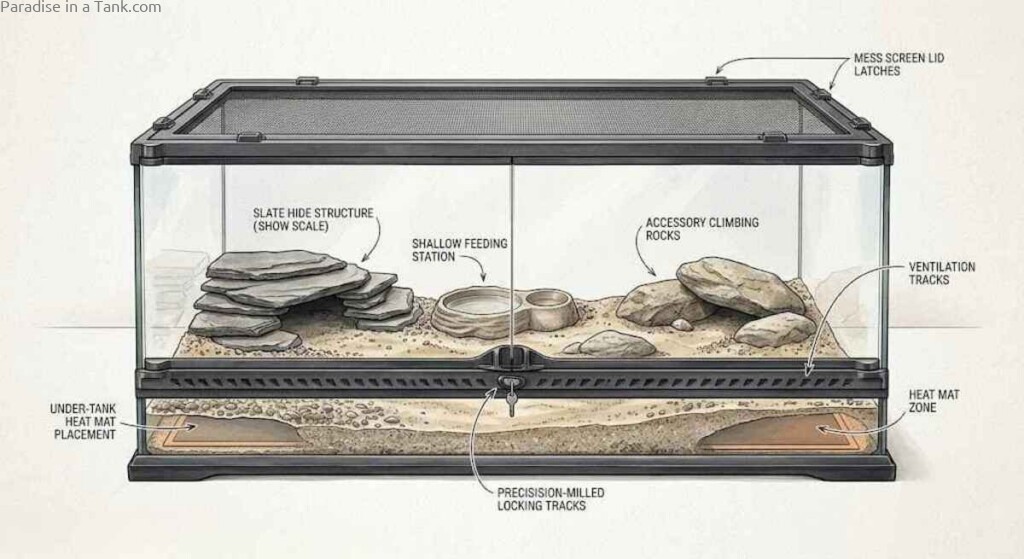
A proper glass terrarium setup for geckos requires tailoring enclosure orientation, thermal gradients, and moisture levels to the specific species. Terrestrial leopard geckos thrive in horizontal 20-gallon long to 40-gallon breeder glass tanks with a 88–92°F warm hide. Arboreal crested geckos require vertical 18x18x24 inch glass terrariums with 60–80% humidity and ambient temperatures between 72–78°F.
Setting up a glass terrarium is not about picking out a pretty glass box at the pet shop and tossing a heat lamp on top. It is about engineering a micro-habitat that respects millions of years of biological evolution. When you bring a gecko into your home, you are taking full responsibility for its life, breath, digestion, and shedding cycles. Glass remains the premier enclosure material for pet reptiles because it holds environmental variables steady, resists rot from moisture, and allows you to build precise microclimates. However, choosing the wrong tank dimensions for your specific gecko species is one of the fastest ways to stress an animal into immune failure, chronic anorexia, or metabolic breakdown.
Before you buy a single piece of hardware, you must understand the fundamental divide in gecko biology: ground-dwelling vs. tree-dwelling. A terrestrial species like the leopard gecko (Eublepharis macularius) spends its entire life navigating rocky arid scrublands and clay crevices. They rely on horizontal surface area to exercise, hunt live insects, and move back and forth along a thermal gradient to regulate their core body temperature. On the flip side, an arboreal species like the crested gecko (Correlophus ciliatus) evolved in the rainforest canopy of New Caledonia. They need vertical space, climbing structures, foliage cover, and high ambient moisture to feel secure.
If you throw a crested gecko into a low, sprawling horizontal tank, it will spend its nights pacing the floor in confusion, suffering from structural stress, and struggling to hunt. If you cram a leopard gecko into a tall, narrow glass cylinder, you will never establish a functional warm-to-cool temperature gradient, and you will end up baking the animal alive or leaving it perpetually cold and unable to digest its meals. You can explore our beginner pet gecko care guide for a deeper look into selecting the right species for your home lifestyle.
Horizontal Glass Tanks (Leopard Geckos)
For terrestrial geckos, horizontal floor space is the absolute currency of good husbandry. A young leopard gecko can temporarily start in a 10-gallon enclosure, but an adult requires a minimum of a 20-gallon long glass tank (24x12x12 inches), with a 40-gallon breeder glass tank (36x18x18 inches) representing the gold standard for long-term health and psychological enrichment.
The reason floor length matters so much comes down to basic thermodynamics. Geckos are ectothermic, meaning they cannot generate their own internal body heat. They rely entirely on external thermal zones to warm up their metabolic engine or cool off to rest. In a 20-gallon long or 40-gallon tank, you have enough horizontal distance (24 to 36 inches) to set up a hot basking zone on one side (88–92°F) while leaving the opposite side at room temperature (72–75°F). This 15 to 20-degree differential gives the gecko complete freedom to choose its optimal body temperature at any minute of the day.
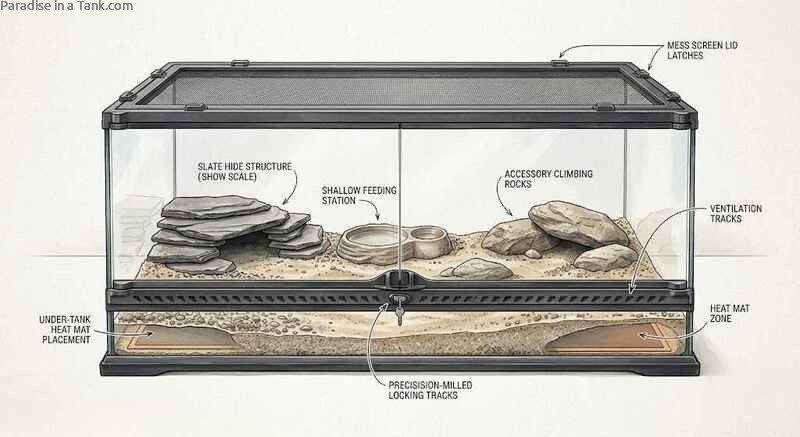
Horizontal glass tanks also offer vital advantages for safety and hygiene:
- Escaping Ammonia and Waste Accumulation: Solid glass walls contain subterranean waste, but screen tops allow rising warm air to carry away metabolic fumes.
- Maximized Hunting Footprint: Wide glass bases provide ample room for dusting live crickets, dubia roaches, or mealworms without prey hiding under unreachable vertical ledges.
- Multi-Hide Microclimates: A proper horizontal setup easily accommodates three distinct hides: a warm hide, a cool hide, and a central humid hide without cluttering the enclosure.
Vertical Glass Terrariums (Crested Geckos)
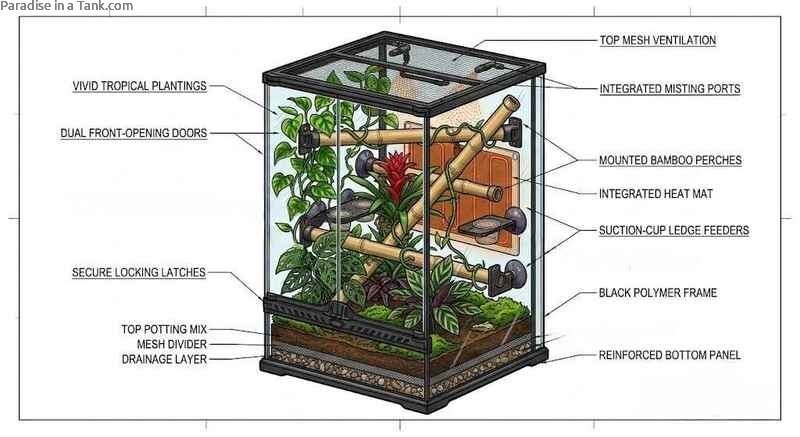
Vertical glass terrariums are designed specifically for canopy-dwelling species that thrive on elevation, vertical vines, and climbing branches. For an adult crested gecko, the standard minimum enclosure dimensions are 18x18x24 inches (or 18x18x36 inches for larger specimens or multi-branch setups).
Arboreal geckos possess specialized microscopic structures on their toe pads called setae—millions of microscopic hair-like projections that interact with surfaces at a molecular level via van der Waals forces. To dive deeper into how these specialized toe pads work, read our detailed article on how and why do geckos stick to walls. Because crested geckos naturally retreat upwards away from ground predators, a vertical tank gives them the vertical drop and climbing height necessary to feel safe.
| Enclosure Type | Ideal Species | Target Tank Dimensions | Primary Habitat Benefit |
|---|---|---|---|
| Horizontal Glass Tank | Leopard Geckos, African Fat-Tailed Geckos | 20-Gallon Long (24x12x12 in) to 40-Gallon Breeder (36x18x18 in) | Wide thermal gradient and maximum ground space for foraging and belly heat. |
| Vertical Glass Terrarium | Crested Geckos, Gargoyle Geckos, Day Geckos | 18x18x24 in to 18x18x36 in Tall Glass Units | High vertical exercise clearance, climbing branches, and aerial humidity retention. |
When selecting a vertical glass terrarium, prioritize units with front-opening dual doors rather than top-only access. Reaching down into a terrarium from above mimics the diving attack of an avian predator, triggering an immediate panic response in your gecko. Front-opening glass doors allow you to approach the animal at eye level, making daily misting, food bowl replacement, and handling far less stressful for the animal.
Substrates, Heating & Lighting
Substrate selection and heating geometry form the core baseline of reptile husbandry. Get these two elements wrong, and you run the risk of causing fatal digestive blockages, thermal burns, or metabolic bone disease. Glass is a brilliant conductor of heat, but it is also an unyielding barrier; understanding how to apply heat and light through glass safely is the difference between a thriving pet and a quiet emergency.
Safe Substrates
The pet industry is flooded with unsafe, brightly colored commercial substrates designed to catch human eyes while putting animal lives at risk. Loose silica sand, calcium-based sands (like Vita-Sand), and crushed walnut shells should never enter a gecko enclosure. When a gecko strikes at a cricket, it inevitably ingests small bits of substrate. Calcium sand is particularly dangerous because it lures geckos to eat it for calcium content, clumping into an immovable, rock-hard concrete mass inside the intestines that leads to fatal impaction.
Instead, stick to substrates that prioritize biological safety and easy waste management:
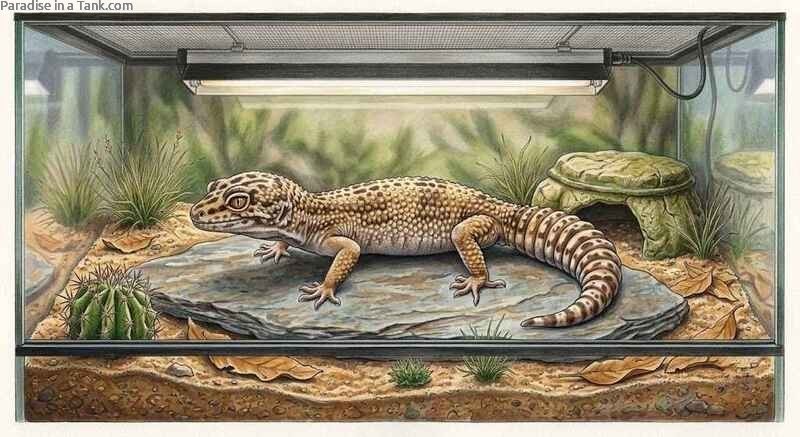
- Slate Tile: Excellent for arid species like leopard geckos. Slate retains heat evenly from beneath, never poses an impaction risk, trims down sharp gecko claws naturally, and cleans up with a simple wipe.
- Paper Towels: The ultimate quarantine and low-maintenance option. Plain, unbleached paper towels allow you to monitor stool consistency, track hydration levels, and eliminate bacterial buildup instantly by swapping them out weekly.
- Bio-Active Arid Mixes: A blend of 70% organic topsoil and 30% washed play sand (or eco-earth mixes) paired with a cleanup crew of isopods and springtails. This mimics natural soil, allows natural burrowing behaviors, and breaks down organic waste biologically.
Gradient Heating
Because reptiles cannot generate metabolic heat internally, their digestive systems rely entirely on ambient heat to break down insect chitin and absorb nutrients. If a gecko’s core temperature drops too low, swallowed food sits in the stomach and ferments, releasing toxic gas and leading to severe gastrointestinal bacterial infections or regurgitation.
There are two primary ways to heat a glass terrarium: Under-Tank Heating (UTH) mats and Deep Heat Projectors (DHPs) or Ceramic Heat Emitters (CHEs).
Under-tank heat mats adhere to the outside bottom glass of the tank, sending direct contact heat through the glass floor into slate or paper towel substrates. This provides essential “belly heat” that aids digestion for ground-dwelling species. However, an un-thermostatted heat mat is a ticking clock. Unregulated heating pads can easily reach surface temperatures over 120°F, cracking the bottom glass of your tank or inflicting horrific full-thickness thermal burns on your gecko’s soft underbelly. Every heat mat must be plugged directly into a digital proportional or ON/OFF thermostat probe set to 88–92°F.
Deep Heat Projectors (DHPs) and halogen bulbs, mounted above the screen top inside a dome fixture, represent the modern standard in reptile thermal care. Unlike traditional ceramic heat emitters that only emit shallow Infrared-C surface heat, DHPs project penetrating Infrared-A and Infrared-B wavelengths. These deep-penetrating infrared waves heat the muscle tissue directly, mirroring natural sunlight warming rocks in the wild.
For lighting, while nocturnal and crepuscular geckos can survive without high-intensity lighting, providing low-level Linear UVB light (such as a Ferguson Zone 1 shade dweller fixture, 2.4% to 7% UVB) dramatically improves calcium synthesis, systemic immunity, and natural day-night circadian rhythms.
Humidity, Misting & Moist Hides
Regulating moisture inside a glass terrarium is an active, daily balancing act. Glass walls hold moisture exceptionally well, which is a massive advantage for rainforest species like crested geckos, but can create dangerous mold growth and respiratory problems for arid desert species like leopard geckos if air circulation is choked off.
Arboreal tropical geckos require a daily humidity cycle swinging between 60% and 80%. You achieve this by thoroughly misting the enclosure walls, live plants, and foliage with purified or reverse-osmosis water every evening using a pump sprayer. As the mist evaporates overnight, the relative humidity rises, providing drinking droplets for the gecko. By daytime, the humidity should drop back down toward 50% to allow the tank to dry out slightly, preventing the proliferation of airborne fungal spores and bacterial skin infections.
For desert-adapted species like leopard geckos, ambient enclosure humidity should remain low (30% to 40%). However, even desert geckos require localized micro-humidity to shed their skin cleanly. In the wild, leopard geckos retreat deep into underground humid rock burrows where subterranean dampness lingers.
Shedding Health
A failure in humidity management manifests most visibly during the shedding process (ecdysis). When a gecko is preparing to shed, its body produces a thin layer of fluid between the old skin layer and the new skin underneath, causing the body color to turn dull and milky grey. The gecko will then rub its snout against rocks or bark to tear open the dead skin layer and literally peel and pull the old skin off with its mouth, eating it to recycle nutrients.
If ambient moisture is too low during this critical window, the dying skin dries out prematurely and adheres to the delicate extremities—most notably the toes, tail tip, and eyelids. As stuck shed dries, it shrinks and tightens like a tourniquet. Over successive bad sheds, constricted toe rings cut off peripheral blood circulation entirely, causing the tissue to necrose, blacken, and drop off permanently.
To prevent stuck toe sheds and limb loss, you must build a dedicated humid hide for every terrestrial gecko setup:
- Select an Enclosure: Take an opaque, food-grade plastic container with a smooth lid (or buy a specialized commercial 2-piece hide).
- Cut an Entrance Hole: Melt or cut a smooth 1.5-inch entry hole on the upper side or lid, smoothing down sharp plastic edges with a lighter or sandpaper to prevent skin scratches.
- Pack Moist Substrate: Line the floor of the hide with 1–2 inches of damp damp sphagnum moss or damp paper towels. The material should be moist to the touch like a wrung-out sponge, but never dripping water.
- Position Along the Thermal Gradient: Place the humid hide right along the warm-to-neutral transition zone of the glass tank (around 80–85°F). The gentle ambient floor heat vaporizes moisture inside the container, creating a stable 80%+ humidity chamber that softens dead skin layers overnight.
By combining the right horizontal or vertical glass tank layout with safe, non-impacting substrates, precise thermostatically controlled heating, and dedicated humid micro-hides, you create a fortress of biological safety for your pet. Take the time to audit your setup parameters today, lock in your digital thermostat probes, and enjoy watching your gecko thrive in a clean, perfectly tuned piece of naturalistic engineering.