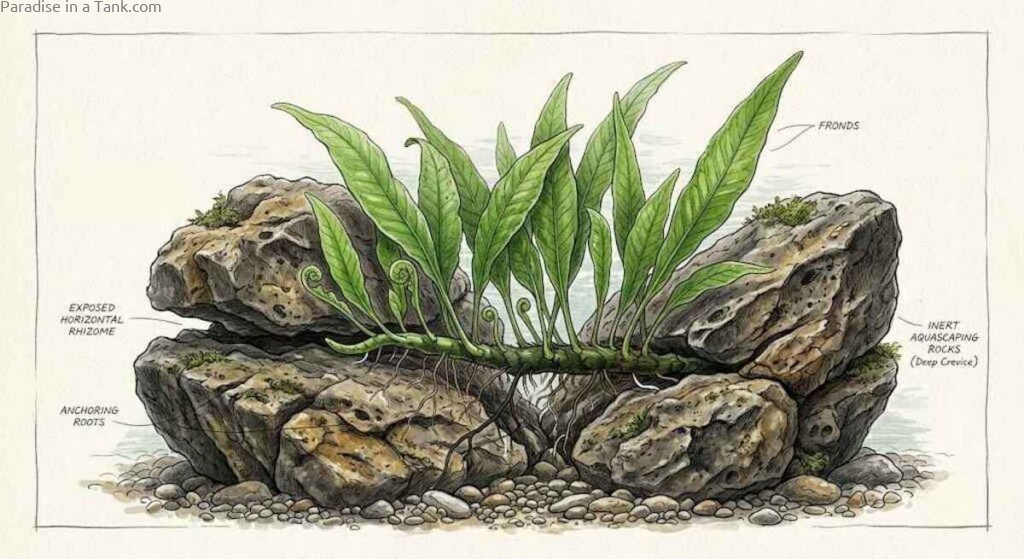
Few visual sights in modern freshwater aquascaping are as satisfying as a lush, emerald specimen of Java Fern thriving atop a piece of gnarled driftwood or porous lava rock. Its rich green fronds wave gracefully in the water currents, creating a natural, ancient riverbed aesthetic that artificial plastic plants simply cannot replicate. Yet, thousands of enthusiastic aquarium keepers purchase their first pot of Microsorum pteropus, bring it home, shove its roots deep into rich aquarium soil or coarse gravel, and watch in heartbreak as the entire plant turns black and dissolves into slush within three weeks.
You did not fail because you lack a green thumb. You failed because you were treated to poor advice at the pet shop. Java Fern is an epiphytic plant hardwired by millions of years of evolution to cling to submerged granite outcrops, exposed river banks, and fallen rainforest timber across Southeast Asia. Its anatomical structure demands flowing water around its core base. Once you understand the biological mechanics of this hardy botanical species and master the physical attachment techniques, you can transform single plant pots into magnificent, self-sustaining aquatic landscapes.
Why Java Fern Cannot Be Planted in Substrate
To properly attach Java Fern (Microsorum pteropus) to aquarium hardscape, secure its horizontal thick green stem (rhizome) onto driftwood or porous rock using cyanoacrylate gel glue, cotton thread, or monofilament line. Never bury the rhizome under substrate, as suffocating this core tissue prevents nutrient exchange and guarantees fatal bacterial rhizome rot.
Rhizome Rot Dynamics: The Biological Cause of Substrate Smothering
To understand why traditional planting methods kill Java Fern, you must examine its vascular structure under a microscope. Unlike standard terrestrial house plants or rooted aquatic flora like Amazon Swords, Java Fern possesses a specialized horizontal plant stem called a rhizome. This thick, fleshy green organ acts as the central command center, carbohydrate storage vault, and primary vascular highway for the plant. From the top of this rhizome, upright fronds sprout toward the light; from the underside, dark brown hair-like structures descend to anchor the organism.
When you bury this delicate rhizome under fine sand, crushed gravel, or dense active aquasoil, you create an immediate biological catastrophe. Substrate beds are micro-environments characterized by low dissolved oxygen levels and dense compaction. Trapped beneath substrate particles, the rhizome is completely cut off from continuous water circulation. Starved of oxygen, cellular respiration within the plant tissue collapses. Anaerobic bacteria quickly invade the compromised cell walls, triggering systemic bacterial decay.
Within days, the firm green tissue of the rhizome softens into a foul-smelling, black mush. The fronds lose their connection to stored sugars, turn translucent brown starting at the base, and break off into floating debris. By the time you notice your plant looks sick, the internal vascular bundle has already rotted beyond repair. If you want to keep this species alive for years, you must treat the rhizome as an above-ground organ that requires open water flow across its entire skin surface.
Benthic Anchorage vs True Root Systems: How Java Fern Absorbs Nutrients
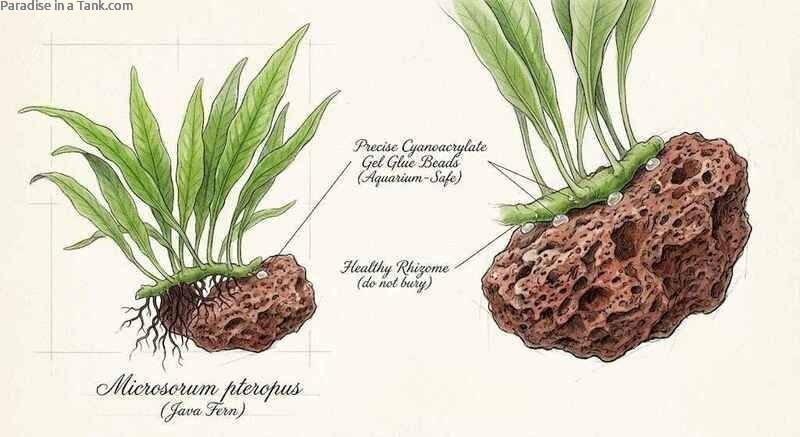
Beginner hobbyists often mistake the dense mat of dark brown, hairy strings dangling from the bottom of a Java Fern for traditional plant roots. In true terrestrial plants, roots act as subterranean pipelines that suck up water and mineral nutrients directly from dark soil. Java Fern roots are fundamentally different biological tools designed for benthic anchorage rather than primary feeding.
These dark appendages are covered in tiny cellular hooks that seek out microscopic pits, grooves, and porous irregularities in submerged timber or stone. They grip hard surfaces with astonishing structural tenacity, working like biological anchor ropes to prevent tropical river currents from sweeping the plant downstream during seasonal flash floods. While these holdfast roots can absorb tiny amounts of dissolved minerals from passing water, the vast majority of nutrient uptake occurs directly through the tissue of the green fronds and the exposed surface of the rhizome itself.
Because Java Fern extracts vital nitrogen compounds, potassium, and trace minerals directly from the water column, planting it in nutrient-rich soil offers zero nutritional benefit. In fact, keeping the rhizome suspended high above the substrate in oxygen-rich water currents gives the plant direct access to floating nutrients like dissolved nitrogen compounds. If you want to explore the diverse leaf shapes and growth habits available to aquascapers, dive into our guide covering popular Java Fern varieties to pick the ideal morph for your aquascape layout.
Method 1: The Cyanoacrylate Super Glue Gel Technique
- Adhesive Selection:
- You must exclusively use ethyl cyanoacrylate gel adhesive for aquarium mounting.
- Liquid super glues are far too runny and will run down hardscape or drip into your substrate bed, causing messy white stains.
- Ethyl cyanoacrylate polymerizes instantly upon contact with moisture, forming a completely non-toxic, inert acrylic plastic bond that will not leach chemicals into your water.
- Avoid any adhesives containing anti-fungal additives, industrial solvents, or heavy metallic compounds.
- Step-by-Step Glue Process:
- Remove the plant from its commercial pot and carefully pick away every bit of rock wool surrounding the roots using fine tweezers.
- Gently pat the specific contact spot on the rhizome dry using a soft paper towel; removing surface moisture guarantees a instant, rock-solid molecular bond.
- Pat dry the targeted mounting site on your driftwood branch or lava rock using a dry microfiber cloth.
- Apply 1–2 tiny, pinhead-sized dabs of cyanoacrylate super glue gel directly onto the tough, woody skin of the rhizome.
- Never cover the entire rhizome in glue; only apply adhesive to 2 or 3 tiny contact points along its length to avoid smothering vascular tissue.
- Press the rhizome firmly against the hardscape contact point for 10–15 seconds, keeping gentle pressure until the glue sets firm.
- Mist the plant fronds with clean tap water or aquarium water every 30 seconds during this process to prevent delicate leaf tissues from drying out and dying.
- Gently submerge the newly attached plant into your display tank; the surrounding water will instantly cure any remaining tacky adhesive into a safe, solid plastic weld.
Using Cyanoacrylate glue gel is easily the fastest, most reliable mounting method for both complete novices and veteran aquascapers. The instant physical hold prevents fish from knocking loose newly placed plants, while the clear-to-white cure color quickly becomes covered by growing plant roots and natural biofilm.
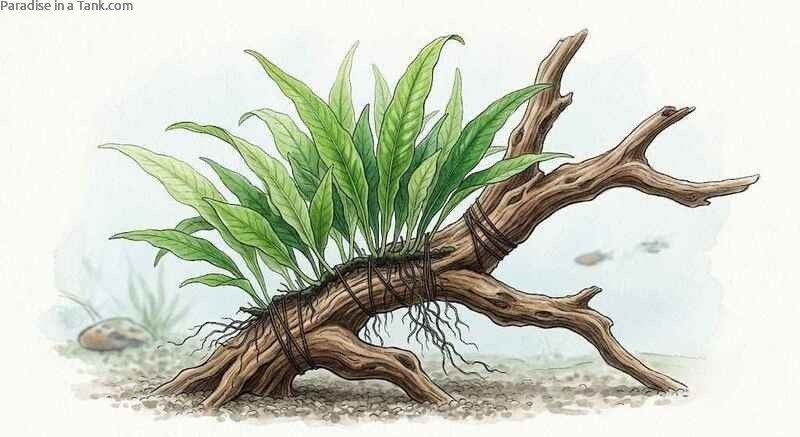
Method 2: Tying with Thread and Fishing Line
- Cotton Thread Method:
- Select 100% organic cotton sewing thread in a dark green, brown, or black color to blend seamlessly with your plant roots and hardscape.
- Position the clean rhizome along the contours of your driftwood branch or textured stone.
- Wrap the cotton thread snugly around both the hardscape object and the rhizome, spacing each wrap about 0.5 inches apart.
- Secure the wrap with a simple double knot on the underside of the hardscape, trimming away long excess thread tails with sharp scissors.
- Over the course of 3–8 weeks, the submerged cotton fibers will naturally break down, decay, and dissolve safely in the water column.
- By the time the thread disintegrates, the plant will have grown permanent, structural anchor roots that bind it tightly to the underlying surface.
- Monofilament Fishing Line:
- Choose clear monofilament nylon fishing line with a 2–4 lb test rating for maximum invisibility under aquarium lighting.
- Use monofilament line specifically for massive, mature Java Fern mother plants whose weight and buoyancy would snap decomposing cotton thread.
- Wrap the line around the rhizome base with consistent, firm pressure—tight enough to hold the weight of heavy fronds, but gentle enough not to slice into the soft green rhizome skin.
- Tie off the line securely using a surgical knot on the hidden backside of your hardscape timber or rock formation.
- Keep in mind that monofilament line is completely non-biodegradable and will remain in your aquarium indefinitely unless manually snipped away with small cuticle scissors once roots take hold.
Tying requires slightly more patience and dexterity than gluing, especially when handling awkward, heavy pieces of soaked driftwood. However, it completely eliminates the risk of leaving temporary white glue residue marks on pristine, expensive hardscape pieces.
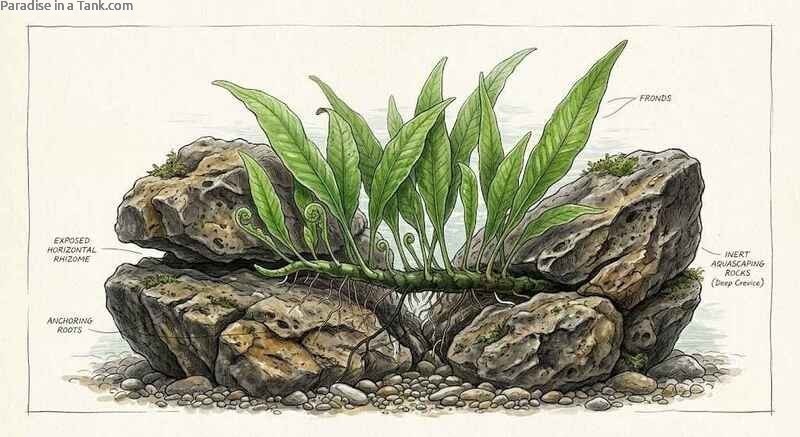
Method 3: Hardscape Crevice Wedging
- Placement Techniques:
- Inspect your hardscape for natural biological anchor points like wood knots, timber splits, lava rock pores, and stone fissures.
- Select a healthy Java Fern specimen with a firm, flexible rhizome and an established cluster of anchorage roots.
- Gently slide the rhizome or root bundle into the crack or gap using blunt-nosed aquarium tweezers or your fingertips.
- Ensure the rhizome itself rests securely inside the structural notch while the main body remains fully exposed to ambient water currents.
- Check that the plant is held in place by natural physical friction without crushing or pinching the green vascular tissue.
- Test the stability of the mount by gently waving your hand through the surrounding water to create a mild current pulse.
- If the plant shifts, wobbles, or floats free, reinforce the wedge site by gently tucking a tiny piece of coarse filter sponge or neutral lava rock behind the rhizome.
Wedging is the ultimate minimalist aquascaping technique because it requires zero artificial adhesives, tying materials, or tool cleanup. It replicates precisely how Microsorum pteropus colonizes wild river systems, allowing roots to crawl naturally outward along rock faces as the plant matures.
Post-Mounting Care & Root Attachment Timelines
Once you have successfully attached your Java Fern using glue, thread, or wedging, your primary responsibility shifts to creating a stable environment where root development can thrive. Do not expect overnight miracles. Java Fern is a notoriously slow-growing slow-burn plant that prioritizes cellular establishment over rapid vertical growth. During the first two weeks post-mounting, the plant undergoes a mild acclimation phase where leaf growth may pause entirely while roots begin seeking out hardscape pore spaces.
To ensure long-term biological success, maintain clean, well-filtered water with stable chemistry parameters. Keep your water temperature between 68–80°F (20–27°C) and maintain a pH range of 6.0–7.5. Java Fern thrives under low to moderate light conditions (around 10–20 PPM of CO2 is helpful but entirely optional). Keep dissolved nitrate levels around 10–20 ppm and provide a basic weekly dose of liquid macro and micro fertilizers to feed the plant directly through its fronds. For a complete deep-dive into water parameters, lighting requirements, and propagation techniques, check out our comprehensive Java Fern care guide to keep your aquatic garden thriving for years.
| Attachment Method | Typical Attachment Timeline | Primary Advantages | Best Suited For |
|---|---|---|---|
| Cyanoacrylate Super Glue Gel | Permanent instantly; roots anchor in 3–5 weeks. | Fast application, instant structural hold, zero wrapping needed. | Smooth lava rock, small branches, quick aquascaping layouts. |
| Organic Cotton Thread | Roots attach firmly in 4–6 weeks before thread decays. | Completely natural, zero plastic residue, invisible over time. | Textured driftwood, branch splits, naturalistic biotope aquariums. |
| Monofilament Fishing Line | Permanent tie; roots anchor tightly in 6–8 weeks. | Extreme tensile strength, holds heavy mother plants easily. | Large specimen plants, heavy rhizomes, tall hardscape towers. |
| Hardscape Crevice Wedging | Roots creep into pores within 4–8 weeks. | Zero materials required, 100% natural, instant repositioning. | Porous lava rock fissures, deeply grooved wood knots, rock piles. |
Watch your newly mounted plants closely over the first month. As long as you keep the rhizome unburied, exposed to clean water flow, and securely fastened against a sturdy surface, those tiny brown roots will creep across your hardscape like creeping ivy. You have successfully honored the plant’s ancestral evolutionary design—and your aquascape will reward you with years of lush, striking beauty.