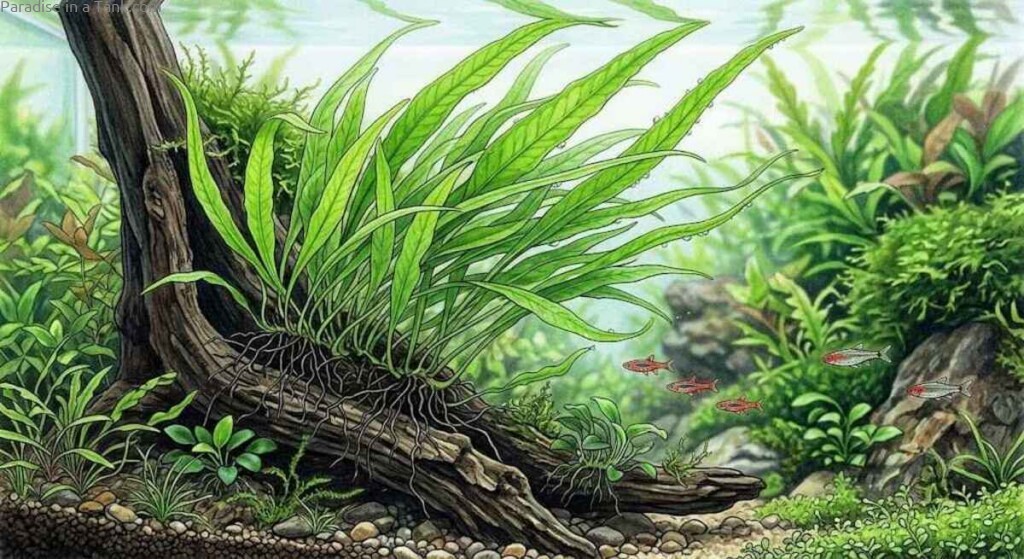
Java Fern varieties like Windelov, Narrow Leaf, Trident, and Needle Leaf offer distinct leaf architectures, ranging from fine 0.25-inch blades to bushy, antlered tips. All cultivars thrive bound to aquascape hardscape under low light levels of 10–30 PAR and water parameters of pH 6.0–7.5 with minimal nitrate buildup.
Navigating the world of freshwater aquascaping often leads fishkeepers to Microsorum pteropus, commonly known as the Java Fern. While the standard wild form has graced home aquariums for decades, specialized natural mutations and cultivated varieties have transformed how we build underwater landscapes. Understanding how these unique morphs behave biologically helps you craft lush underwater greenery without running into frustrating die-offs, ugly yellowing fronds, or rotting rhizomes.
When you introduce these plants to your aquarium, you are dealing with ancient epiphytic ferns hardwired over evolutionary history to cling to rocks and submerged wood in shaded Asian stream beds. They do not feed through traditional roots buried in deep substrate; instead, their dark green to brown rhizomes crawl along hard surfaces while fine hair-like brown roots grip microscopic crevices. If you bury that subterranean rhizome under heavy gravel or fine sand, oxygen flow drops to zero, anaerobic bacteria invade the plant tissue, and the entire fern rots from the inside out. If you are brand new to keeping these resilient epiphytes in your tank, reviewing the ultimate Java Fern care guide will give you a rock-solid foundation on lighting, water chemistry, and essential nutrient balances.
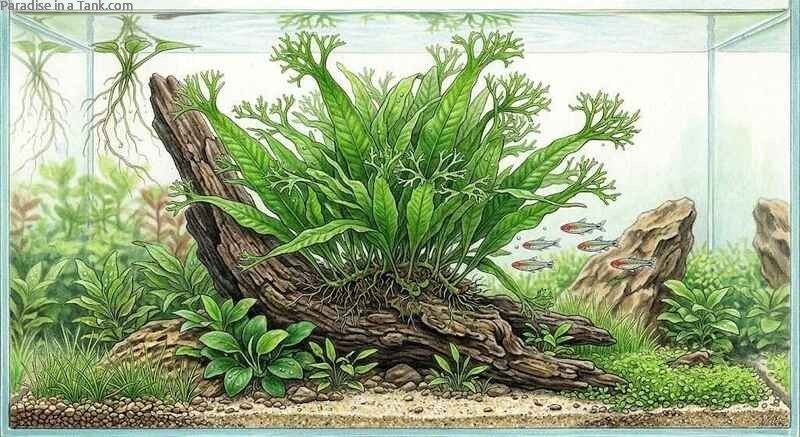
Java Fern Windelov (Microsorum pteropus ‘Windelov’)
Named after Holger Windeløv, the founder of Tropica, Java Fern Windelov is easily one of the most eye-catching cultivated cultivars available in the trade. This variety exhibits a dense, bushy growth habit that tops out at roughly 6–8 inches in height, making it an ideal midground anchor for mid-sized or large display tanks. Rather than producing smooth, strap-like leaves, Windelov produces heavily branched, lace-like structures that give the plant a crested, feathery silhouette.
In a healthy aquarium, Windelov grows at a steady, moderate pace under low-to-medium lighting conditions. It absorbs essential nutrients directly from the water column through its fronds, utilizing tiny dissolved traces of iron and potassium. Because it thrives in water conditions ranging from pH 6.0–7.5, GH levels of 3–12 dGH, and water temperatures of 68–82°F, it effortlessly adapts to almost any standard tropical tank setup.
When planted in groups along dark pieces of Malaysian driftwood, Windelov creates an incredible sense of texture that breaks up the uniform green of broader stem plants. It provides tight, protected hiding zones for small fish species, shy dwarf cichlids, and newborn shrimp. However, because its physical footprint is quite dense, it requires continuous, clean water flow to prevent dead spots from forming inside its core.
Morphological Identifiers: Antler-Branched Lace Tip Structure
The defining biological characteristic of Java Fern Windelov lies at the apical end of every single leaf. As the main frond reaches outward, the leaf blade splits into multiple fine, finger-like divisions, resembling the intricate branching of stag antlers or delicate lace. This specialized structure dramatically increases the total surface area of the frond, allowing the plant to maximize light absorption in dim, shaded riverbeds where light penetration is minimal.
These crested tips give the plant a distinct, textured volume that softens harsh lines of rockwork or heavy driftwood. However, because these fine antler tips are thin and delicate, they are exceptionally sensitive to sudden shifts in water chemistry. Rapid fluctuations in total dissolved solids, aggressive chemical treatments, or sudden spikes in dissolved ammonia can cause the fine tips to turn translucent, yellow, or dark brown overnight.
When these lace tips experience severe osmotic stress, the plant shuts down nutrient absorption in those terminal structures, leading to tip burn. Maintaining stable water parameters with consistent weekly water changes is the single best way to preserve these delicate antler tips in pristine condition.
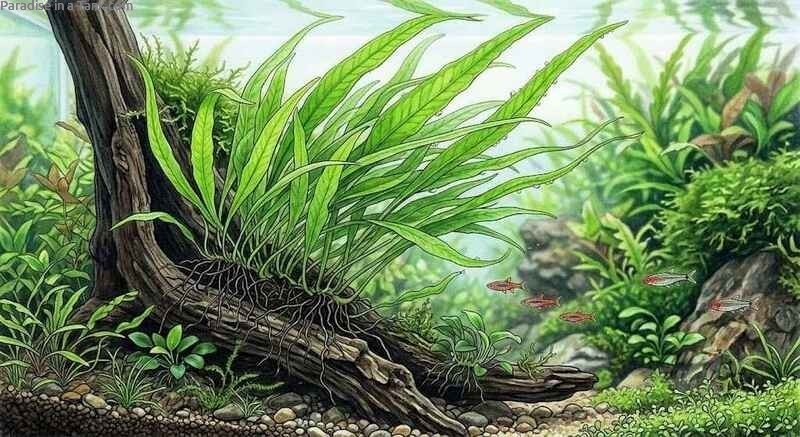
Maintenance Nuances: Preventing Algae Accumulation in Dense Tip Clusters
While the dense antler structure creates stunning visual depth, it also acts as a natural physical trap for floating debris, uneaten fish food, poop, and organic detritus. In tanks with low water movement, fine organic particles settle deep inside the compact clusters of lace tips. Over time, this trapped rot creates a localized spike in organic waste, inviting persistent growths of staghorn algae and stubborn black beard algae directly onto the tips.
To keep your Windelov fronds clean and free of suffocating algae, maintain moderate, gentle water circulation across the fronds using a spray bar or circulating powerhead. You do not want a violent torrent that rips the plant off its mooring, but rather a soft, constant breeze that lifts fine debris off the fronds before it can settle and decay.
During your routine weekly water changes, take a soft siphon hose and gently hover it over the plant tips to vacuum out trapped particulate matter. If you notice early algae filaments creeping onto the tips, resist the urge to scrub them aggressively; instead, carefully trim away individual damaged leaves near the rhizome using sharp aquatic pruning shears to encourage fresh, clean regrowth.
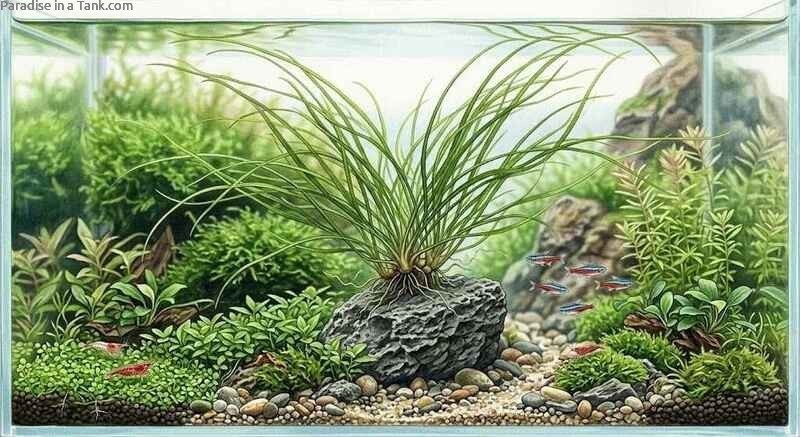
Narrow Leaf vs Needle Leaf Java Fern
Choosing between slender-leafed Java Fern varieties comes down to understanding the precise scale and leaf width required for your visual design. Both varieties replace the wider, paddle-shaped fronds of standard Java Fern with elongated, sweeping blades that sway naturally in tank currents. However, their leaf dimensions, overall mass, and structural rigidity differ significantly under identical aquarium conditions.
Proper physical attachment is critical for both of these fine-leafed cultivars to ensure their delicate rhizomes remain uncovered and healthy. If you need step-by-step instructions on securing epiphytes using thread, line, or plant glue, check out our guide on how to attach Java Fern to driftwood and rocks to keep your plants firmly anchored without damaging living tissue.
- Narrow Leaf Specifications: Slender 0.5-inch leaf width creating sweeping vertical movement.
- Needle Leaf Specifications: Compact 0.25-inch leaf width engineered for high-detail nano tanks.
Narrow Leaf Java Fern (Microsorum pteropus ‘Narrow’) produces dark green fronds that grow up to 10–12 inches long while maintaining a maximum width of just 0.5 inches. As the leaves stretch upward toward the light, they bow gracefully in water currents, creating dramatic vertical texture and a sense of depth in medium to large aquascapes. The leaves are remarkably flexible yet sturdy, resisting damage from curious grazing fish like bristlenose plecos or small gouramis that might otherwise nibble softer foliage.
Needle Leaf Java Fern (Microsorum pteropus ‘Needle’) represents an even more extreme miniaturization of frond structure. With leaves rarely exceeding 0.25 inches in width and topping out at 6–8 inches in height, this cultivar is specifically engineered for intricate nano tanks and fine-scale aquascapes. The fronds grow extremely dense and upright, forming tight brush-like thickets that provide critical shelter for dwarf shrimp, tiny fry, and delicate rasboras without overwhelming small aquatic spaces.
Because Needle Leaf fronds are so thin, they require clean, well-oxygenated water to thrive. Under poor lighting or high organic loads, Needle Leaf fronds can develop dark spots or melt along their margins. Providing stable parameters with pH between 6.0 and 7.5, along with a modest dose of liquid potassium, ensures both Narrow Leaf and Needle Leaf variants maintain bright, healthy green coloration across all growth phases.
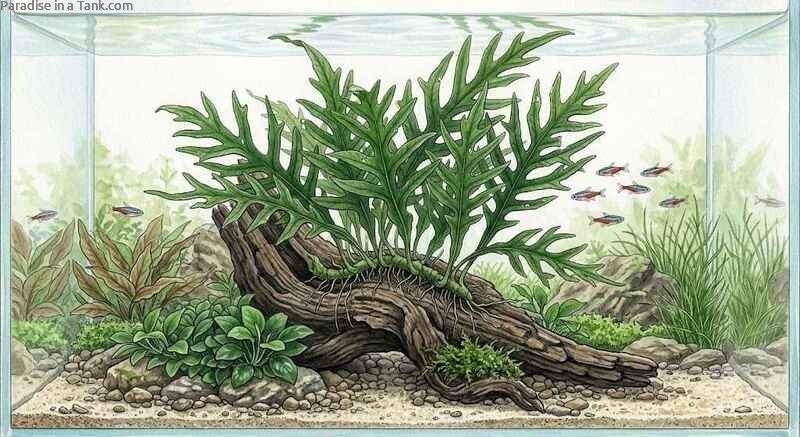
Trident Java Fern Morphology
Trident Java Fern (Microsorum pteropus ‘Trident’) offers a distinctive balance between the broad leaves of standard Java Fern and the fine texture of Needle Leaf variants. This variety is highly sought after by modern aquascapers for its unique lobed geometry, rapid adaptation rate, and striking structural impact when mounted on elevated hardscape arrangements.
Under stable water parameters with low nitrate levels under 20 PPM, Trident produces medium-green, vibrant fronds that add dynamic visual interest to midground structures. It exhibits a slightly faster growth rate than Windelov or Needle Leaf variants, readily producing adventurous daughter plantlets along the undersides of mature leaves when conditions are ideal.
- Structural Identifiers: Multi-lobed, three-pronged leaf branching patterns.
The signature feature of Trident Java Fern is its distinct multi-lobed leaf architecture. Near the base or midpoint of each leaf, the frond splits laterally into several pronounced segments, typically forming a prominent central blade flanked by two smaller side lobes. This three-pronged shape strongly resembles the classic trident, giving the variety its popular name.
As the plant matures in a low-light setup receiving 10–30 PAR, individual fronds can develop even more complex multi-lobed splits, creating an intricate, fork-like pattern along the outer leaf margins. The leaves remain relatively narrow—usually between 0.3 to 0.6 inches wide per segment—and can reach lengths of 8–10 inches. This unique branching geometry creates deep shadow play and multi-dimensional layering when planted alongside fine mosses or dark driftwood branches.
When propagating Trident Java Fern, you can simply snip the creeping rhizome between leaf clusters using sharp shears, making sure each severed section retains at least three healthy fronds and a cluster of roots. Attach the new division to hardscape, and it will quickly establish itself and send out new lobed leaves.
Comparative Variety Matrix: Leaf Width, Maximum Height, and Aquascaping Placement
Selecting the right Java Fern variety requires comparing physical dimensions, growth traits, and ideal positioning within your aquascape design. The chart below breaks down the key structural attributes of each major cultivar to help you make informed decisions for your aquarium setup.
| Variety Name | Average Leaf Width | Maximum Height | Ideal Aquascape Placement | Key Visual Characteristic |
|---|---|---|---|---|
| Java Fern Windelov | 0.5–0.75 inches at base | 6–8 inches | Midground Hardscape Anchor | Feathered antler-like lace tips that add bushy dense volume. |
| Narrow Leaf Java Fern | 0.5 inches maximum | 10–12 inches | Background & Midground Hardscape | Long sweeping slender leaves that create graceful vertical flow. |
| Needle Leaf Java Fern | 0.25 inches maximum | 6–8 inches | Nano Midground & Micro Detail | Extremely ultra-fine razor-thin fronds tailored for high-detail setups. |
| Trident Java Fern | 0.3–0.6 inches per lobe | 8–10 inches | Focal Midground Hardscape | Distinctive three-pronged multi-lobed leaves with dynamic side splits. |
Each of these distinct Java Fern cultivars brings a unique structural personality to your aquarium, giving you full creative freedom to build captivating underwater scenes. By matching their physical growth habits with proper hardscape placement, clean water parameters, and adequate water circulation, you will enjoy lush, long-lasting green foliage that transforms your tank into a thriving aquatic ecosystem.