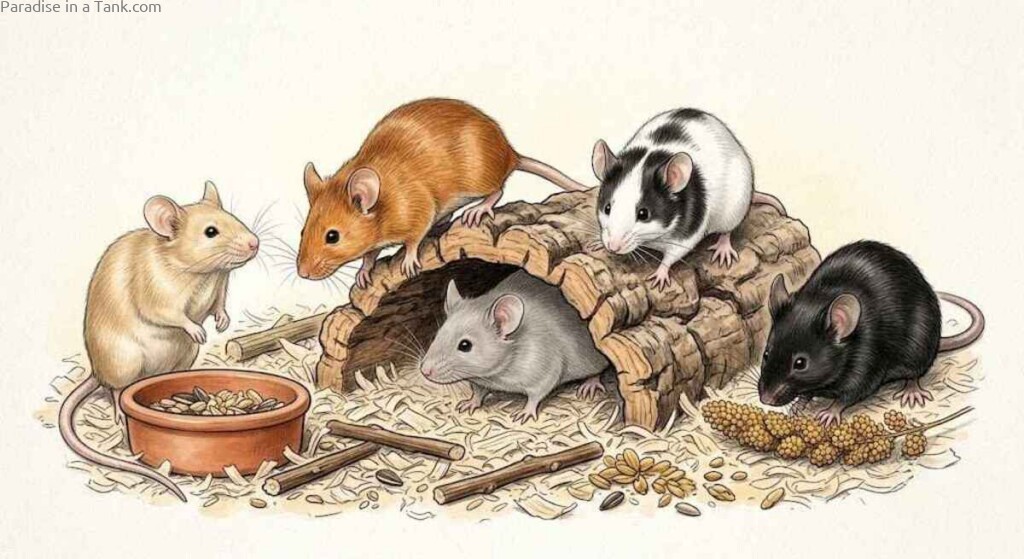
Introduction to Fancy Mice (Mus musculus domesticus)
Fancy mice care requires a clean enclosure kept between 65°F–75°F, a balanced diet of 14%–16% protein lab blocks supplemented with fresh seeds, and proper social housing. Females thrive in pairs or trios, while males must be housed alone. Provide a solid 10–20 gallon enclosure with deep aspen bedding, continuous fresh water, and daily physical enrichment.
Fancy mice (Mus musculus domesticus) are not disposable starter pets or low-effort living decorations for a lonely corner of your bedroom. They are intensely curious, biologically complex, and deeply sensitive pocket mammals carrying millions of years of prey-species survival instincts in their tiny bodies. When you bring a fancy mouse into your home, you are entering into an ancient evolutionary contract with an animal whose metabolism burns hot, whose teeth grow continuously, and whose hyper-aware nervous system is constantly scanning for danger.
If you treat a mouse like a miniature toy, you will face an uphill battle against stress-induced illnesses, foul odors, and defensive behavioral issues. But if you take the time to understand their anatomy, ancestral drives, and environmental requirements, these tiny rodents will reward you with astonishing intelligence, charming social interactions, and fascinating daily routines. Let us break down everything you need to know to transform from a casual keeper into a disciplined, expert custodian.
Domestic Mice vs. Wild Field Mice
It is a common misconception among beginners that a fancy mouse is just a wild house mouse (Mus musculus) or deer mouse (Peromyscus) that someone scooped up from a barn and put in a cage. That could not be further from the biological truth. Fancy mice have been selectively bred for hundreds of generations specifically for temperament, coat colors, distinct body types, and calm demeanor toward human handlers.
Wild field mice are driven by sheer survival panic, carrying high stress hormones, intense territorial aggression, and natural flight responses that make them virtually impossible to hold without receiving severe, panic-driven defensive injuries. Domestic fancy mice, on the other hand, have had those wild survival edges softened through generations of captive husbandry, resulting in animals that can bond closely with human caretakers when handled with patience and respect.
| Characteristic | Domestic Fancy Mice (Mus musculus domesticus) | Wild Field Mice (Peromyscus / Mus musculus) |
|---|---|---|
| Genetic Lineage | Bred over centuries for docility, unique coat genetics, and human interaction. | Wild-born with intact, raw survival instincts designed to dodge natural predators. |
| Physical Markers | Varied coat types (satin, rex, longhair) and colors (calico, silver, chocolate). | Uniform agouti, brown, or grayish-white counter-shading built for camouflage. |
| Behavioral Profile | Inquisitive, handleable with training, and adaptable to artificial domestic routines. | Highly reactive, prone to extreme stress, leaping escapes, and aggressive panic bites. |
| Dietary Adaptation | Thrives on formulated lab blocks, seed mixes, and controlled fresh produce. | Opportunistic scavengers consuming wild grains, seeds, insects, and vegetative matter. |
Lifespan, Temperament & Why Mice Make Great Enclosed Pets
The average lifespan of a healthy fancy mouse ranges between 1.5 to 3 years. While that timeframe sounds brief compared to a dog or cat, every single month of a mouse’s life is packed with intense physical activity, rapid learning, and complex social communication. They possess a blistering metabolic rate, with a resting heart rate that can surge past 500 to 600 beats per minute when active. This high-octane biology means their lives move in fast-forward, making every care choice you make immediately impactful to their longevity.
In terms of temperament, mice are inquisitive explorers that utilize their delicate whiskers (vibrissae) and sensitive noses to map out every square inch of their habitat. They communicate through high-frequency ultrasonic vocalizations that human ears cannot even detect, alongside subtle body posture shifts and scent markers.
Their compact size makes them ideal for keepers who want an active, fascinating pet without occupying half a living room with massive wooden hutches or giant pens. However, housing them properly requires thought. If you choose to house your mice in a glass aquarium rather than a wire cage to eliminate drafts and bedding mess, you must strictly monitor air circulation. Improper glass setups trap metabolic moisture, leading to severe ammonia build-up that destroys a rodent’s fragile respiratory lining. To keep your enclosure safe, explore our comprehensive guide on keeping pet mice in glass tanks and aquariums before setting up your habitat.

Diet & Feeding Requirements
To maintain a mouse’s surging metabolism without causing liver failure, obesity, or nutritional deficiencies, you must provide a balanced, scientifically structured diet. In the wild, mice are opportunistic omnivores that spend their waking hours foraging for plant seeds, grains, roots, and the occasional insect larvae. In captivity, relying solely on commercial seed mixes is a recipe for disaster because mice will selectively pick out high-fat sunflower seeds and pumpkin seeds while leaving essential protein and vitamin pellets behind.
Nutritional Needs: Pellets, Seeds & Fresh Veggies
The foundation of your mouse’s daily diet must consist of a high-quality, commercially formulated rodent block (lab block) containing 14%–16% crude protein, 4%–5% crude fat, and 5%–10% fiber. Lab blocks ensure that every single bite delivers identical, complete nutrition, preventing selective feeding habits that lead to malnutrition.
- Core Staple (80% of Diet): Formulated lab blocks available at all times to satisfy their constant need to gnaw and digest food.
- Seed Mixes (10%–15% of Diet): Low-fat seed blends containing oat groats, canary seed, millet, and crushed barley provided 2–3 times per week for mental enrichment and natural foraging behavior.
- Fresh Supplemental Produce (5% of Diet): Tiny thumbnail-sized pieces of dark leafy greens (kale, romaine lettuce, spinach), broccoli florets, cucumber slices, and small pieces of carrot provided 2 times per week.
- Protein Boosts (Occasional Treat): Plain cooked egg, dried mealworms, or plain unseasoned chicken bits offered once every 14 days during molting or growth phases.
- Dangerous Foods to Avoid: Raw beans, unpeeled potatoes, onions, garlic, citrus fruits, chocolate, candy, and high-sugar commercial yogurt drops.
Because mice possess open-rooted incisors that grow continuously throughout their entire lives, failing to provide hard lab blocks or safe wooden chew toys will result in overgrown teeth. When incisors overgrow, they curl backward into the roof of the mouth or jaw, preventing the animal from eating and causing severe starvation.
Water Protocols: Water Bottles vs. Heavy Ceramic Dishes
Hydration is a non-negotiable parameter for fancy mice. A single day without water can cause fatal organ failure in a small rodent. You must evaluate whether to provide water via a vacuum-sealed drip bottle or a heavy shallow ceramic dish.
Vacuum-sealed glass or heavy-duty plastic water bottles equipped with a stainless-steel double-ball bearing spout are the gold standard for mouse enclosures. They keep the water supply completely isolated from bedding, urine, and feces. Mount the bottle at a comfortable height so the mouse does not have to contort its neck awkwardly to drink. Inspect the ball bearing daily by tapping it with your finger to ensure water flows freely and hasn’t jammed.
Shallow ceramic dishes can be used as a secondary hydration source, particularly for elderly mice struggling with arthritis who cannot push a bottle bearing. However, mice are notorious diggers and burrowers. Within 15 minutes of placing a shallow water dish in an enclosure, your mice will inevitably kick up aspen shavings, fecal pellets, and food bits straight into the water bowl. This creates a murky soup of rotting organic debris that harbors dangerous bacteria like E. coli and Pseudomonas. If you use a dish, it must be elevated on a solid wooden platform and scrubbed clean with hot water every single day.

Social Behavior & Grouping
Understanding the deep evolutionary social structures of fancy mice is the difference between maintaining a peaceful, thriving colony and witnessing violent territorial warfare. Mice have strict social hierarchies dictated by pheromones, scent marking, and hormonal signals. You cannot treat male and female mice with the same housing rules.
Females (Mice Sororities)
Female fancy mice are intensely social creatures that experience profound psychological distress and stress-induced depression if housed in solitude. In the wild, female rodents construct communal nests, share nursing duties, and groom one another to reinforce group bonds.
- Minimum Group Size: Always keep female mice in pairs, trios, or small groups (often called a “sorority”). A trio is ideal, as it prevents one female from dominating a single cage mate.
- Introducing New Females: Never toss a brand-new female mouse directly into an established group’s home cage. The resident females will view the newcomer as an intruder and inflict nasty bites.
- Quarantine Protocol: Isolate new arrivals for 14–21 days to monitor for external parasites (mites) or upper respiratory infections before beginning introductions.
- Neutral Territory Introductions: Introduce females in a completely neutral space free of old scent marks, such as a cleaned bathtub or neutral plastic bin lined with fresh towels, adding scattered treats to encourage peaceful interactions.
While housing females together is vital for their mental health, it comes with a high volume of waste. Female colonies consume food rapidly and process it just as fast through their high-speed digestive tracts. If you notice an overwhelming amount of droppings accumulating in the nest boxes, read our detailed breakdown on why pet mice poop so much to understand their fast digestion and how to manage cage hygiene.
Males: The Solitary Rule
Unlike females, intact male fancy mice must almost always be housed alone in individual enclosures. In the wild, a single dominant male controls a harem of females and aggressively drives off competing males. When you force two intact male mice to share an enclosed cage, their soaring testosterone levels will inevitably trigger vicious, blood-soaked fights for dominance.
Brothers raised together from the same litter may live peacefully for several weeks, creating a false sense of security for a beginner keeper. But as soon as they reach sexual maturity at roughly 6–8 weeks of age, territorial switches flip in their brains. You will wake up to blood on the bedding, severe tear wounds along their backs and hindquarters, or a dead mouse in the corner.
Do not feel guilty about housing a male mouse by himself. A solitary male mouse does not pine for a male buddy; he views every other male as a direct threat to his survival. To keep a solitary male happy, you must act as his primary source of social enrichment through daily hand interaction, gentle handling, scattered foraging toys, and varied maze layouts.

Common Health Issues & Lifespan Care
Because mice are small prey animals, their natural instinct is to hide all physical signs of illness or pain for as long as possible. Showing weakness in the wild makes an animal an immediate target for predators. By the time a mouse looks visibly sick to an untrained human eye, the disease process is often well advanced. You must inspect your mice daily, looking closely for subtle red flags.
- Upper Respiratory Infections (URI): The absolute biggest killer of captive mice. Caused by bacterial pathogens like Mycoplasma pulmonis, often triggered by ammonia accumulation from dirty bedding or high cage humidity. Watch for “clicking” noises when breathing, sneezing, watery eyes, and hunched posture.
- External Parasites (Mites): Microscopic fur mites cause intense itching, leading the mouse to scratch its neck and shoulders until raw, bloody scabs form. Treat immediately with vet-prescribed ivermectin or selamectin drops.
- Mammary Tumors: Common in aging female mice due to high natural estrogen levels. These appear as fast-growing, soft lumps under the skin along the armpits, belly, or groin.
- Overgrown Incisors: Misaligned jaw bones or lack of hard chewing substrates prevent natural tooth wear, causing teeth to puncture the palate.
- Tail Injuries & DeGloving: Occurs when a mouse is lifted improperly by the tip of its tail. The delicate skin strips away, exposing bare bone and requiring emergency surgical amputation.
Handling your mice correctly plays a huge role in preventing both physical injury and fear-based aggression. If you grab a nervous mouse abruptly or squeeze its body, its immediate survival instinct is to turn around and sink its razor-sharp teeth into your fingers. If you are struggling with a skittish pet or want to break bad habits, review our diagnostic guide on why pet mice bite to master gentle taming methods.
Caring for fancy mice is a deeply rewarding journey that demands active observation, rigorous sanitation schedules, and a commitment to understanding their biological instincts. When you provide deep aspen bedding for burrowing, high-protein lab blocks, balanced social groups, and a draft-free environment, you are giving these intelligent creatures the high-quality life they deserve. Pay close attention to their daily behaviors, keep their habitats pristine, and enjoy every moment with your extraordinary pocket companions!