What Happens Immediately If a Betta Eats Goldfish Flakes?
No, betta fish cannot eat goldfish food safely because it lacks vital animal proteins and is packed with plant fillers they cannot digest. While a single accidental flake will not kill your betta instantly, it can cause immediate bloating, dangerous constipation, and severe digestive distress that compromises their delicate swim bladder control.
If your predatory little companion manages to gobble up a loose piece of goldfish flake, you do not need to immediately panic. A single bite will not cause their internal organs to collapse on the spot, but you must stop the behavior right then and there. Your betta might pace around the tank or thrash at the water surface looking for more, entirely unaware that they have just ingested a bellyful of structural trouble. Within hours, that flake begins absorbing water inside their short gastrointestinal tract, expanding like an uncooperative sponge.
Because a betta is not designed to process heavy plant starches, the food simply sits there and begins to ferment. You will notice your fish becoming visibly sluggish, losing that fiery personality that makes them so captivating to watch. They might sink to the bottom of the enclosure or struggle to maintain their balance in the water column. This happens because the swelling gut presses directly against their swim bladder, an internal organ responsible for keeping them buoyant. If you want to avoid these issues entirely, you should explore a complete goldfish care guide for beginners to see how drastically different their environment and dietary requirements truly are from your tropical predator.
The Biological Matchup: Betta Carnivore vs. Goldfish Grazer
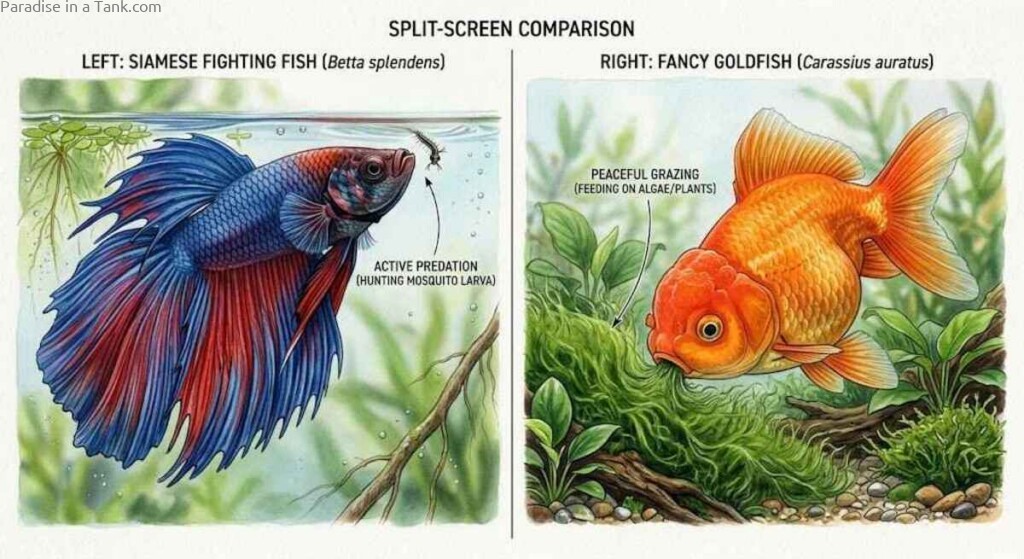
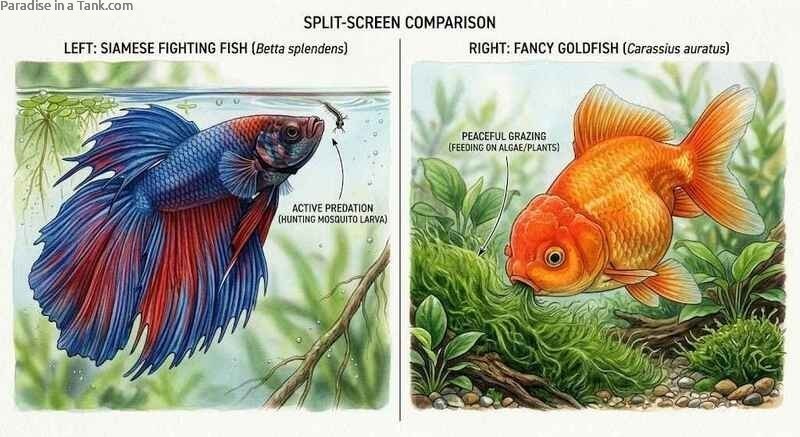
To understand why this is such a critical issue, we have to look closely at the ancestral evolutionary contract governing these two completely distinct species. Evolution spent millions of years fine-tuning these animals for very specific environments, and their internal anatomy reflects that history perfectly. Goldfish are natural bottom-dwelling foragers that spend their entire days picking at decaying biological matter, algae, and plant roots. Bettas, on the other hand, are highly specialized surface predators designed to hunt down living, moving targets in tropical environments.
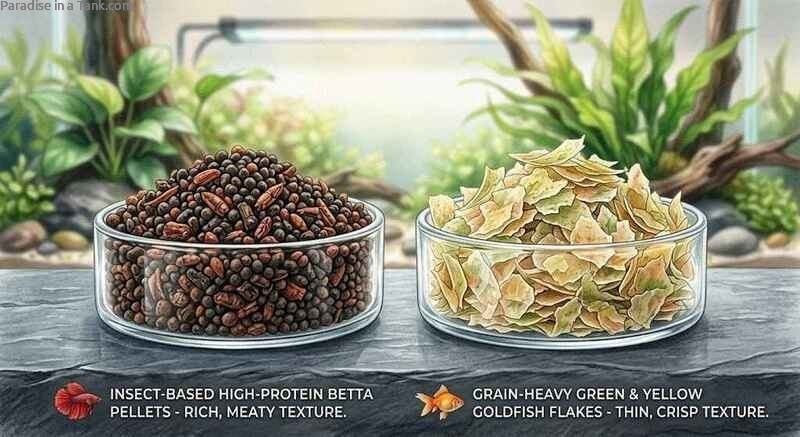
When you drop a generic flake intended for a grazer into a tropical tank, you are asking your fish to violate their primitive survival mechanics. A look into what do goldfish eat reveals a diet heavily biased toward carbohydrates, grains, and plant matter. Forcing a strict carnivore to consume the menu of a continuous grazer is a recipe for internal disaster. Your tropical pet requires a massive concentration of pure animal proteins and specific lipids to power their high-velocity lifestyle, which is the exact opposite of what keeps a cold-water fish thriving.
Why a Betta’s Digestive System Rejects Plant Filler
The true problem lies deep within the animal’s physical interior layout. A betta fish possesses a remarkably short, highly acidic digestive tract designed to break down dense muscle tissues and insect shells rapidly. Their stomach produces powerful enzymes that dissolve proteins with incredible efficiency, but it completely lacks the complex biological tools needed to fracture plant cell walls. Goldfish, conversely, do not even possess a true anatomical stomach; they use an incredibly long, winding intestinal pathway designed to slowly ferment fibrous greens over many hours.
When a betta consumes heavy plant fillers like soybean meal, wheat flour, or corn starch, their short system simply cannot break those complex molecules down. The undigested material transforms into a thick, sticky mass that completely plugs up their intestines. This intestinal blockage stops everything else in its tracks, causing severe swelling that pinches vital blood vessels. The animal cannot extract any real nutrition from these carbohydrate-heavy fillers, meaning they are essentially starving their bodies of vital resources while simultaneously suffering from a painful physical obstruction.
The Anatomy of a True Insectivore
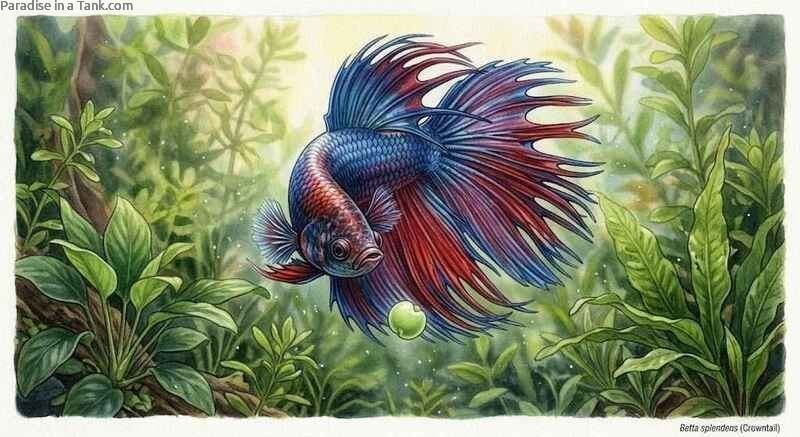
In their native wild habitats, bettas are precision-engineered insectivores that specialize in snatching mosquito larvae, tiny water bugs, and unsuspecting terrestrial insects from the water’s surface. Their mouths are uniquely upturned like a tiny trapdoor, specifically angled to grab food floating above them rather than picking things off the substrate. Their eyes are sharply focused forward to calculate strike distances with absolute accuracy, allowing them to snap up prey in the blink of an eye.
Every single element of their physical makeup expects high-protein, nutrient-dense meals that come from living tissue. Their bodies rely on these clean fats and amino acids to maintain the brilliant iridescent colors on their fins and to protect their heavy slime coats from fungal infections. When you deny them this ancestral fuel, their immune system plummets, their vibrant scales begin to fade into dull tones, and they lose the ability to ward off everyday environmental pathogens. If you have ever wondered about common aquatic setups, investigating whether a betta fish can live in a bowl will show you how vital proper environmental constraints and specific nutrition are for keeping these territorial creatures alive.
The Serious Health Dangers of Feeding Goldfish Food to Bettas Long-Term
If you make the mistake of feeding your betta a continuous diet of goldfish food over several weeks, you are actively writing a death sentence for your fish. The systemic nutritional deficiencies will slowly erode their internal organs from the inside out. Because goldfish food contains very low concentrations of raw protein and far too many carbohydrates, your betta will suffer from a condition known as fatty liver degeneration. Their body tries desperately to store the excess carbohydrates as fat around their vital organs, eventually causing their liver to fail completely.
Furthermore, the chronic constipation caused by those indigestible plant binders leads to a horrific condition known as dropsy. As the blockage worsens, the fish’s kidneys become overwhelmed, causing massive fluid retention inside the abdominal cavity. The pressure builds up so intensely that their scales begin to point straight outward like a pinecone. Once an animal reaches this advanced stage of physical deterioration, the damage is almost always irreversible, and they will quickly perish. You can read about how devastating these systemic failures can be by looking over the list of goldfish diseases with treatments and symptoms to understand how quickly poor husbandry compromises an aquatic animal.
| Nutritional Deficiencies | Immediate Physical Symptoms | Long-Term Internal Consequences |
|---|---|---|
| Insufficient Crude Animal Protein | Loss of scale coloration and fin fraying. | Complete muscle wasting and failure of the immune system. |
| Excessive Plant Fillers and Starches | Severe belly bloating and floating upside down. | Chronic intestinal blockages and permanent swim bladder damage. |
| Low Vital Lipids and Amino Acids | Lethargy and complete lack of spawning behavior. | Total organ failure and deadly fluid buildup in the body. |
Emergency Betta Foods: What to Feed When You Run Out of Pellets
We have all been there—you open your cabinet only to realize the pellet jar is completely empty, and the local pet store is already closed for the night. Do not panic, and absolutely do not reach for the goldfish food as a lazy substitute. You can easily raid your own kitchen or backyard to find temporary, safe, high-protein alternatives that satisfy your insectivore’s primitive requirements without destroying their digestive health.
- Boiled Freeze-Dried or Frozen Meats: Unseasoned, boiled chicken or white fish cut into microscopic, bite-sized pieces can work wonders in an absolute pinch.
- Fresh Earthworms or Mosquito Larvae: If you can find clean, pesticide-free mosquito larvae from a rainwater bucket in your yard, your fish will happily gobble them up.
- Hard-Boiled Egg Yolk: A tiny crumb of hard-boiled egg yolk provides a massive dose of clean lipids and proteins, though you must use it sparingly to avoid clouding your water.
- Thawed Frozen Shrimp or Seafood: Small slivers of plain, raw shrimp can be rinsed thoroughly and fed to your pet as an excellent emergency meal.
Always remember that these household substitutes are strictly emergency options designed to buy you time until you can purchase a proper, species-specific tropical pellet. When you do feed these alternative options, make sure the portions are smaller than the size of the fish’s eye to prevent overfeeding. Keep your water clean by skimming out any uneaten scraps immediately so they do not rot on the bottom of the enclosure. By remaining disciplined and respecting your fish’s ancient evolutionary biology, you will ensure they live a long, healthy, and incredibly vibrant life in your home.